


Galaxy Digital returned to profitability in the third quarter of 2026, reporting $323 million in net income as gains from its investment portfolio and rapid growth in its AI data center business helped offset continued losses in its core digital assets division. Shares were up on Tuesday following the announcement.
Galaxy Digital Shares Rise Following $323M Q3 Profit, New $200M Buyback Plan
WRITTEN BY

SHARE
Key Takeaways
- Galaxy Digital returned to profitability in Q3 2026, reporting $323 million in net income and $455 million in adjusted EBITDA, driven largely by investment gains and AI infrastructure growth.
- AI data center profits surged, with adjusted gross profit nearly quadrupling to $79 million as Galaxy expanded its Texas facilities and pursued additional capacity.
- Galaxy authorized another $200 million share buyback after completing its previous $200 million program, while total assets climbed 51% to $16.4 billion.
The Mike Novogratz-led cryptocurrency investment firm reported Tuesday that it earned $323 million during the three months ended Sept. 30, reversing an $85 million loss in the second quarter. Adjusted earnings before interest, taxes, depreciation, and amortization (EBITDA) reached $455 million, compared with a $77 million loss in the previous quarter.
Galaxy reported adjusted gross profit of $569 million, up sharply from $43 million in the second quarter. Diluted earnings per share reached $0.66, while adjusted earnings per share came in at $0.83.
“Galaxy delivered a strong third quarter, reflecting the strength of our established digital assets franchise, significant appreciation across our investments portfolio, and the growing contribution from our data centers business,” Novogratz said in the earnings announcement.
The company’s treasury and corporate division accounted for much of the improvement, generating $419 million in adjusted gross profit, compared with a $42 million loss in the previous quarter. The segment benefited from appreciation across Galaxy’s investments portfolio.
Meanwhile, its digital assets business generated $71 million in adjusted gross profit, up 9% from the previous quarter, although it still recorded a $9 million adjusted EBITDA loss.
Cryptocurrency trading volumes increased 12% quarter over quarter, outperforming a broader spot market that experienced declining volumes. Galaxy’s average loan book grew 27% to $1.8 billion, while combined assets under management and assets under stake climbed 46% to $10.4 billion.
The company’s expanding institutional cryptocurrency operations included an August partnership with BNY to bring staking services to the banking giant’s digital asset custody platform. As previously reported by Bitcoin.com News, the arrangement is designed to let eligible institutional clients earn staking rewards while maintaining their assets within BNY’s existing custody infrastructure.
AI Data Center Expansion Accelerates
Galaxy’s data center division emerged as a significant growth driver during the quarter, generating $79 million in adjusted gross profit, nearly quadrupling the $20 million recorded in the second quarter. Adjusted EBITDA rose to $69 million from $11 million.
The increase reflected the first full quarter of revenue-generating operations under the company’s lease with AI infrastructure provider CoreWeave at its Helios campus in Texas. Galaxy delivered all 133 megawatts of critical IT load associated with the first phase by the end of June.
Galaxy also completed a $3.5 billion senior secured debt offering to finance the second phase of Helios I, which is under construction. The company expects to begin delivering additional data halls in the second quarter of 2027.
Galaxy said it is pursuing potential tenants for another 830 megawatts of approved capacity at Helios II that remains unleased. Its total gross power development pipeline has expanded to more than 5.7 gigawatts.
The expansion follows Galaxy’s July acquisition of approximately 500 acres in McGregor, Texas, for another AI and high-performance computing campus. As Bitcoin.com News reported at the time, the project initially targets 74 megawatts of capacity, with the potential for significantly larger development in subsequent years.
Galaxy has increasingly redirected its infrastructure investments toward AI computing, including converting its former bitcoin mining operations at Helios to serve demand from technology companies.
Galaxy Authorizes Another $200 Million Stock Buyback
Alongside its earnings announcement, Galaxy disclosed that its board had approved an additional $200 million share repurchase program on Oct. 26.
The new authorization follows completion of an earlier $200 million buyback program on Oct. 15, under which Galaxy repurchased approximately 9.8 million shares. Bitcoin.com News covered the original authorization in February, when the company introduced the initiative following a fourth-quarter loss.
Galaxy ended September with $16.4 billion in total assets, up 51% from the previous quarter, and $3 billion in total equity. Its holdings of cash, stablecoins, and U.S. Treasury securities nearly doubled to $4.9 billion from $2.5 billion.
The results mark a significant turnaround after a difficult start to 2026, as Galaxy reported a $216 million first-quarter loss amid declining cryptocurrency prices. The third-quarter rebound underscores Galaxy’s growing reliance on two distinct businesses: cryptocurrency financial services and AI computing infrastructure.
Galaxy shares on the Nasdaq (GLXY) rose following the earnings announcement, finishing the trading day up more than 9.5% at a price of $17.18. Shares in the firm have fallen approximately 23% since the start of the year.
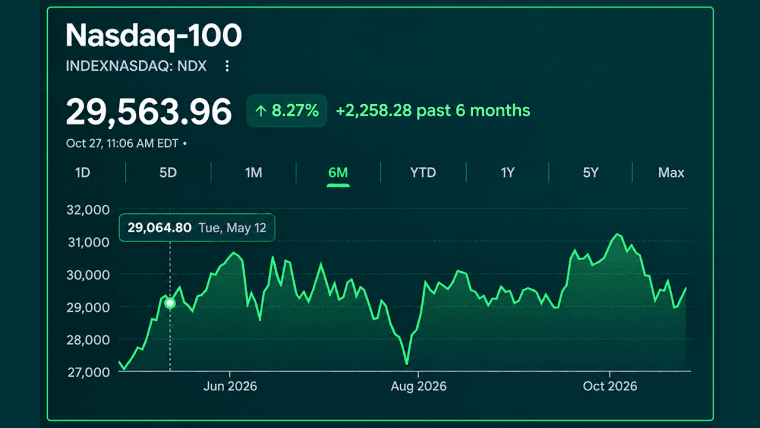
Janus Henderson and Centrifuge launched JQQQ on Tuesday, introducing what the companies describe as the first blockchain-native, issuer-sponsored fund tracking…
Read Now: Nasdaq-100 Enters Tokenized Fund Era With Janus Henderson JQQQ