


Bitcoin mining technology company Luxor has raised $16 million in a strategic funding round led by CMT Digital, accelerating its expansion into artificial intelligence infrastructure as cryptocurrency mining businesses increasingly pursue opportunities in the rapidly growing AI computing market.
Bitcoin Mining Firm Luxor Raises $16 Million to Accelerate AI Expansion
WRITTEN BY

SHARE

Key Takeaways
- Luxor raised $16 million in a funding round led by CMT Digital to accelerate its expansion into AI computing, hardware trading, and financial derivatives.
- Bitcoin miners are increasingly pivoting to AI, with companies including Hut 8, Terawulf, Core Scientific, IREN, and Cipher investing heavily in AI infrastructure.
- Luxor is taking a different approach, focusing on supplying hardware, software, and financial services to the AI industry rather than converting mining facilities into data centers.
Luxor Raises $16 Million
The Seattle-based company announced the investment Tuesday, with participation from bitcoin mining hardware manufacturers Canaan and MicroBT, along with Halo, Steelhead, and several angel investors. The financing includes both primary and secondary capital, although Luxor did not disclose the breakdown or its valuation.
The funding follows Luxor’s September launch of Luxor AI, a business division designed to bring the company’s existing expertise in energy management, computing hardware, financial derivatives, and software into the AI and high-performance computing (HPC) sectors.
Luxor said it will use the capital to expand its AI-focused cloud platform, provide working capital for its growing hardware trading business, increase its activity in computing derivatives and market-making, and hire additional engineering and business development personnel.
The company is building on its established bitcoin mining operations, which include a mining pool, specialized hardware brokerage, firmware, energy services, and financial products that allow miners to hedge fluctuations in computing revenue.
According to Luxor, its hardware brokerage has facilitated $1 billion in bitcoin mining equipment transactions, while its energy division manages more than 75 megawatts of electrical load across the ERCOT and Southwest Power Pool markets. Its AI cloud platform had processed 1.8 million workloads year-to-date as of September.
Luxor is also expanding its brokerage of graphics processing units and AI servers, tapping relationships with equipment manufacturers and suppliers to source hardware in an increasingly competitive market.
Another focus is the development of financial derivatives tied to computing capacity. Luxor already offers over-the-counter options, forwards, and other contracts linked to computing rental indexes, extending a model it previously developed for Bitcoin mining hashrate.
“Compute markets are converging: the same miners, power sites and capital that served digital mining are now powering AI,” Luxor CEO and co-founder Nick Hansen said in the announcement.
Bitcoin Miners Shift Focus to AI
The investment comes as bitcoin mining companies increasingly redirect their infrastructure and capital toward AI, seeking revenue opportunities beyond the volatile economics of cryptocurrency production.
In July, Bitcoin.com News reported that Hut 8 had secured a $9.8 billion, 15-year lease for an additional 352 megawatts of AI computing capacity at its Beacon Point campus in Texas. The agreement doubled the tenant’s commitment at the site to 704 megawatts.
Meanwhile, Terawulf has undertaken an aggressive expansion into AI infrastructure. In May, the company acquired a Kentucky data center site targeting one gigawatt of high-performance computing capacity by 2030, with its AI revenue already surpassing bitcoin mining revenue during the first quarter of 2026.
Other major mining companies, including Core Scientific, IREN, and Cipher, have similarly repurposed or reduced bitcoin mining operations to accommodate AI computing customers.
The transition has not been without costs. An October analysis published by Bitcoin.com News estimated that publicly traded miners shed approximately 75 exahash per second of realized bitcoin mining capacity during the first half of 2026, representing roughly $1.5 billion in equivalent hardware investment.
Unlike operators converting large mining facilities into AI data centers, Luxor is positioning itself as a provider of the hardware, software, trading, and financial infrastructure serving both industries.
Its latest investment suggests that the convergence between bitcoin mining and AI is creating opportunities not only for companies that own data centers, but also for businesses supplying the equipment, financial products, and services supporting an expanding market for computing power.
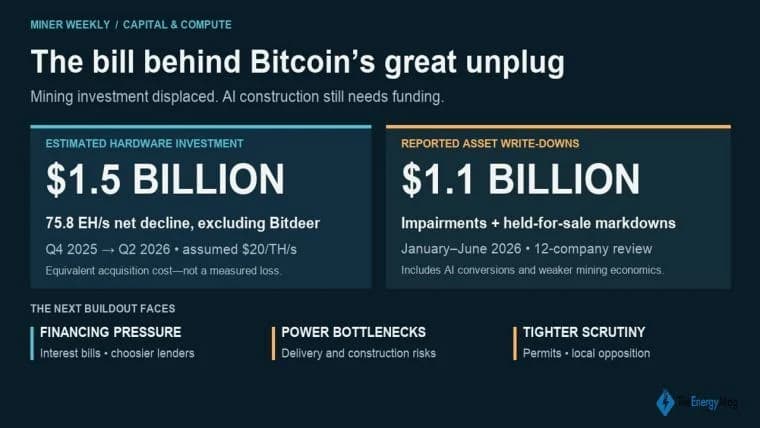
The hashrate public bitcoin miners shed in the first half of 2026 carries an uncomfortable price tag: roughly $1.5 billion…
Read Now: Bitcoin’s Great Unplug: $1.5 Billion in Hardware Behind the AI Pivot