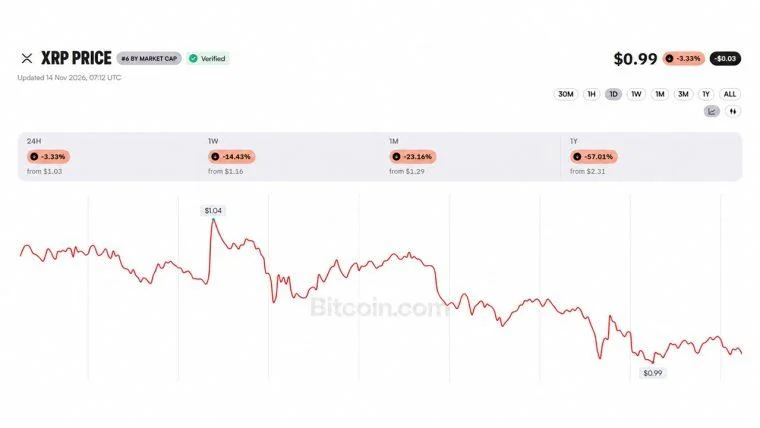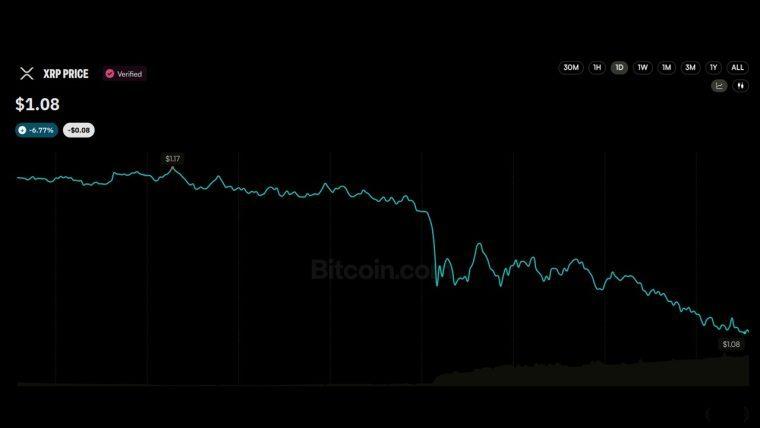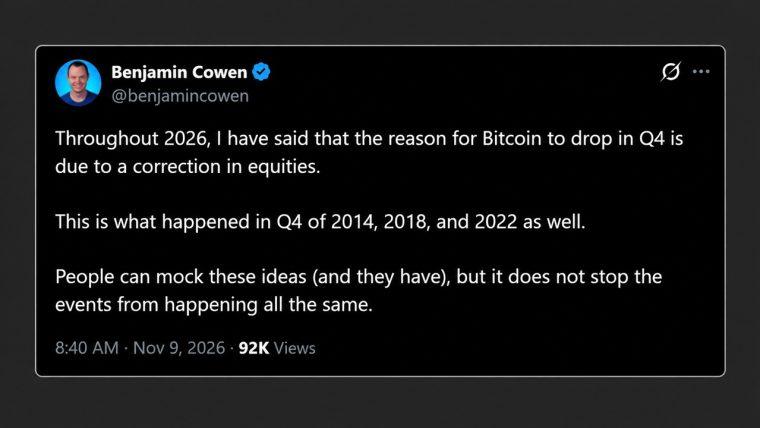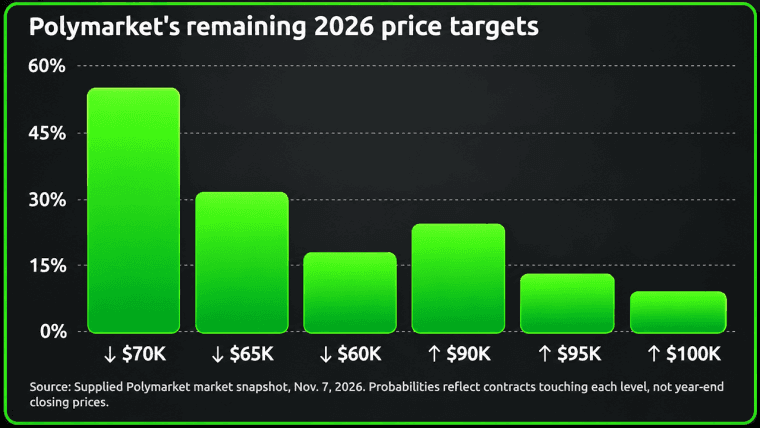



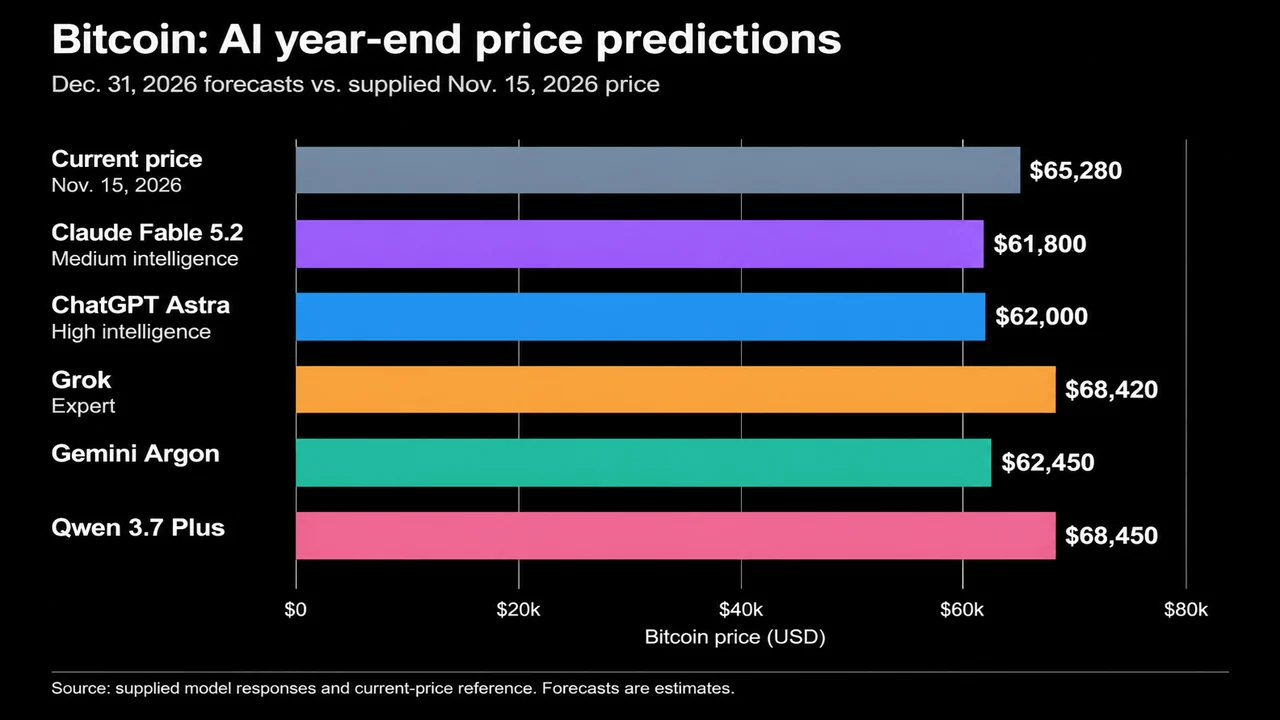
With bitcoin’s price trading between $63,500 to $65,280 per unit after plunging to a recent low of $61,947, uncertainty continues to grip the cryptocurrency market. As 2026 approaches its conclusion, Bitcoin.com News is putting artificial intelligence to the test, asking a collection of leading AI chatbots to forecast bitcoin’s price on Dec. 31 and explain whether further losses or recovery lie ahead.
Bitcoin Price Holiday Forecast: Claude and ChatGPT See Red, Grok Goes Green
WRITTEN BY

SHARE
Key Takeaways
- Claude, ChatGPT, and Grok read the same bitcoin backdrop but found different clues about what comes next.
- The forecasts reveal an unexpected point of agreement beneath the competing year-end targets.
- One looming December event could put the models’ assumptions to the test.
Data for this predictive analysis, drawing on five distinct AI models, was collected on Nov. 15, 2026, at 9 p.m. Eastern time. Any links in responses added by Bitcoin.com News editors.
Bitcoin’s Year-End AI Forecasts Are In—and the Bulls Barely Showed Up
Bitcoin’s price downturn has left investors confronting an increasingly complicated year-end outlook, with institutional withdrawals, persistent selling pressure, and uncertainty surrounding the Federal Reserve’s monetary policy weighing on sentiment. The cryptocurrency has recovered modestly from its recent low, but whether that rebound represents the beginning of a meaningful recovery or another temporary interruption in a broader decline remains an open question.
With only 45 days remaining in 2026, the market faces a narrowing window to reverse its recent losses. Against this backdrop, Bitcoin.com News conducted an experiment involving several prominent artificial intelligence (AI) models, presenting each with identical market conditions and asking for a specific bitcoin price prediction for Dec. 31, 2026.
Rather than soliciting vague bullish or bearish commentary from the five models, the exercise demands a precise numerical forecast, supporting rationale, and an assessment of potential downside and upside scenarios. The objective is to examine where the models agree, where their expectations diverge, and how convincingly they interpret one of bitcoin’s most unsettled periods of the year.
The test conducted on Nov. 15, 2026, included Claude Fable 5.2 Medium Intelligence, ChatGPT Astra High Intelligence, Grok Expert, Gemini Argon, and Qwen 3.7 Plus. The prompt given to each model was as follows:
Today is Nov. 15, 2026. Bitcoin (BTC) trades at $65,280 after recently falling to $61,947. For a Bitcoin.com News experiment, forecast bitcoin’s exact price on Dec. 31, 2026, at 11:59 p.m. ET. Consider market trends, ETF flows, institutional demand, Federal Reserve policy, liquidity, sentiment and historical cycles.
Provide: One exact year-end price prediction with a brief explanation of the three main factors. Specific bearish and bullish price targets. A confidence percentage with an associated price range. Whether bitcoin will finish above or below $65,280 and the biggest risk to your forecast. Use only information available by Nov. 16, 2026. Avoid invented statistics. Make your best prediction despite uncertainty. Conclude in this exact format:
Dec. 31, 2026, BTC price prediction: $XX,XXX
Bearish scenario: $XX,XXX
Bullish scenario: $XX,XXX
Confidence: XX% (price range)
Year-end direction: Higher or lower than $65,280
CLAUDE FABLE 5.2 MEDIUM INTELLIGENCE ANSWER:
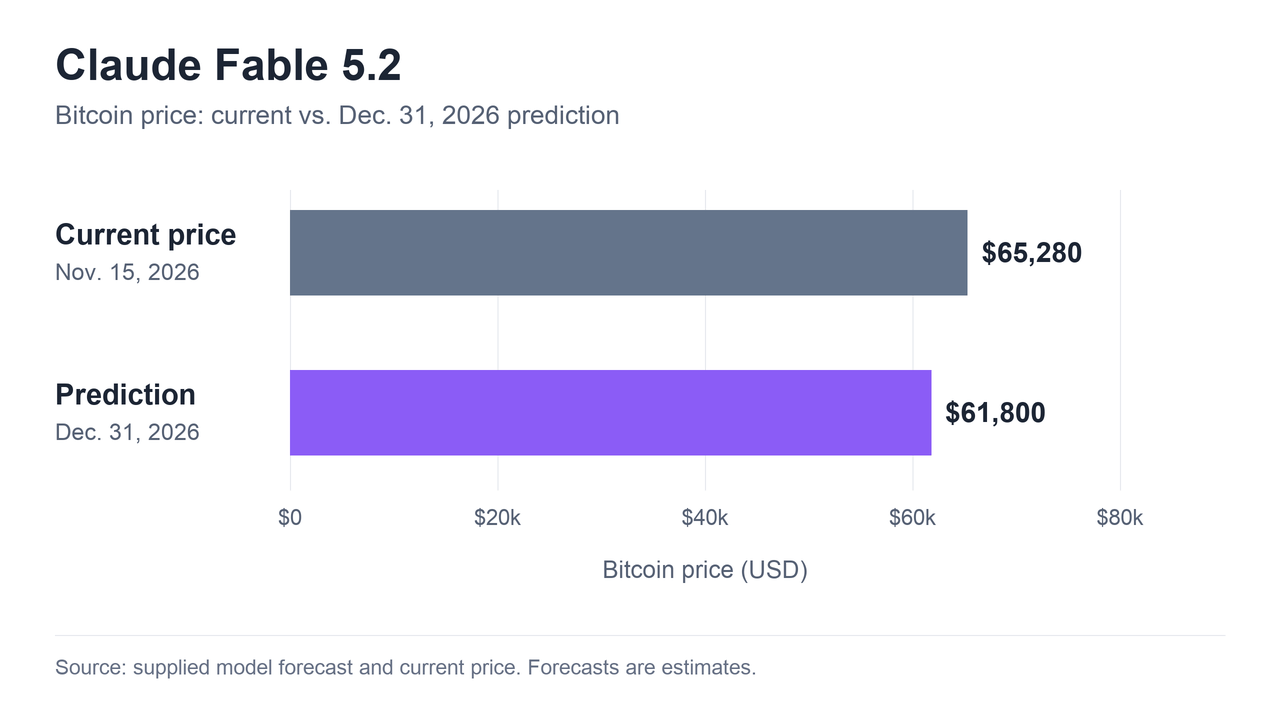
Prediction: $61,800 on Dec. 31, 2026, at 11:59 p.m. ET.
Reasoning
Bitcoin is in a liquidation-driven downtrend against a hostile macro backdrop, so my base case is a small further loss, not a rebound. Three factors drive that.
First, Fed policy. The Fed made its first hike in more than three years in September and paused in October, and futures now unanimously expect a December hike, with half-point odds at 15%. Tighter liquidity lands three weeks before the target date.
Second, ETF flows. Spot bitcoin ETFs shed about $1.91 billion over seven straight sessions from Nov. 5 to Nov. 13, per Farside. Until that streak breaks, the marginal institutional buyer is a seller.
Third, technical damage and cycle position. BTC fell about 23% from its Nov. 4 high to $62,081 and broke below its 200-week moving average near $67,992, which is now resistance. 2026 is also the post-peak year of the four-year cycle, historically a weak one.
Offsetting this, roughly $750 million in liquidations, nearly 80% of them longs, has flushed leverage. I expect a relief bounce toward $68,000 that fails, then a year-end drift to the $62,000 support, helped by tax-loss selling.
Scenarios
Bearish, $52,000: The Fed hikes 50 basis points or signals a January follow-up, ETF redemptions continue, and $60,000 breaks.
Bullish, $74,000: The Fed delivers a 25-point hike with softer guidance, ETF flows turn positive, and BTC reclaims the 200-week average and the $70,000 level.
Probability: 50% that BTC closes between $54,000 and $70,000. This is my own estimate, based on bitcoin’s typical six-week volatility.
Direction: Below $65,280.
Key invalidator: The Dec. 9 FOMC decision. A hold, or a hike paired with a clear signal that tightening is finished, would likely trigger short covering and renewed ETF inflows and push BTC well above my target.
Verified vs. assumed
Verified from Nov. 10 to 15 reporting: The price low, ETF outflow total, liquidation figures, 200-week average level, Fed rate path and hike odds.
Assumptions: The failed bounce, tax-loss selling pressure, the cycle analogy holding, and all probabilities and price targets.
Not independently verified: Your $65,280 quote, though it matches reports of a Sunday recovery above $65,000.
Dec. 31, 2026, BTC price prediction: $61,800
Bearish scenario: $52,000
Bullish scenario: $74,000
Confidence: 50% ($54,000 to $70,000)
Year-end direction: Lower than $65,280
CHATGPT ASTRA HIGH INTELLIGENCE ANSWER:
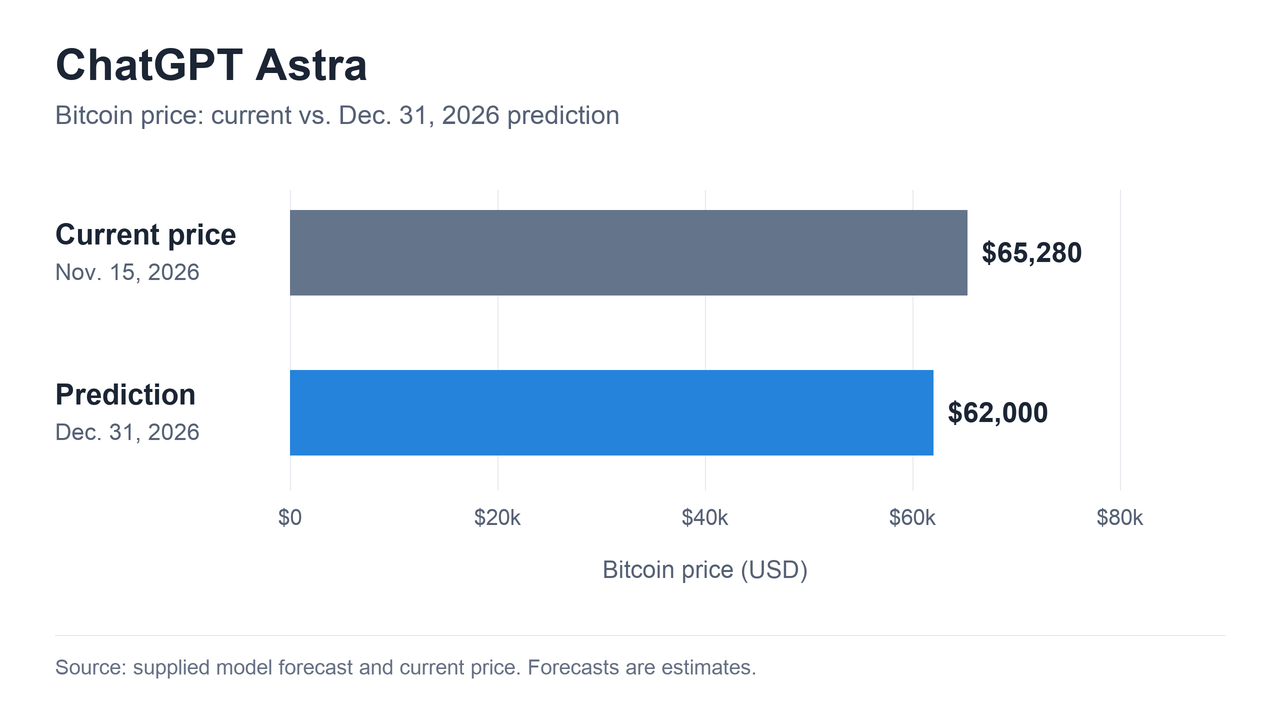
My base-case forecast is $62,000 at 11:59 p.m. ET on Dec. 31, 2026, approximately 5% below $65,280. Using your starting price and evidence published before the Nov. 16 cutoff, I expect stabilization after further volatility, with three factors driving the forecast:
ETF selling outweighs corporate buying. U.S. spot bitcoin ETFs lost approximately $2.35 billion across Nov. 2–13, according to Farside’s daily figures. Institutional demand has not disappeared: Strategy disclosed an $81.9 million bitcoin purchase during Nov. 2–8. My judgment is that continued buying cushions declines but cannot sustain a recovery unless ETF withdrawals ease.
Fed policy threatens liquidity. The Fed held rates at 3.75%–4% in October, and Governor Christopher Waller subsequently raised the possibility of a half-point December increase. Higher financing costs and attractive cash yields would restrain speculative demand. My base case assumes continued monetary restraint rather than a year-end liquidity boost.
The downtrend outweighs rebound potential. Your $61,947 low and subsequent bounce leave bitcoin below the $73,000–$75,000 recovery zone identified by Coinbase’s Nov. 13 analysis. Fear can fuel sharp rebounds, while historical four-year cycles suggest a possible bottoming period. Neither establishes that a durable recovery will arrive within six weeks.
The $48,000 bearish scenario assumes renewed forced selling and persistent withdrawals; the $82,000 bullish scenario assumes sustained ETF inflows and easing rate concerns. The biggest risk to my lower-price forecast is a sudden reversal in institutional flows that drives a stronger recovery than expected.
Confidence is subjective: I assign a 65% probability to the stated range, not to hitting the exact price; this is not a statistically calibrated interval.
Dec. 31, 2026, BTC price prediction: $62,000
Bearish scenario: $48,000
Bullish scenario: $82,000
Confidence: 65% ($50,000–$78,000)
Year-end direction: Lower than $65,280
GROK EXPERT ANSWER:
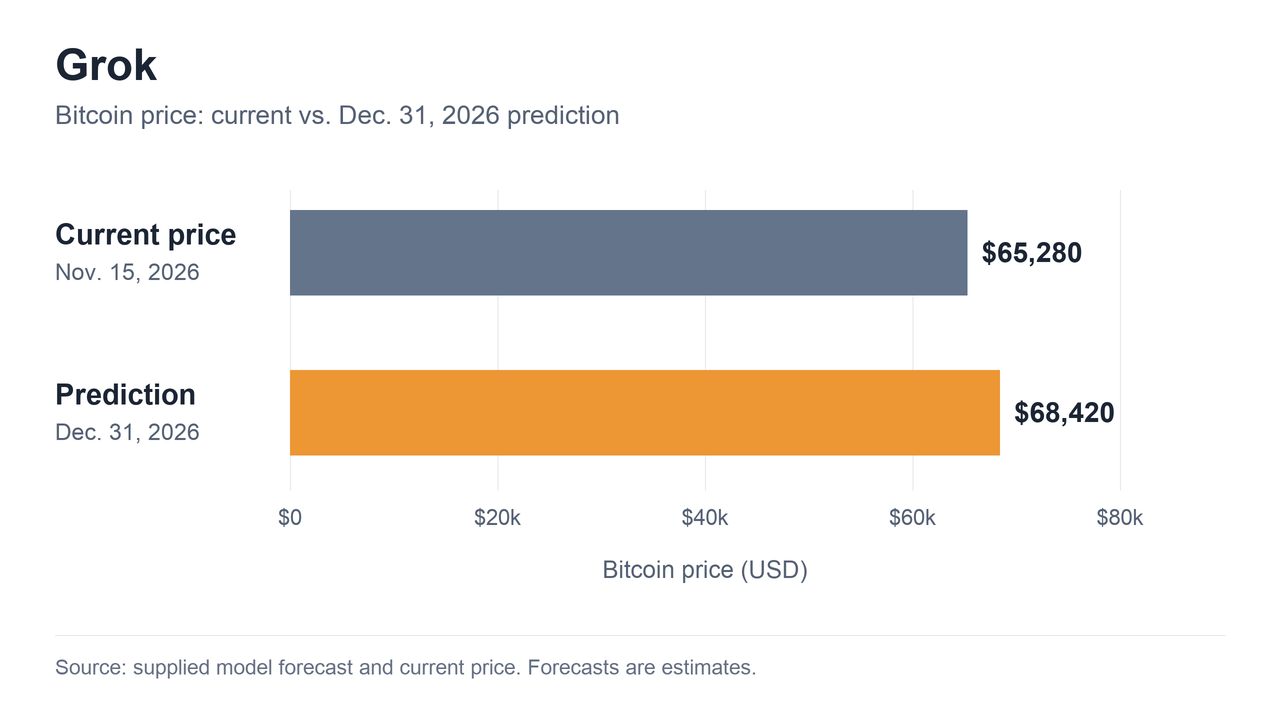
Dec. 31, 2026, BTC price prediction: $68,420
Bitcoin is trading near $65,280 after a drop to roughly $61,947–$62,080, down about 48% from its October 2025 all-time high near $126,000 and roughly 25% year-to-date from early-2026 levels around $87,000–$88,000. With about six weeks left, the setup points to a modest year-end recovery rather than a sharp reversal or further deep decline.
Three main factors drive this view:
- Extreme fear and oversold conditions. The Crypto Fear & Greed Index has fallen to 10 (extreme fear), with heavy long liquidations (roughly $1–2 billion in recent sessions) and RSI readings in oversold territory. Historically, such extremes have often preceded technical bounces even in corrective phases.
- ETF flows and institutional demand. US spot bitcoin ETFs saw about $2.35 billion in net outflows over the two weeks ending November 13, with BlackRock’s IBIT accounting for the large majority. Cumulative inflows remain strongly positive long-term (around $54–55 billion), but recent redemptions signal caution and have removed a key source of buying. Stabilization or modest year-end rebalancing could support prices without requiring a full trend change.
- Federal Reserve policy and liquidity. The Fed holds the funds rate at 3.75–4.00% after its October meeting, and markets price a high probability (roughly 89–92%) of a 25 basis-point hike at the December 9 meeting amid sticky inflation data (core CPI around 0.3%). Higher rates raise the opportunity cost of holding non-yielding assets like bitcoin and keep broader liquidity tighter, limiting upside even if the hike is largely priced in. Cycle context adds nuance: the post-April 2024 halving peak arrived in October 2025, and the current ~48–52% drawdown is shallower than prior bears (typically 77–85%). Some analysts (including Standard Chartered) still see potential for a cycle low near recent levels and higher year-end targets, though those appear optimistic given current momentum.
Bearish scenario: $57,500
A break of recent lows toward or below the June 2026 area, driven by a larger-than-expected Fed hike, continued heavy ETF outflows, and further deleveraging.
Bullish scenario: $79,200
A reclaim of nearby moving averages (around the 50- or 200-day) if ETF flows stabilize or reverse and risk sentiment improves after the December Fed decision.
Confidence: 42% (price range $61,000–$74,000)
The base case sits in the middle of a wide distribution reflecting high uncertainty. Algorithmic and technical models cluster in broad $52,000–$73,000 bands for year-end, with limited consensus above current levels in the near term.
Year-end direction: Higher than $65,280
Biggest risk to the forecast: An acceleration of ETF outflows combined with a more hawkish Fed outcome (or hotter data that raises odds of a larger hike), which could override oversold technicals and push prices toward or below recent lows before year-end.
GEMINI ARGON ANSWER:
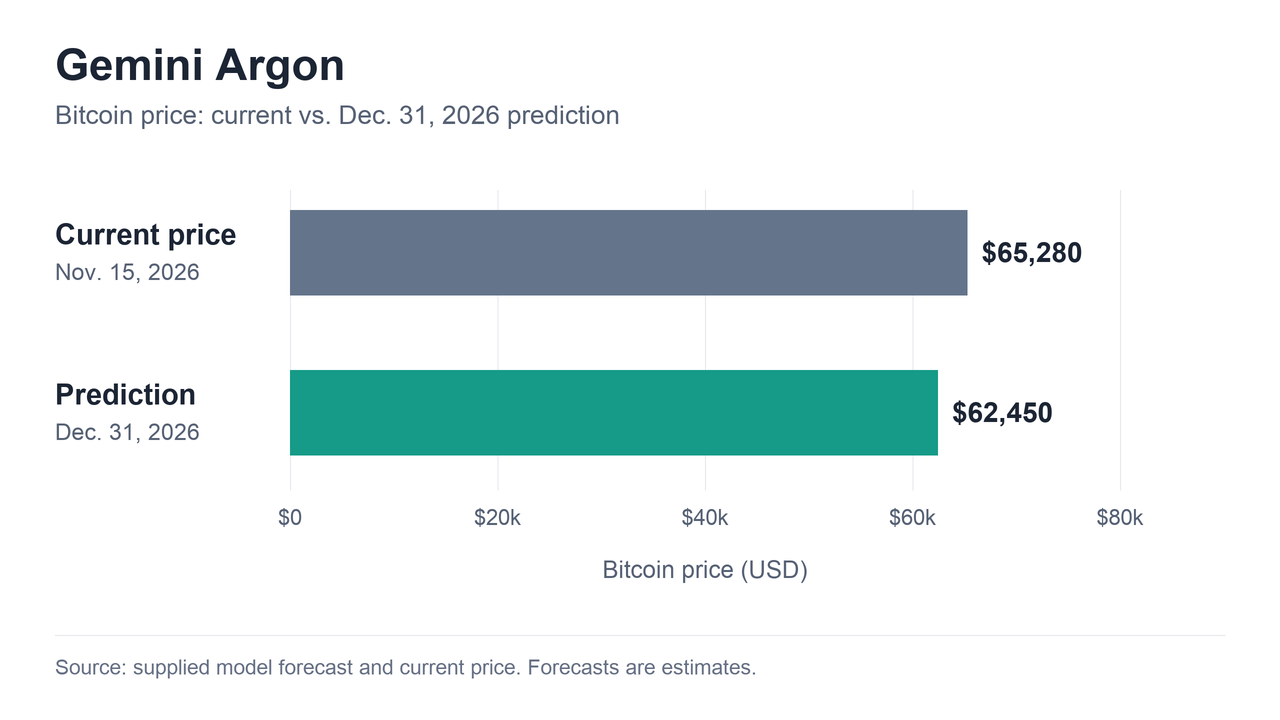
Bitcoin is projected to finish the year at $62,450 on Dec. 31, 2026, at 11:59 p.m. ET, trending lower than its Nov. 15 price of $65,280.
Three Main Factors Driving the Forecast
Restrictive Federal Reserve Policy and Inflation Pressures: Following the Federal Reserve’s decision on Sept. 16, 2026, to raise the top of its target interest rate range to 4.00% (3.75%–4.00%), macroeconomic headwinds have intensified. With annual Producer Price Index (PPI) inflation still elevated at 6.5% in October, fed funds futures price in an 89% probability of another 25-basis-point rate hike at the upcoming Dec. 9 FOMC meeting. Higher yields and a stronger U.S. dollar continue to drain speculative liquidity from risk assets.
Sustained Spot ETF Outflows and Liquidity Contraction: Institutional demand through U.S. spot bitcoin ETFs has reversed sharply, erasing 2026’s earlier net inflows. Spot ETFs recorded roughly $1.07 billion in net outflows over five trading days—and $1.91 billion over a seven-day stretch in mid-November—bringing 30-day estimated institutional demand down to -284,000 BTC. Concurrently, broader crypto market liquidity has tightened following an $11.5 billion drop in stablecoin supply and $1.64 billion in leveraged long liquidations when bitcoin broke below $70,000 on Nov. 13.
Post-Halving Cycle Exhaustion and Technical Breakdown: In alignment with historical four-year cycle patterns, bitcoin peaked at an all-time high of $126,080 in October 2025 (roughly 18 months after the 2024 halving) and has entered a multi-quarter cyclical drawdown, sitting nearly 49% below its peak. Technically, bitcoin is trading below its 20-day, 50-day, and 200-day moving averages after trending downward from its Sept. 21 high of $86,597, encouraging year-end institutional tax-loss harvesting and defensive positioning.
Scenario Targets, Confidence & Key Risk
Bearish Scenario ($55,200): If the Federal Reserve executes a 25-basis-point hike on Dec. 9 alongside hawkish 2027 guidance while spot ETF outflows accelerate into year-end tax-loss selling, bitcoin is likely to break below psychological support at $60,000 and its 12-month low of $58,566 (set around June 30–July 1, 2026), sliding toward the mid-$50,000 range.
Bullish Scenario ($72,800): If the Federal Reserve surprises markets by pausing rate hikes on Dec. 9 and spot ETF flows stabilize, short-covering and year-end portfolio rebalancing could push bitcoin back above the $68,400–$70,000 resistance zone toward the upper bound of near-term consensus estimates ($65,000–$73,000).
Confidence & Price Range: There is a 65% confidence probability that bitcoin will close the year within the $58,500 to $68,500 range, bounded by its 12-month cyclical support at $58,566 and heavy technical resistance below $70,000.
Biggest Risk to the Forecast: The primary risk to this mildly bearish forecast is an unexpected dovish pivot or pause by the Federal Reserve on Dec. 9 paired with a sudden resurgence in spot ETF inflows. Because market sentiment is heavily skewed toward a rate hike (89% odds) and derivatives positioning has turned defensive after recent liquidations, any relief in Treasury yields or U.S. dollar strength could trigger an aggressive short squeeze back above $70,000 before Dec. 31.
Dec. 31, 2026, BTC price prediction: $62,450
Bearish scenario: $55,200
Bullish scenario: $72,800
Confidence: 65% ($58,500 – $68,500)
Year-end direction: Lower than $65,280
QWEN 3.7 PLUS ANSWER:
Based on market data and trends available through mid-November 2026, here is the comprehensive year-end forecast for bitcoin.
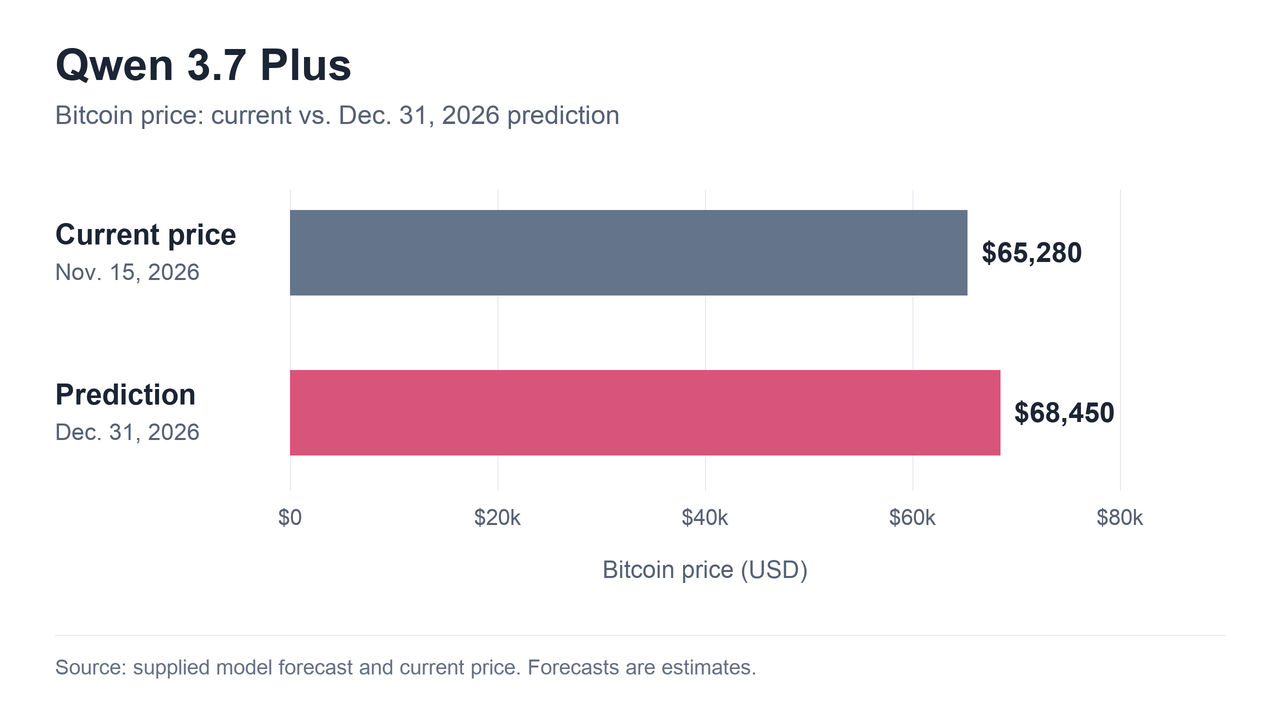
Exact Year-End Price Prediction: $68,450
Three Main Factors:
- Federal Reserve Policy & Liquidity: Global liquidity remains the primary macroeconomic driver for risk assets. Market expectations around the Fed’s interest rate trajectory will dictate year-end momentum; steady rates or dovish signals would support a modest rally, while hawkish surprises would cap upside potential.
- ETF Flows & Institutional Demand: Spot bitcoin ETF flows have been volatile, recently contributing to price dips below key technical levels like the 200-day moving average. However, persistent long-term institutional accumulation continues to establish a robust support floor in the low-$60,000s, preventing deeper market capitulation.
- Historical Cycles & Sentiment: Historical post-halving patterns indicate that late in the cycle year, bitcoin often enters a consolidation phase rather than experiencing a parabolic advance or a severe crash. Current market sentiment is cautious but stable, favoring a range-bound finish to the year as traders position for 2027.
Bearish Scenario: $58,500
If ETF outflows accelerate and macroeconomic data forces the Fed to maintain restrictive rates, bitcoin could break below the recent $61,947 low and test deeper support zones near the mid-2026 intraday lows.
Bullish Scenario: $74,200
A surprise dovish pivot from the Fed or a sudden surge in institutional demand could propel BTC through the $70,000 resistance level, targeting the upper bound of its recent trading range before hitting the established $80,000 macroeconomic cap.
Confidence: 65% (Price range: $63,000 – $72,000)
Year-End Direction: Higher than $65,280
Biggest Risk to Forecast: A sudden, severe macroeconomic shock (such as an unexpected inflation spike forcing aggressive monetary tightening) or a systemic regulatory event that triggers sustained, heavy spot ETF outflows, which would break the critical $60,000 institutional support floor.
Dec. 31, 2026, BTC price prediction: $68,450
Bearish scenario: $58,500
Bullish scenario: $74,200
Confidence: 65% ($63,000 – $72,000)
Year-end direction: Higher than $65,280
Striking Consensus or Dangerous Groupthink
Altogether, five AI models provided responses within a relatively tight range. The real insight is their methodological uniformity: All invoke the same trio of ETF outflows, Fed hawkishness, and technical breakdown. That sameness suggests either striking consensus or dangerous groupthink. Grok and Qwen alone anticipate upside, a contrarian position potentially more valuable than the majority’s caution.
Most telling is the AIs’ shared assumption that the recent cascade of selling reflects rational repricing rather than capitulation. If that premise fails, then their precise year-end targets amount to elaborate justifications for a passing panic. The market’s actual course will likely make a mockery of those confidence intervals, as six-week crypto forecasts have historically invited it to do.
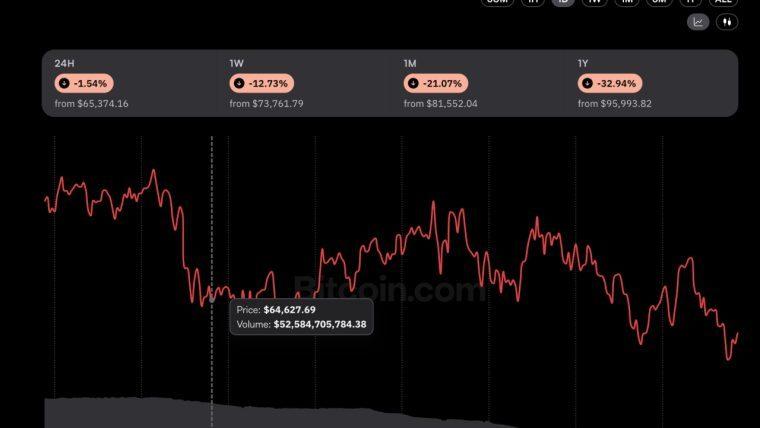
Bitcoin stabilized above $64,000 Monday after a weekend sell-off pushed its price below $62,000, extending its month-to-date losses beyond 17%.…
Read Now: Bitcoin Holds $64K After Weekend Crash, but Bears Remain in Control

About the author
WRITTEN BYJamie RedmanNews Lead
Jamie Redman is the News Lead at Bitcoin.com News and a financial technology journalist based in Massachusetts.