


The computer that guided Apollo astronauts to the moon once ran Bitcoin’s mining math, and a viral clip of the stunt is lighting up crypto timelines again this week.
NASA's Apollo Computer Mined Bitcoin in 2019 But Today It Would Take Forever
WRITTEN BY

SHARE
Key Takeaways
- Ken Shirriff’s team got an Apollo Guidance Computer to run one bitcoin hash every 10.3 seconds in 2019.
- Bitcoin’s hashrate reached 934 EH/s in September 2026, about 14 times the 65 EH/s the team faced.
- At today’s hashrate the machine would need about 13 million times the age of the universe to find a block.
The Clip That Came Back
Crypto media outlets circulated the story again earlier today, explaining that computer scientist Ken Shirriff was able to program an Apollo Guidance machine to mine Bitcoin. Shirriff first published the project on his blog in July 2019, drawing coverage from several popular media houses at the time.
The reason the story continues to pique the interest of crypto enthusiasts is simple, i.e. it sets one of the most famous computers in history against the most powerful computing network on Earth, and the gap between them explains proof-of-work, bitcoin’s mining system, better than any diagram.
The Machine on the Bench
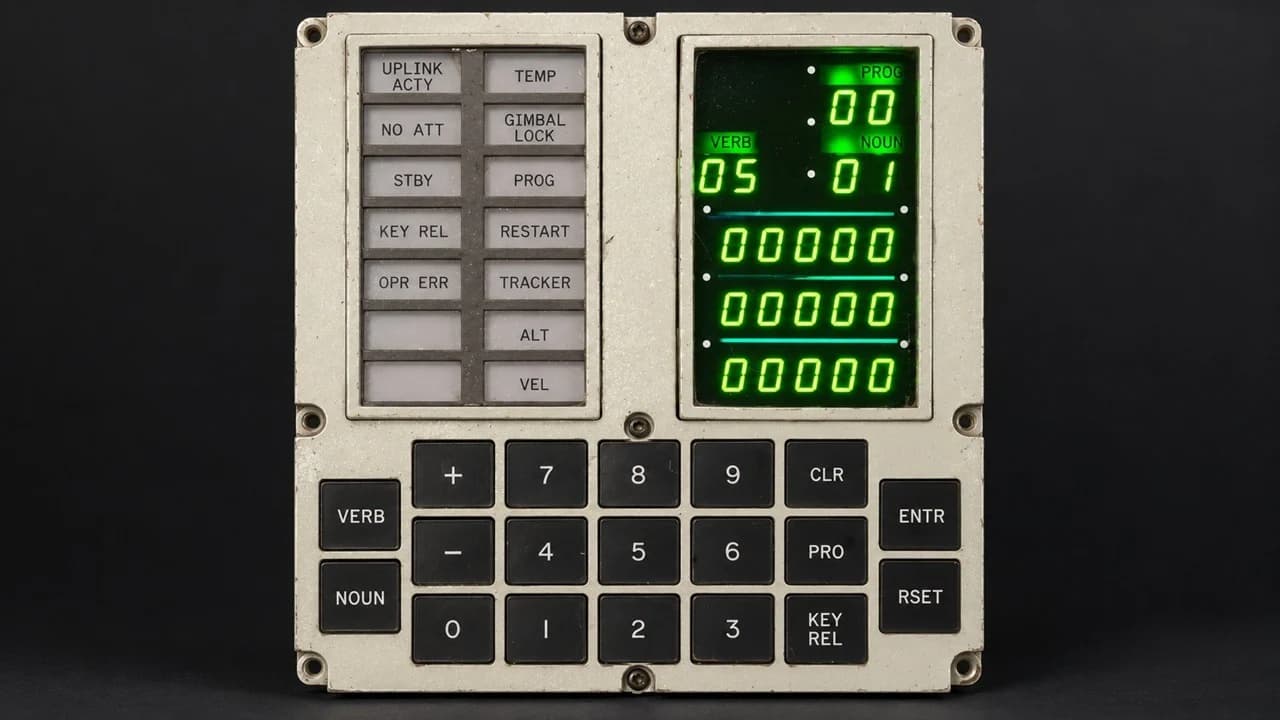
The Apollo Guidance Computer (AGC) handled navigation and engine control on the Apollo missions. According to Shirriff, it weighs about 70 pounds, has 2K words of RAM (roughly 4 kilobytes), 36K words of read-only memory, and can perform about 40,000 additions per second.
This particular unit never went to space but Shirriff believes it was installed in LTA-8, a lunar module test article, and its private owner picked it up at a scrapyard in the 1970s after NASA discarded it. Shirriff restored it with Mike Stewart, Carl Claunch and Marc Verdiell, the engineer behind the Curiousmarc Youtube channel.
How Slow Is 10.3 Seconds?
Shirriff wrote the mining code in AGC assembly language. The computer needed 5.15 seconds to compute a single SHA-256 hash, the cryptographic function bitcoin uses. Because BTC mining hashes each block header twice, that works out to 10.3 seconds per bitcoin hash.
To prove the code worked, he fed it block 286,819, a block that had already been mined, and the AGC reproduced the correct result but never earned a satoshi.
The moon computer is not even the slowest miner in Shirriff’s collection. He has also mined on an IBM 1401 mainframe from the early 1960s, which needed 80 seconds per hash, while a 1973 Xerox Alto managed 1.5 hashes per second.
In 2019, the bitcoin network was running at about 65 exahashes per second (EH/s), or 65 quintillion hashes every second. At that difficulty, Shirriff calculated the AGC would need about 4×10^23 seconds on average to find a block. Since the universe is roughly 4.3×10^17 seconds old, that meant “about a million times the age of the universe.”
What Does the 2026 Math Say?
The network has grown a lot since then, and bitcoin’s hashrate sat at 934 EH/s after the Sept. 5 difficulty adjustment, which pushed mining difficulty 1.31% higher to 127.45 trillion. That is about 14 times the hashrate Shirriff was up against.
Scale his estimate by that factor and the AGC would now need roughly 5.8×10^24 seconds to find one block, or about 13 million times the age of the universe. The next difficulty adjustment is expected soon, with a recent report showing hashprice (the revenue miners earn per unit of computing power) jumping 22.24% to $39.63 per petahash per day, while fees made up just 0.43% of miner rewards.
That makes the block subsidy the main thing keeping machines switched on. Bitcoin’s price hit $81,000 yesterday, a welcome lift for an industry whose difficulty sits 13% below where it started the year.
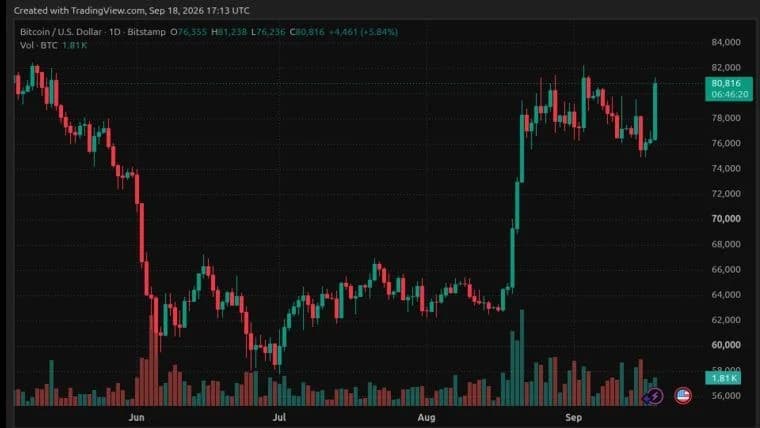
Bitcoin surged past $81,000 on Friday, hitting an intraday high of $81,238, before settling around $80,800 with a $1.62 trillion…
Read Now: Bitcoin Price Hits $81K on Renewed Spot Demand, Leverage Reset