



PRESS RELEASE.
SPONSORED CONTENT
This is a paid press release provided by xBubble. The statements, claims, data, and other information contained herein were supplied by the advertiser and have not been independently verified by Bitcoin.com News. Bitcoin.com News does not endorse or guarantee the accuracy, completeness, or reliability of this content. Readers should conduct their own research before taking any action based on the information presented.
xBubble: Bubble Code's (Almost) Zero Barrier for Building Businesses
SHARE
Press release
AI coding has already made developers much more productive. With modern coding agents, technical users can generate code, debug issues, modify applications, connect services, and ship products faster than ever before.
But for non-technical users, including some OPCs(one-person companies), creators, and local businesses,the experience is still very different.
They may know what they want to build. They may understand their customers, their services, their products, and their market. But turning that idea into a working online business still requires a lot of technical knowledge. It is almost impossible to independently evaluate and make decisions throughout the software development process: architecture design, code generation, testing, deployment, hosting, maintenance, third-party services purchasement, and future updates.
This is where Bubble Code comes in.
Bubble Code is xBubble’s new software-building feature, built on top of xBubble’s SOP system. It follows the same philosophy behind xBubble: instead of asking every user to become a sophisticated Vibe Coder, xBubble packages complex AI workflows into task-specific SOPs.
With Bubble Code, that same SOP logic is applied to software generation and software modification.
The user states the business goal.
Bubble Code runs the right Coding SOP.
Why Current Coding Agents Are Still Difficult for Non-Technical Users
Today’s coding agents are powerful, but they still assume a certain level of technical understanding.
For developers, this is not a problem. A developer can read generated code, inspect errors, decide which architecture to use, configure services, test the output, and deploy the application.
For non-technical users, the experience is very different.
The first barrier is technical setup. Building and launching a software project often involves domain names, servers, hosting, databases, third-party APIs, deployment environments, configuration files, and service accounts. Even if AI provides instructions, users still need to understand what each part means and how to make the right choice.
The second barrier is technical decision-making. A coding agent may ask questions such as: Do you need an admin panel? How should order status be managed? What user roles are required? What happens when a form submission fails? How should data be stored? These questions are normal for developers, but difficult for users without a software background.
The third barrier is understanding product requirements. A business owner may say, “I want to create an online store,” but that simple sentence includes many hidden steps: product pages, product images, descriptions, customer information, order state management, fulfillment status, backend access, and future edits.
In other words, the problem is not only whether AI can write code. The problem is whether ordinary users can turn a business idea into a clear, executable software workflow.
Bubble Code is designed to reduce these barriers.
Its goal is to package software-building workflows into SOPs based on users’ customized demand, so users can begin with a business objective instead of technical architecture.
From xBubble SOPs to Bubble Code
Bubble Code is a collection of Coding SOPs and packaged AI-accessible third-party service. Together, they help users move from business intent to working software without having to manage every technical layer themselves.
Bubble Code reduces the last-mile gap in three ways:
First, it packages third-party services. Many projects require services outside the codebase: domains, servers, cloud hosting, DNS, SMS, payments, model APIs, and other infrastructure. Users can choose trusted service providers themselves, or let AI match them with suitable providers. These service providers handle procurement, configuration, deployment, and support. Eligible services can be consumed through xBubble credits, so users do not need to manage separate technical accounts and payment processes one by one.
Image: The Structure of Bubble Code Services
Users can also connect directly with service providers through AI matching or self-selection. Different service providers may choose different infrastructure. One may use AWS, another may use Azure, another may specialize in domains, Cloudflare setup, or payment integration.
This makes Bubble Code different from a fully centralized builder. xBubble focuses on the software-building workflow, while service providers can support the infrastructure layer. Users know what resources they are using, who provides them, and what they cost.
Second, Bubble Code encapsulates the development and modification workflows for scenario-specific applications. For many business types, key technical decisions can be standardized or delegated to AI: an online store, a service booking page, or a lightweight AI application should not require the user to choose databases, package versions, deployment setup, or backend architecture. Instead, the SOP hides these technical details and lets the AI make architecture-level decisions autonomously. The user only needs to confirm business-facing constraints, such as budget, feature scope, target users, pricing rules, payment flows, or compliance requirements.
Third, Bubble Code supports SOP iteration. Some cases will still require additional help. When a user cannot answer a technical question, or when the current SOP does not cover a specific requirement, a service provider can assist, complete the setup, or help create a more customized SOP. Over time, repeated solutions can become reusable workflows.
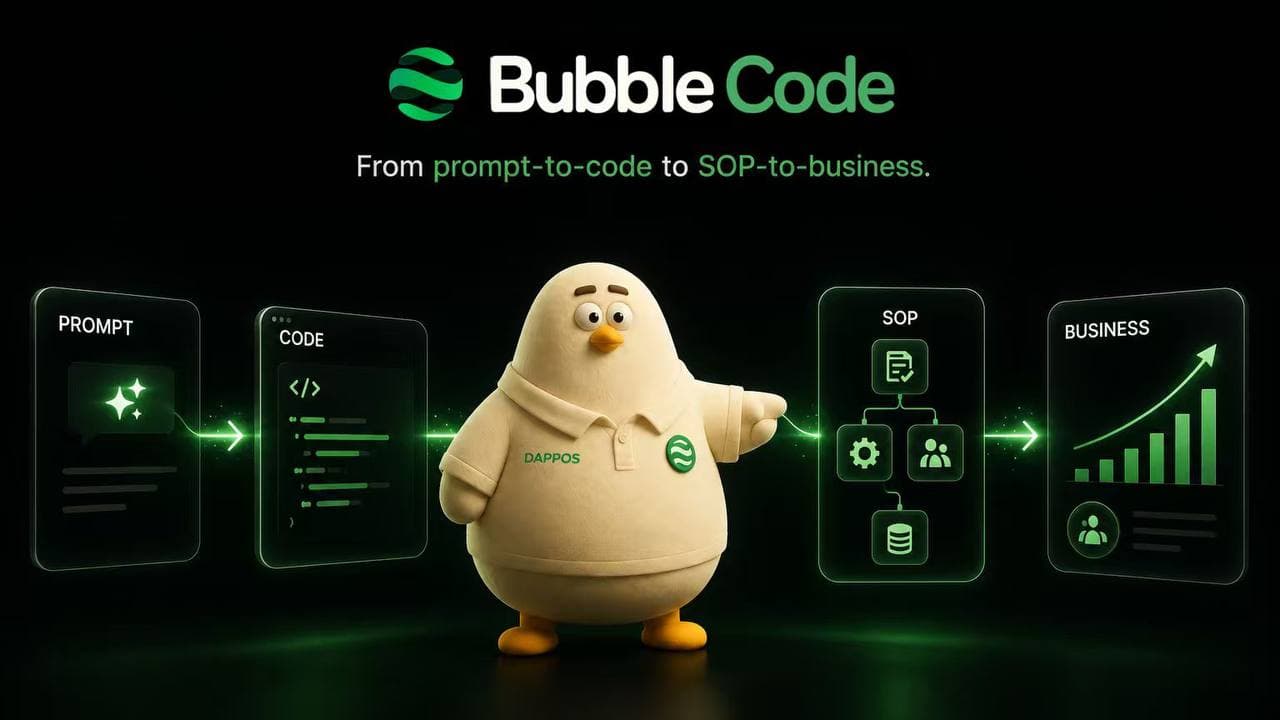
This is the shift from prompt-to-code to SOP-to-business.
Coding SOPs That Takes Users from Idea to Live Business
Bubble Code focuses on business workflows, not demo pages.
A demo page only proves that AI can generate code. A live business needs a page, a user flow, login, payment, backend records, service configuration, and a path for future updates.
One important use case is Web3-enabled commerce and service sales.
A user may want to sell products, digital goods, service packages, event access, consulting sessions, or community-related merchandise. Bubble Code can package the basic workflow: brand elements, page structure, product or service media and description, wallet login, stablecoin payment, order records, backend management, and launch materials.
The user does not start from a template. The user starts from what they want to sell.
Besides, for many small businesses, growth does not begin with a large advertising budget. It begins with customers, communities, partners, and repeat relationships.Bubble Code can also help generate marketing materials based on the target audience, and support configurable referral or incentive rules when needed.
Another use case is lightweight AI agent applications.
As model APIs become easier to access, many users will want to launch small AI tools: an image-generation agent based on brand mascot, a role-based chat tool, or a workflow agent for a specific audience. The challenge is not only calling a model API. The user also needs an interface, login, usage tracking, credit consumption, payment, and a way to publish or sell the tool.
Bubble Code can turn these requirements into Agent Application SOPs.
Not every AI agent needs to start as a venture-backed startup. Some can start as small, useful, paid products.
Toward Near-Zero Barriers
The first stage of AI coding asked: can AI write code?
The next stage asks a more important question: can AI help more people launch businesses?
Web3 reduces friction in login, payment, and digital ownership. xBubble reduces friction in software generation, service configuration, and business workflow creation. Service providers help complete the infrastructure layer. Coding SOPs hide unnecessary technical complexity and expose the business decisions users actually understand.
This does not mean every business can be built without human judgment. It means users should not need to become software engineers before they can test a business idea.
Bubble Code is not here to make everyone become a programmer. It is here to make software building feel closer to business building.
_________________________________________________________________________
Bitcoin.com accepts no responsibility or liability, and shall not be liable, whether directly or indirectly, for any loss, damage, claim, cost, or expense of any kind, whether actual, alleged, or consequential, arising out of or in connection with the use of, or reliance upon, any content, goods, or services referenced in this article. Any reliance placed on such information is strictly at the reader’s own risk.