


The White House says the Senate has until September 15 to advance the Clarity Act after Democrats blocked a procedural vote before the August recess, with prediction markets now pricing roughly a one in four chance the bill becomes law in 2026.
White House to Senate: Pass Clarity Act by Sept. 15 or Never
WRITTEN BY

SHARE

Key Takeaways
- White House adviser Patrick Witt has set a hard September 15 deadline for the Senate to advance the bill.
- Senate Majority Leader John Thune says Democrats blocked a floor vote before the August recess.
- Polymarket odds for 2026 passage fell to about 15.5%, down from roughly 30% a week earlier.
A Hard Deadline From the White House
Patrick Witt, executive director of the Presidential Council of Advisors for Digital Assets, drew a firm line under the Clarity Act’s timeline, adding:
“If they can’t get there by September 15, they never will.”
He further accused Senate Minority Leader Chuck Schumer and other Democrats of orchestrating a blockade against what he characterized as a routine procedural vote before recess.
A White House official added that the administration remains committed to the bill, noting it has “agreed to the most comprehensive and wide-ranging ethics provision” attached to any crypto legislation to date, in an attempt to address Democrats’ concerns about conflicts of interest tied to officials’ digital-asset holdings.
How the Senate Got Here
The Clarity Act, formally H.R. 3633, has already cleared several legislative hurdles. The House passed its version 294-134 in July 2025, and the Senate Banking Committee advanced a companion bill 15-9 on May 14, 2026, with all Republicans and two Democrats in favor. A merged text combining Senate committee work was released on July 22.
That is where momentum stalled. Seven Democrats, including Sens. Angela Alsobrooks and Ruben Gallego, rejected the Republican-drafted merged bill, pushing for stronger provisions on ethics rules, consumer protection, illicit-finance safeguards and oversight of decentralized finance (DeFi). Senate leadership was unable to secure a time agreement to bring the bill to the floor before the chamber left for recess, and Thune has pinned the delay squarely on Democratic obstruction.
The Senate has now queued a cloture vote, the procedural step required to end debate and move to a final vote, for September 15 at 2:15 p.m. Advancing the motion needs 60 votes. Republicans expect all 53 of their members to support it, meaning seven Democrats will need to cross over, the same threshold that collapsed talks in July.
The SEC Moves on Its Own
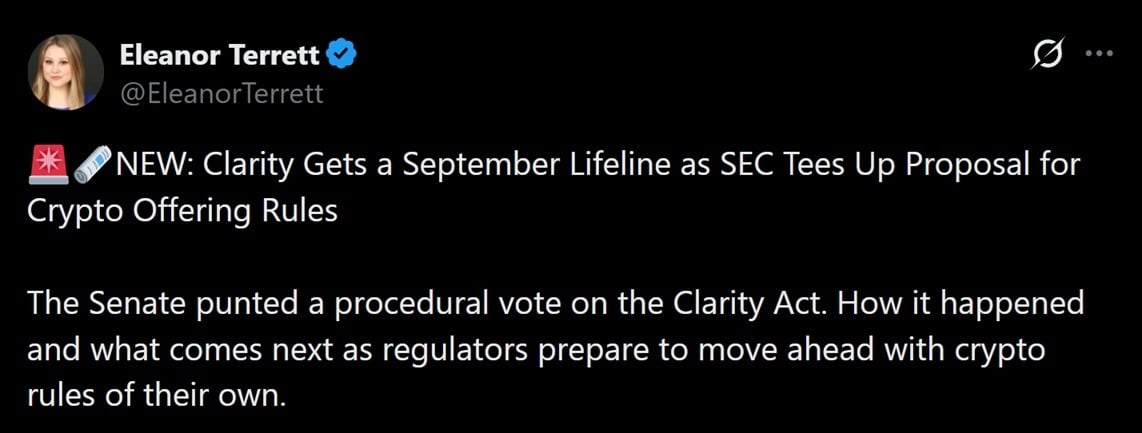
The Securities and Exchange Commission (SEC) has scheduled an open meeting for Friday to consider proposing new rules for a tailored offering regime covering certain crypto investment contracts. The move would give the SEC its own framework for how crypto assets are offered to investors, independent of whatever Congress eventually passes.
Bitcoin.com News has tracked the bill’s fading odds for weeks; Polymarket pricing on Clarity Act passage had already slipped from 38% to 27% in early August, before falling to an all-time low of 13% after the recess punt. The metric has since recovered and currently stands at around 25%.
A failure to advance the bill in September would not kill crypto market-structure legislation outright, but lawmakers and lobbyists broadly agree it would push any resolution into 2027 at the earliest, given how little floor time remains once campaign season begins in earnest.
That would leave the SEC and Commodity Futures Trading Commission (CFTC) to keep dividing oversight of digital assets under existing law, an arrangement both the industry and many lawmakers consider inadequate for a market that has grown far beyond the statutes originally written to police it.
Sixty votes on Sept. 15 would move the CLARITY Act closer to Senate floor consideration. The 2:15 p.m. EDT cloture…
Read Now: CLARITY Act Vote Is Set for Sept. 15: Here’s What Happens Next