


A small group of traders extracted $8.2 million from Polymarket’s five-minute bitcoin contracts by pushing the spot price on Binance just before settlement, researchers from Stanford University and Singapore Management University found.
Stanford Study: Polymarket's Bitcoin Bets Were Rigged in the Final 10 Seconds
WRITTEN BY

SHARE

Key Takeaways
- Stanford and SMU researchers found 821 traders took $8.2 million from Polymarket’s 5-minute bitcoin bets.
- Net order flow on Binance jumped about 50% in the final 10 seconds before settlement, the study found.
- The paper says 15-minute contracts show far less abuse, pointing to longer settlement windows as the fix.
Striking New Findings Emerge
Polymarket’s fastest bitcoin betting product shows systematic signs of settlement manipulation, according to a new study by David Dai and Ruizhe Jia of Stanford University’s Department of Management Science and Engineering and Shihao Yu of Singapore Management University’s Lee Kong Chian School of Business.
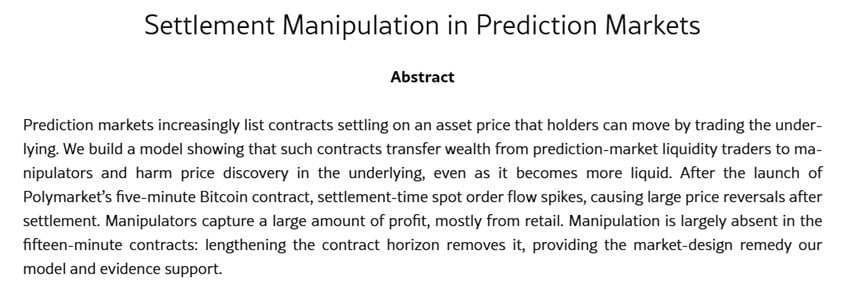
The working paper, titled “Settlement Manipulation in Prediction Markets,” examined roughly 16,000 five-minute bitcoin up-or-down contracts from their Feb. 12, 2026 launch through April. The contracts settle against a Chainlink oracle that aggregates spot prices from major exchanges, meaning whoever can nudge the spot price in the final moments can decide which side of the bet pays out.
Describing the profits, the authors wrote that manipulators “take $8.2 million in the pushed cycles while breaking even in the rest.”
The mechanics are straightforward, i.e. a trader buys the “up” side of a five-minute contract, then fires aggressive buy orders into the Binance spot market (the world’s largest crypto exchange by volume) seconds before the betting window closes. Because the Binance mid-price sits, in the researchers’ words, “about two and a half basis points from the oracle” resolution price, even a small push can flip the settlement outcome.
A Recurring Pattern in the Final 10 Seconds
The fingerprints show up in the order books because after the five-minute contracts launched, net order flow on Binance in the final ten seconds before each close jumped roughly 50% above pre-launch levels. The bursts were concentrated and directional, arriving precisely as the betting windows expired.
The behavior was rare but lucrative and only 821 traders out of roughly 243,000 (or about one in 300) exhibited clear manipulation patterns. The costs, meanwhile, were not evenly shared, with 93% of the losses falling on retail participants, who effectively served as liquidity providers on the losing side of pushed settlements.
A Longer Clock as the Fix
The researchers observed that the manipulation signature is “much attenuated” in Polymarket’s 15-minute bitcoin contracts, suggesting that a longer settlement horizon makes the trade too expensive to push reliably. Their primary policy recommendation is simply to lengthen the contract horizon.
The findings land at a delicate moment for the prediction market industry, especially since crypto-native price betting has become one of its fastest-growing segments, with traders stacking more than $100 million on bitcoin price outcomes across Polymarket, Kalshi and Myriad in recent months.
Polymarket, the largest platform by volume, is meanwhile preparing a token airdrop planned for the fourth quarter of 2026, a launch that would put an even brighter spotlight on the integrity of its settlement design.
Neither Polymarket nor Chainlink has publicly responded to the paper’s findings, and the authors stopped short of alleging any rule-breaking by the platform itself. Whether the platform adjusts that design is now an open question.

The Czech Republic has become the latest European country to block Polymarket as unlicensed gambling, adding the crypto-based prediction market…
Read Now: Czechia Blocks Polymarket as Unlicensed Gambling, Ordering a 15-Day ISP Shutdown