


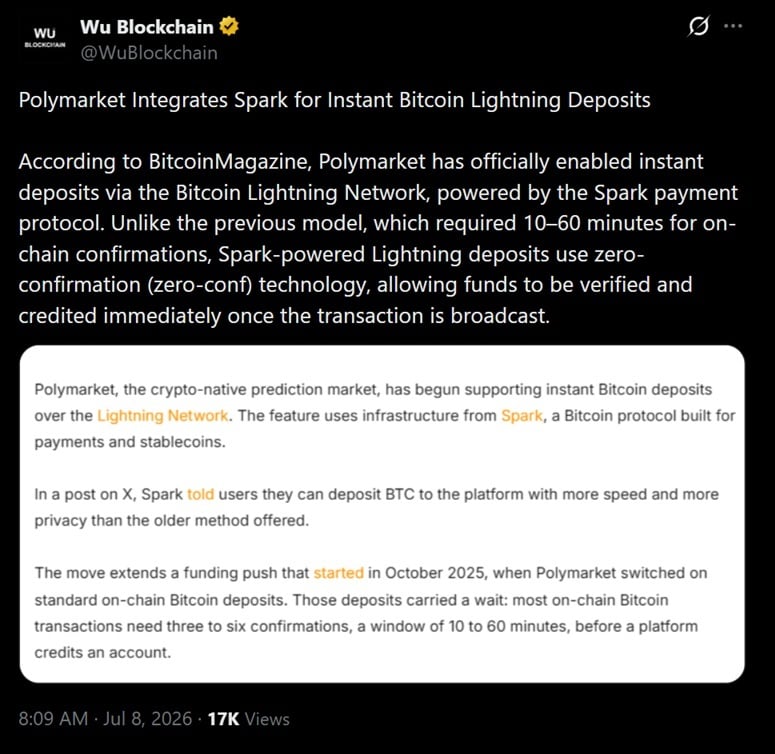
Polymarket, the world’s largest prediction market, has enabled instant bitcoin deposits over the Lightning Network, with new rails powered by the Spark protocol crediting funds in under one second.
Polymarket Switches on Instant Bitcoin Lightning Deposits, Cutting 60-Minute Waits to Under a Second
WRITTEN BY

SHARE
Key Takeaways
- Polymarket now credits bitcoin Lightning deposits in under 1 second via Spark, versus 10–60 minutes onchain.
- Spark validates BTC transfers at broadcast, replacing the 3–6 confirmations Polymarket required since October 2025.
- Kalshi’s $5.42 billion April volume lead over Polymarket raises the stakes for faster funding rails in 2026.
Opening up New Avenues
Polymarket has switched on instant bitcoin deposits via the Lightning Network, a payments layer built on top of the Bitcoin network (powered by the Spark protocol). The upgrade replaces a funding flow that previously took anywhere from 10 to 60 minutes, with the new route crediting deposits in under a second with near-zero fees.
The change is a sharp departure from the standard onchain bitcoin deposits Polymarket added in October 2025, which required three to six network confirmations before the platform credited an account. They carried a higher minimum deposit that reflected bridging costs, but the Lightning route changes that status quo, settling transactions in seconds while keeping minimums low.
Tether CEO Paolo Ardoino, whose company issues the USDT stablecoin, praised the underlying technology, describing it as:
“A route to programmable Bitcoin over Lightning.”
How Spark’s Zero-Conf Rails Work
Spark was developed by Lightspark and is built on statechain technology, a design that moves bitcoin ownership off the main chain while preserving user custody. The protocol validates a bitcoin transaction at the moment it is broadcast, checking for double-spend risk, fee adequacy, and replace-by-fee flags before crediting the deposit.
The structure also lightens Polymarket’s operational load as the platform does not have to manage confirmation thresholds or run its own Lightning nodes, because a single Spark software development kit (SDK) handles onchain, Lightning, and stablecoin rails. Deposits remain self-custodial, with each wallet tied to the user’s own keys, so traders retain control of their funds until they place a trade.
As things stand, wallet providers including Breez, Xverse, and Cake are building on the protocol, indicative of the fact that instant bitcoin settlement could become a standard feature across consumer crypto apps rather than a niche add-on.
A Funding Arms Race With Kalshi
The upgrade lands in the middle of an intensifying battle for prediction market volume as rival exchange Kalshi posted $5.42 billion in April taker volume, overtaking Polymarket’s $1.99 billion for the first time as the sector’s monthly total hit $8.6 billion.
The latter also recently unveiled perpetual futures trading for U.S. markets, broadening its offering beyond simple event contracts as it works to reclaim ground from its regulated rival.
Bitcoin deposits give Polymarket access to the deepest pool of capital in crypto and by meeting bitcoin holders where they are, the platform is removing a conversion step that previously pushed some would-be depositors toward stablecoin funding instead.
With Kalshi setting monthly records and both platforms courting the same pool of traders, deposit speed, fees, and asset coverage are likely to decide where the next wave of prediction market capital lands.

Prediction-market traders moved nearly $460 million combined across Kalshi and Polymarket on England's 3-2 round-of-16 win over Mexico. Seen as…
Read Now: Prediction Markets Traded Nearly $460M on Mexico-England as World Cup Odds Swung From Red Card to Certainty