


Solana planted a $13.5 billion flag in real-world assets (RWAs), with stablecoins in mix, and Redstone’s latest report says that puts the chain in pole position for Internet Capital Markets.
Redstone Report: Solana’s RWA Engine Rooms Light up With $13.5B Onchain

This article was published more than a year ago. Some information may no longer be current.
WRITTEN BY

SHARE

Redstone Analysis: Solana’s Tokenized Assets Top $13.5B, Building Internet Capital Markets
The modular oracle protocol and decentralized finance (DeFi) firm Redstone explains that Solana’s RWA footprint isn’t a rounding error; it’s the headline, with nearly 500% year-over-year growth, median fees under a tenth of a cent, and sub-second finality backing claim.
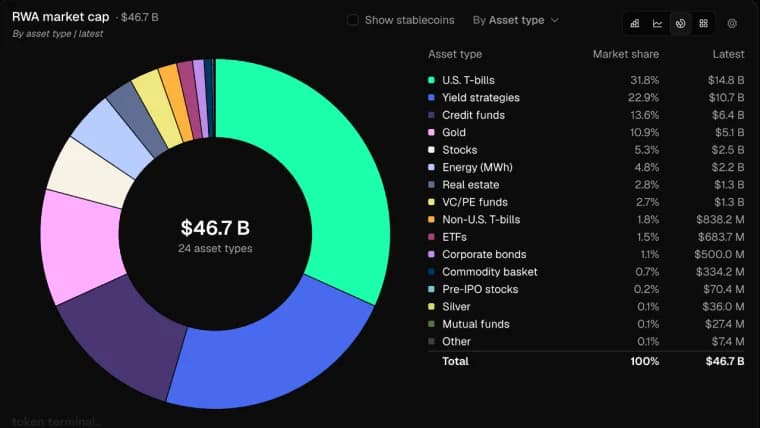
Redstone’s new analysis, published on Monday, frames the moment clearly: tokenized finance jumped from $5 billion in 2022 to more than $31 billion by September 2025, and Solana’s share now tops $13.5 billion, including stablecoins.
Stablecoins dominate the stack on Solana, led by USDC above $8 billion, far outpacing USDT’s roughly $2 billion supply, while newer entrants like PYUSD, FDUSD, AUSD and EURC nibble for market share.

Beyond dollars, non-stablecoin RWAs lean heavily toward tokenized U.S. Treasuries, which account for more than 90% of the category on Solana thanks to products like Ondo’s USDY and OUSG and Blackrock’s BUIDL.
Institutions are shipping here: Apollo’s ACRED and Hamilton Lane’s SCOPE arrive via Securitize, while Vaneck’s VBILL and Centrifuge-anchored funds extend access, turning Solana into a busy onchain street.
The rails are built for compliance and speed: Token-2022 extensions enable KYC gates, transfer rules and corporate actions, while average 400-millisecond finality and 100% uptime over twelve months keep throughput snappy.
Pricing and plumbing matter; Redstone oracles now secure RWA markets on Drift Institutional and Kamino, bringing NAV-aware feeds that let DeFi strategies plug into tokenized funds without hand-waving mark-to-fantasy.
TradFi bridges are forming too: R3’s Corda is wiring regulated networks to Solana’s public chain, letting banks keep privacy controls while settling into deeper liquidity pools where users already transact.
The takeaway is simple: Solana’s blend of speed, compliance tooling and institutional proof points makes it a natural venue for tokenized assets to graduate from pilots to production at internet scale.
About the author
WRITTEN BYJamie RedmanNews Lead
Jamie Redman is the News Lead at Bitcoin.com News and a financial technology journalist based in Massachusetts.