


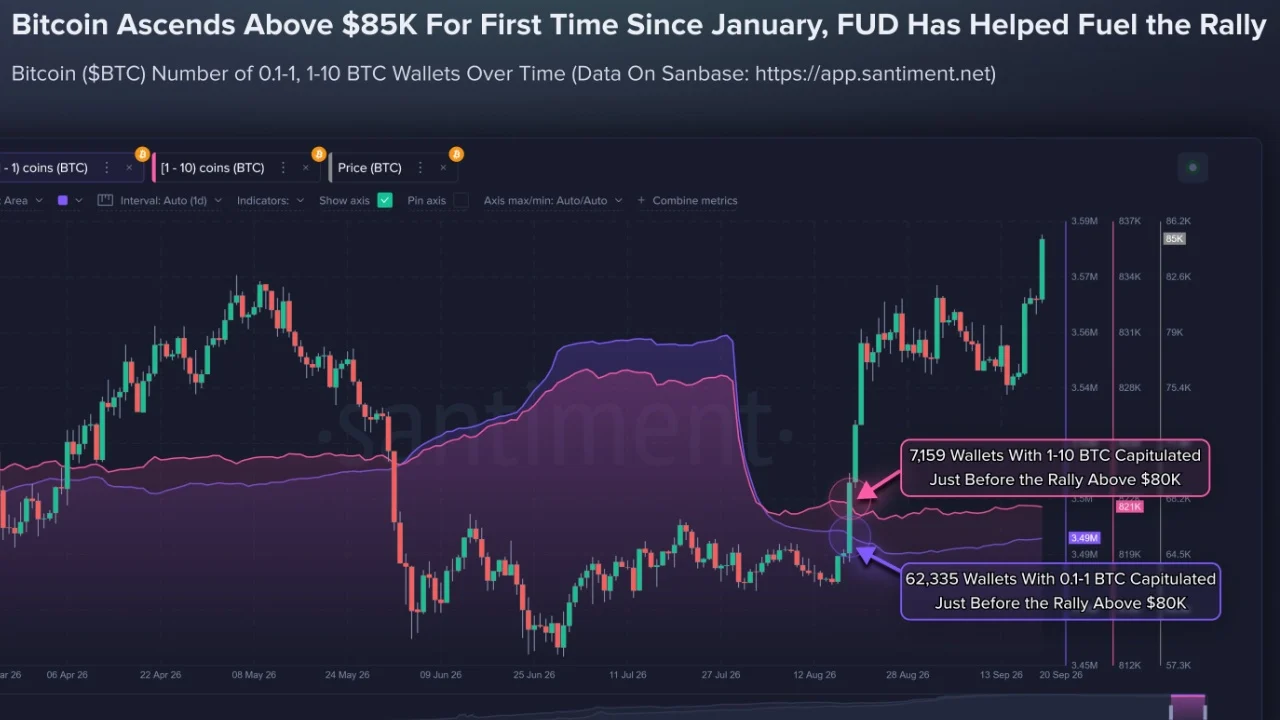
Bitcoin climbed above $85,000 after 69,494 wallets disappeared from two smaller-holder balance groups during the July-August downturn. Santiment argues that the earlier capitulation reduced reactive supply before the latest rally.
Smaller Bitcoin Holders Sold Before $85K Rally as 69,494 Wallets Exit
WRITTEN BY

SHARE
Key Takeaways
- Two smaller-holder wallet groups lost a combined 69,494 addresses.
- Bitcoin subsequently broke above $85,000 for the first time since January.
- Short liquidations and renewed ETF inflows strengthened the advance.
Smaller Bitcoin Wallet Groups Contract Before Breakout
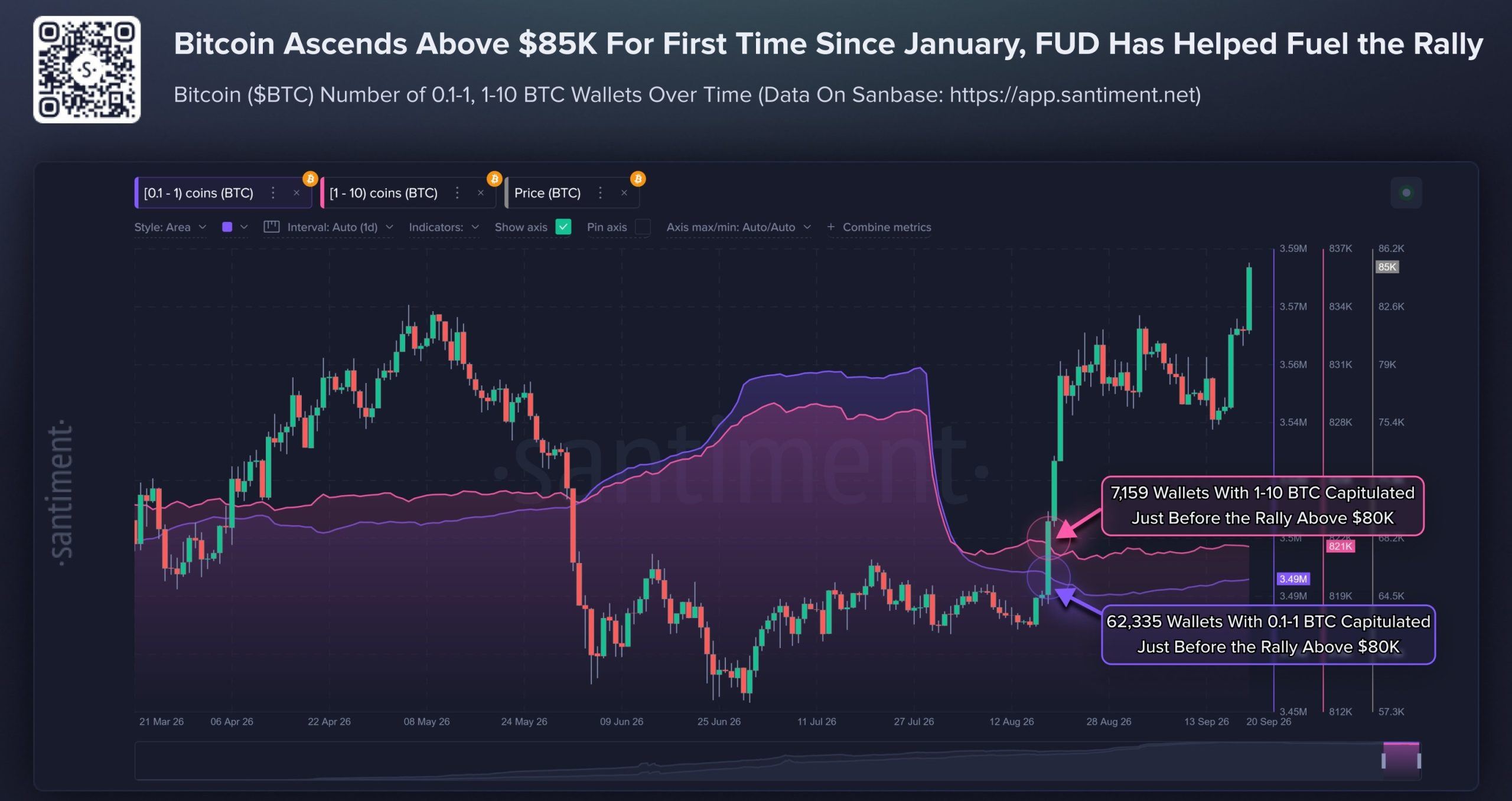
Smaller bitcoin holders appear to have reduced their exposure before the cryptocurrency recovered above $85,000. Onchain analytics platform Santiment reported on X on Sept. 21 that 62,335 wallets holding between 0.1 and 1 BTC disappeared during the July-August shakeout, along with 7,159 wallets containing between 1 and 10 BTC.
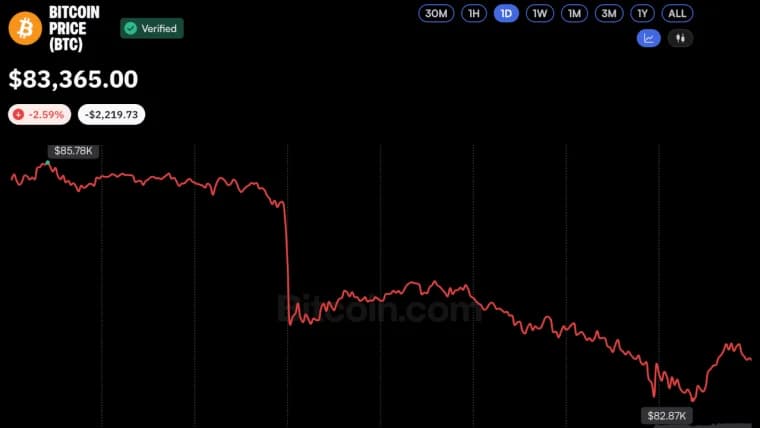
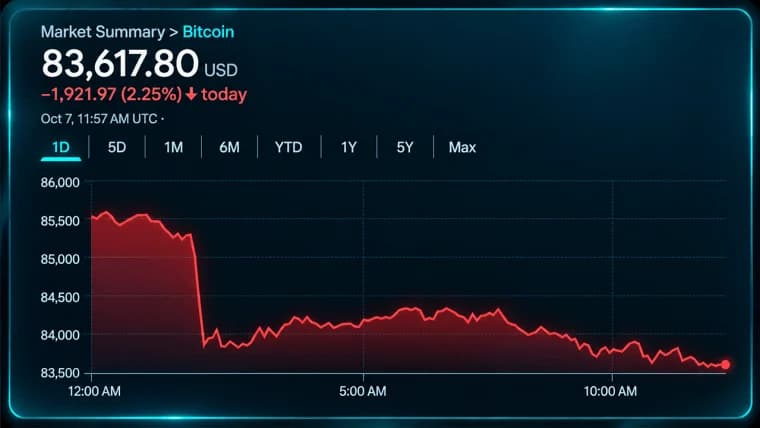
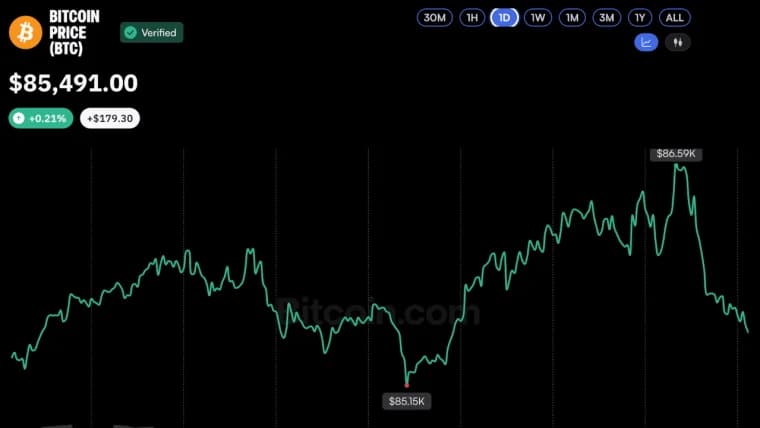
The combined decline equals 69,494 wallets across the two balance groups, according to Santiment’s analysis. The figure measures addresses that left those specific ranges, which can occur through selling, consolidation, or balance changes; it does not establish that every wallet was closed. Bitcoin reclaimed $80,000 after the contraction and later exceeded $85,000 for the first time since January.
Santiment interpreted the shift as capitulation among smaller holders before the breakout. The firm wrote:
“Capitulation can leave supply in stronger hands. Once fearful holders finish selling, less reactive supply remains available to dump into the next rally, especially when larger buyers keep absorbing coins.”
Supply Shifts Toward Larger Bitcoin Holders
The wallet decline fits a wider change in bitcoin ownership observed during the market downturn. A July analysis found that wallets holding 1,000 to 10,000 BTC accumulated 66,700 BTC over 60 days, while holders with 100 to 1,000 BTC distributed 77,800 BTC in what Cryptoquant contributor Amr Taha described as one of the most aggressive selling periods visible in the current data.
Transfers toward larger holders may reduce the supply readily offered during a rebound when those participants retain their positions. Bitcoin whales can influence market liquidity through the size and timing of their transactions, though wallet data cannot reveal an owner’s identity or prove that every balance change represents a sale.
The latest rally nevertheless carried signs of speculative acceleration. CoinGlass tracks forced closures across major derivatives venues, where rising prices can liquidate short positions and generate additional market purchases. Santiment placed bearish crypto liquidations near $648 million during the move, saying the short squeeze accelerated bitcoin’s advance while falling oil prices also improved risk appetite.
ETF Demand Adds Support as Bitcoin Clears $85,000
Institutional demand also improved before bitcoin crossed the milestone. Farside Investors recorded more than $430 million in net inflows to U.S. spot bitcoin exchange-traded funds on Sept. 18, led by more than $300 million for Fidelity’s FBTC and over $100 million for Blackrock’s IBIT. The inflows followed heavy withdrawals on Sept. 15 and Sept. 16, which were partly offset by a smaller inflow on Sept. 17.
The Friday rebound in bitcoin ETF demand helped offset earlier weekly outflows as BTC moved above $80,000. The reversal provided a source of spot-market demand alongside the derivatives squeeze, although the full Sept. 14-18 period produced only a modest net inflow after heavy withdrawals from several funds.
Bitcoin crossed $84,000 after reclaiming its 50-week moving average before extending its advance beyond $85,000. Santiment cautioned that smaller-holder capitulation does not guarantee continued gains and that aggressive buying near market highs can produce the opposite setup.
Strive Inc. bought another 1,355 bitcoin for roughly $107.7 million last week, yet somehow finished the same stretch with more…
Read Now: Strive’s Bitcoin Stash Tops $2B After a 5-Week Buying Binge