
Poland’s state energy company Orlen lost hundreds of millions of dollars after a covert plan to buy discounted Venezuelan crude using tether collapsed.
How $230M in Crypto for Venezuelan Oil Vanished on USB Drives
WRITTEN BY

SHARE

Key Takeaways
- Polish energy firm Orlen lost up to $424 million after a $230 million USDT advance for Venezuelan crude vanished via intermediaries.
- The failure highlights major counterparty risks when using tether as an off-ledger payment system for commodities.
- Three former Orlen executives face up to 25 years in prison, while the firm pursues international arbitration.
Disappearing Millions and USB Drives
A clandestine attempt by Poland’s state-controlled energy giant to purchase discounted Venezuelan crude using cryptocurrency has collapsed into one of the largest corporate and political scandals in the nation’s history, leaving hundreds of millions of dollars unaccounted for.
According to a report by the Financial Times, Orlen lost up to $424 million following a late 2023 scheme to bypass traditional banking systems using Tether, a dollar-pegged stablecoin known as USDT. The venture began in late November 2023 in Abu Dhabi, United Arab Emirates, when Samer Awad, then head of Orlen Trading Switzerland, or OTS, met with Kam Ho “Alex” Tse, the 25-year-old founder of Dubai-based trading firm Hannon International.
At the time, the U.S. government had temporarily eased sanctions on Venezuela’s energy sector, opening a window to acquire heavy Merey 16 crude oil at significant discounts. However, Venezuelan state oil company PDVSA was largely cut off from Western banking networks and required partial prepayments in USDT to execute trades.
Within days of signing a contract for 6 million barrels of crude, OTS wired an uncollateralized $230 million advance payment to Hannon. Though the formal contract made no explicit mention of cryptocurrency, Hannon was tasked with converting the cash into USDT to secure cargo allocations from PDVSA.
In turn, Hannon enlisted multiple Dubai intermediaries and Venezuelan brokers to convert the dollar funds into digital tokens. Court records, internal communications and blockchain analysis cited by the Financial Times reveal that Hannon converted an initial batch of funds through a Dubai financial firm, paying $400,000 in fees to obtain 80 million USDT. An additional $135 million sent to another intermediary yielded only 85 million USDT, leaving a $50 million shortfall.
Following the transaction, representatives for Hannon traveled to Caracas, Venezuela, to meet local brokers linked to PDVSA. Over several weeks in January 2024, private cryptocurrency keys controlling tens of millions in USDT were handed over on USB flash drives in restaurants and hotel rooms.
Hannon representatives delivered a USB drive containing access to 60 million USDT on Jan. 5, 2024, followed by a second drive holding 50 million USDT on Jan. 28. Additional drives containing 22 million USDT were handed over between February and March 2024.
Political Backlash and Criminal Charges
Shortly after the transfers, contact with the Venezuelan brokers was lost, and PDVSA could not release the oil cargoes as a result. Only one vessel was ultimately loaded, receiving roughly 500,000 barrels of fuel oil worth $28.8 million — a small fraction of the intended order. Orlen officially canceled the contract in March 2024.
Accounting for lost prepayments, ship chartering fees, legal expenses and accrued liabilities, Polish authorities estimate Orlen’s total financial losses from the deal to be between $378 million and $424 million.
The revelations have sent shockwaves through Poland, which is still reeling from the collapse of the cryptocurrency exchange Zondacrypto in April and the arrest of former Poland Olympic Committee president Radosław Piesiewicz.
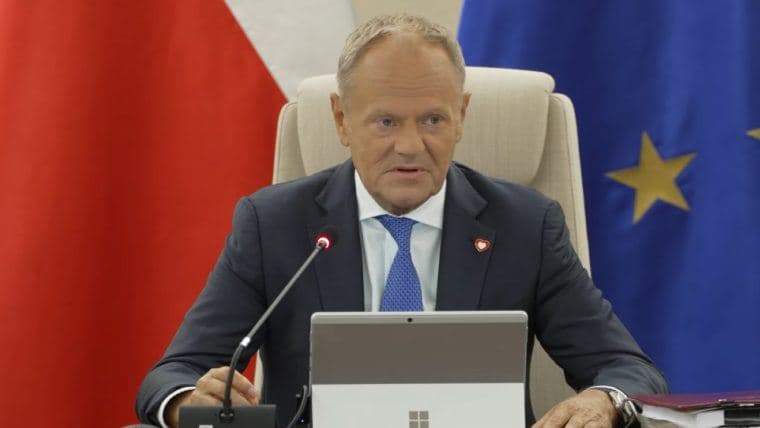
Polish Prime Minister Donald Tusk publicly condemned the operation, describing it as a “disgrace in front of the entire world.” Tusk, whose government remains at loggerheads with the Polish crypto industry, directed criticism at the previous Law and Justice, or PiS, administration, questioning how state funds were converted into USDT in a foreign land.
Polish prosecutors opened criminal investigations into OTS management, leading to formal indictments against three former senior executives that carry potential prison sentences of up to 25 years.
Meanwhile, Orlen’s new management team has disavowed the transaction’s setup and launched international arbitration proceedings in Dubai to recover the $230 million advance payment. Hannon maintains that it acted in good faith on Orlen’s instructions and denies liability for the downstream loss of the digital assets.