


Vaneck has asked the U.S. Securities and Exchange Commission (SEC) to let it withdraw its Lido Staked Ethereum Exchange-Traded Fund (ETF), a year after filing for it.
Vaneck Pulls the Plug on Its Lido Staked Ether ETF Before Launch
WRITTEN BY

SHARE
Key Takeaways
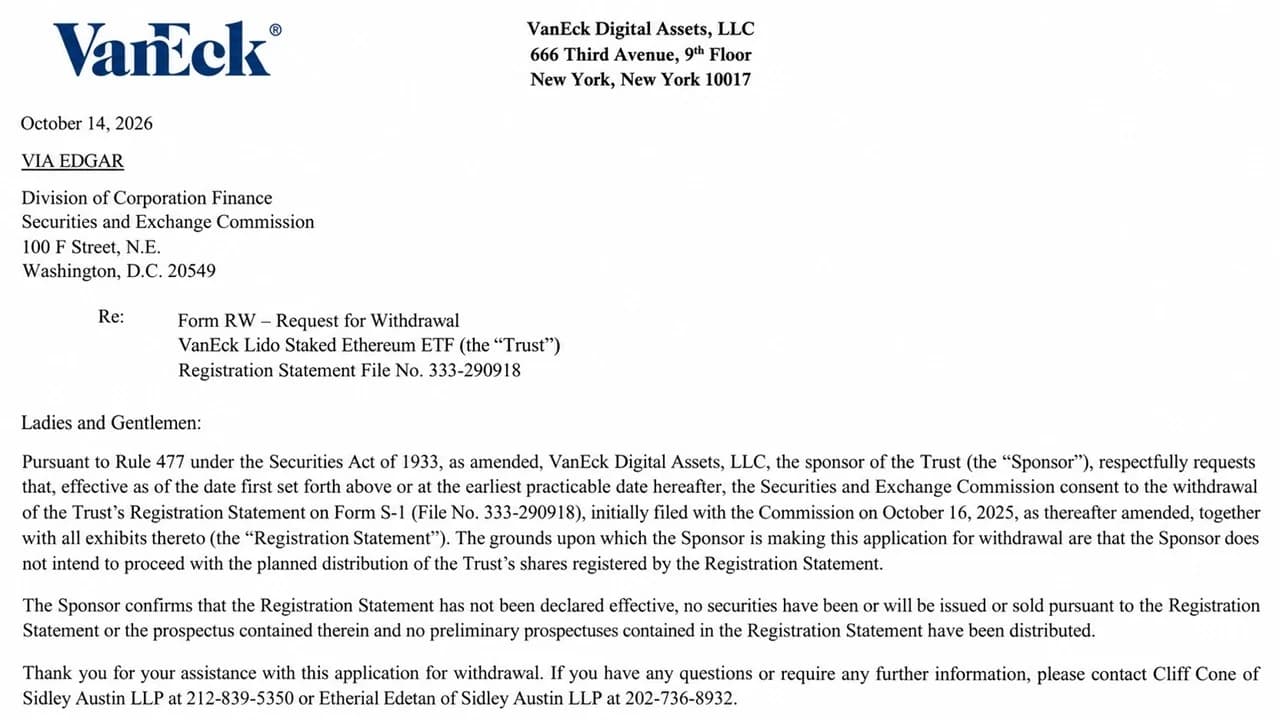
- Vaneck filed to withdraw its Lido Staked Ethereum ETF registration on Oct. 14, 2026.
- Lido’s total value locked has fallen to about $23.6 billion from $33.3 billion a year earlier.
- Blackrock’s ETHB, launched in March 2026, now competes directly for staked ether ETF demand.
The One-Line Exit
The filing was short, and in a Form RW dated Oct. 14, Vaneck Digital Assets vice president Matthew Babinsky asked the SEC to consent to withdrawing the registration because the sponsor “does not intend to proceed with the planned distribution” of the trust’s shares. The letter confirms the registration statement was never declared effective and that no shares were sold.
The withdrawal sat unnoticed for more than a day before market feeds started to pick up the update earlier today.
What Was Supposed to Be Inside
The product was a first of its kind on paper because rather than holding ether and staking it through chosen validators, the fund would have held stETH, the liquid staking token issued by the Lido protocol. When the S-1 landed in October 2025, Lido said the fund “closely mirrors Ethereum’s staking economics” while keeping daily liquidity and transparent onchain backing.
For Lido, it was meant to be a stamp of legitimacy (a Wall Street wrapper around its own token), while for investors, it promised staking yield without running nodes or touching decentralized finance (DeFi).
The Room Got Crowded
A lot seems to have changed in 12 months as Blackrock first launched the iShares Staked Ethereum Trust (ETHB) in March, and the fund reported $409.8 million in net assets by March 31, per its first quarterly filing. ETHB stakes ether directly through validators and doesn’t depend on a third-party token.
Staking itself has gone mainstream through brokers too, with Interactive Brokers rolling out ether staking with Zerohash this week, giving clients yield in a regular brokerage account with no ETF needed.
A late entrant built on a single protocol’s token would have had to win investors from Blackrock on fees and distribution, which would have been a hard sell, to say the least. It would also carry an extra layer of risk that a direct-staking fund avoids. If stETH ever traded at a discount to ether, as liquid staking tokens can during market stress, the fund’s value would drift away from the asset investors thought they were buying.
Lido’s Shrinking Pool
The underlying asset of the proposed etf had been losing ground as well, with Lido’s total value locked (TVL) currently standing at roughly $23.6 billion, down from about $33.3 billion a year ago. Part of that drop reflected ether’s own slide, with ETH trading near $2,450 as of today.
Demand for ether funds has also been patchy and U.S. spot bitcoin and ether ETFs lost $391 million in a single session this week. Furthermore, Bitcoin.com News reported earlier in the week that Blackrock drove $150 million of bitcoin and ether ETF selling. Launching a niche staked ether product into those outflows would not have been an obvious win.

Blackrock CEO Larry Fink is sounding the recession alarm over proposals to halt new data center construction, warning that America's…
Read Now: Blackrock Boss Larry Fink Sounds Recession Alarm Over AI Data Center Shutdowns