


Hyperliquid has emerged as crypto’s top revenue generator outside the industry’s two dominant stablecoin issuers, pulling in $429 million as of Sept. 15. More strikingly, sector-wide revenue has remained relatively resilient even as bitcoin fell almost 40% during 2026.
Hyperliquid Generates $429M as HYPE's Price Hits All-Time High of $95
WRITTEN BY

SHARE

Key Takeaways
- Hyperliquid led non-stablecoin crypto revenue with $429M as of Sept. 15.
- Crypto revenue averaged $1.08B monthly in 2026, holding up better than bitcoin’s near-40% drop.
- It remains to be seen if Hyperliquid and Pump.fun can sustain revenue as markets stabilize.
Hyperliquid Leads $3.4B Crypto Revenue Pool
Crypto prices may be under pressure, but some of the industry’s biggest businesses are still producing substantial revenue.
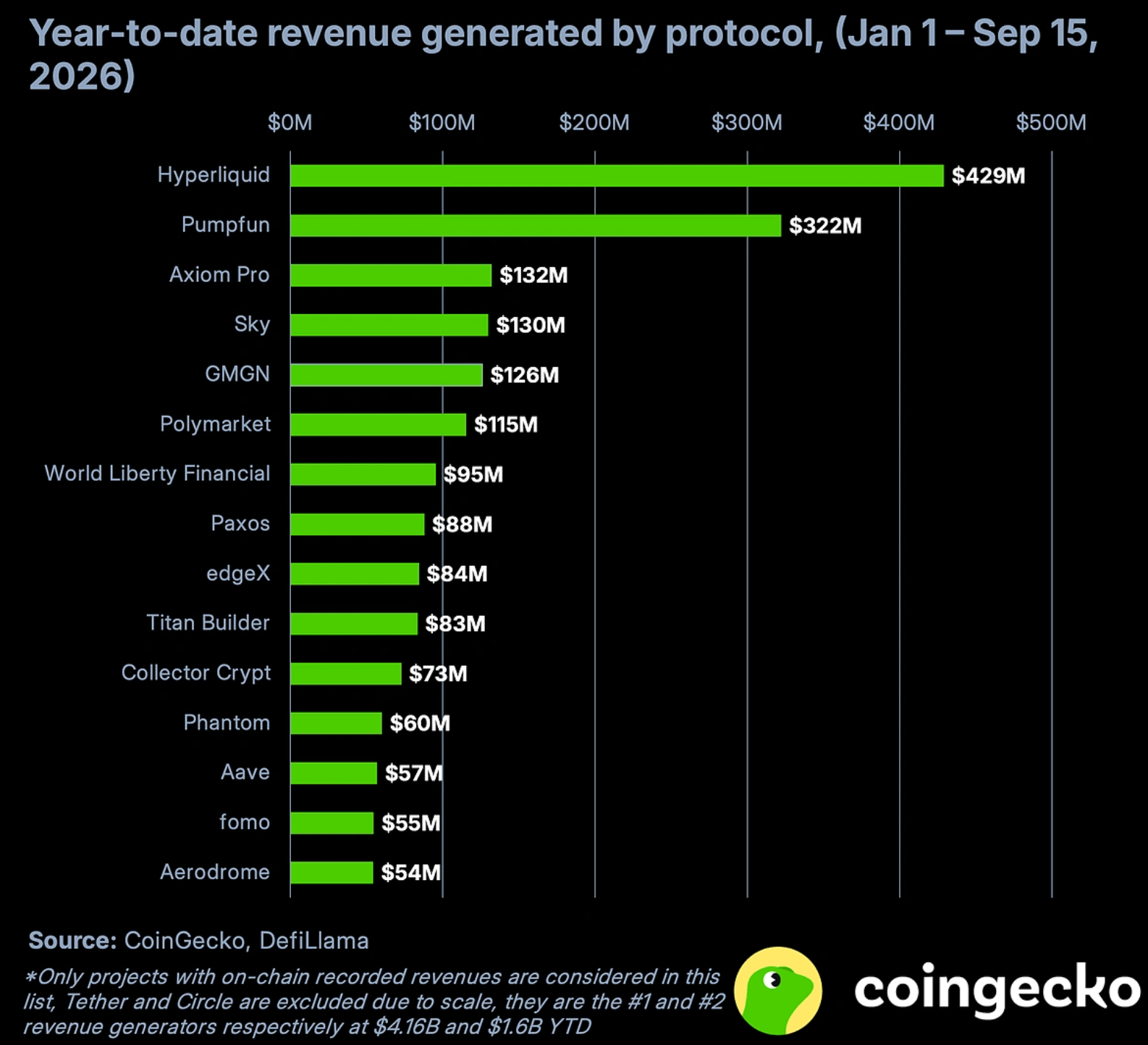
Hyperliquid generated $429.04 million from Jan. 1 through Sept. 15, giving the perpetual-futures platform 12.62% of a $3.40 billion revenue pool that excludes Tether and Circle.
Pump.fun ranked second with $322.21 million, driven largely by token creation and trading activity on its Solana memecoin launchpad. Together, Hyperliquid and Pump.fun produced $751.25 million, 22.1% of the total tracked by Coingecko.
The figures show that speculative activity remains lucrative even during a weaker crypto market.
Trading Infrastructure Is Becoming Big Business
Perhaps the more revealing names sit just below the leaders.
Axiom Pro ranked third with $132.09 million, while GMGN generated $126.03 million to take fifth place. Neither is primarily a blockchain protocol. Both are trading terminals designed to make onchain markets easier to access.
Axiom integrates Hyperliquid for perpetuals trading, effectively monetizing some of the same activity driving Hyperliquid’s growth. GMGN is closely associated with Solana memecoin trading, placing it alongside the speculative ecosystem that has powered Pump.fun.
That suggests an important shift: the companies simplifying access to crypto markets can capture meaningful economics without owning the underlying trading venue.
Revenue Leaders Stretch Far Beyond DeFi
The leaderboard is unusually diverse.
Sky generated $129.87 million, while prediction market Polymarket posted $115.48 million. World Liberty Financial reached $95.37 million, Paxos generated $87.93 million, and perpetuals platform EdgeX produced $84.37 million.
Titan Builder, Collector Crypt, Phantom, Aave, Fomo and Aerodrome also made the top 15. Combined, those 15 projects accounted for 56.02% of the $3.40 billion tracked pool.
The ranking excludes Tether and Circle because their scale would overwhelm the comparison. Grayscale, which generated $154.14 million and would otherwise rank third, was also removed because its revenue comes mainly from asset-based sponsor fees rather than protocol usage.
Crypto Revenue Is Holding Up Better Than Prices
The broader trend may be the bigger story.
Across all tracked projects, including Tether and Circle, monthly crypto revenue averaged $1.08 billion during the first eight months of 2026. That is down 11.68% from 2025’s $1.22 billion monthly average and 10.14% from the same eight-month period last year.
Bitcoin, meanwhile, fell almost 40% over the comparable period.
For investors, that gap matters. Crypto valuations have weakened sharply, yet the businesses built around trading, stablecoins, lending, and onchain speculation are still generating more than $1 billion a month.
The market may be bearish, yet its revenue engine looks considerably harder to kill.