


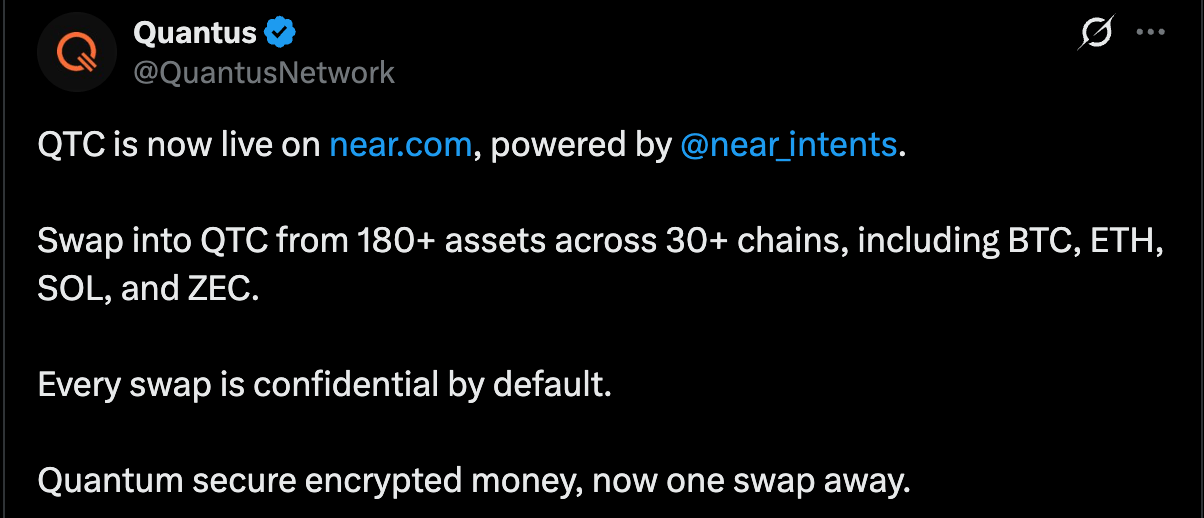
Quantum-focused blockchain Quantus has launched trading for its QTC token through near.com and Near Intents, giving users access to more than 180 assets across over 30 chains without first sending funds to a centralized exchange.
Quantum-Safe Quantus Launches QTC Token Trading via Near Intents
WRITTEN BY

SHARE
Key Takeaways
- Quantus launched QTC trading via Near Intents, connecting 180+ assets across more than 30 chains.
- The model gives new tokens a path to liquidity without relying on centralized exchange listings.
- QTC must prove cross-chain access can drive adoption for post-quantum crypto assets.
Quantus Opens QTC Trading Across 30+ Chains
Quantus is taking an unusual route to market.
The proof-of-work blockchain has opened trading for its native QTC token through near.com, allowing holders of bitcoin, ether, USDC, ZEC, and more than 180 other assets to acquire QTC directly from accounts they control.
There is no centralized exchange listing at launch.
Instead, Quantus has integrated with Near Intents and its 1Click Swap API, meaning wallets and applications already connected to the system can offer QTC without building separate Quantus infrastructure.
For a new crypto asset, that turns interoperability itself into the distribution strategy.
Near Intents Becomes QTC’s Market Gateway
The setup reflects a deliberate design choice.
Quantus does not support smart contracts, staking, or token issuance on top of its network. That means it cannot host a conventional decentralized exchange (DEX) of its own.
Near Intents is the natural answer to that limitation. Users can swap into QTC from assets spread across more than 30 blockchains while retaining control of their near.com accounts.
Christopher Smith, CEO of Quantus, said the model brings “QTC post-quantum security into a much broader onchain market without compromising the principles it was built around.”
Quantum Safety Is the Core Investment Thesis
Quantus launched its mainnet on Sept. 9 with a narrow purpose: creating digital money designed to withstand future quantum attacks.
QTC transactions use ML-DSA, the post-quantum digital-signature standard finalized by the U.S. National Institute of Standards and Technology in 2024.
The concern is long-term rather than immediate. If sufficiently powerful quantum computers eventually emerge, then signature schemes used by many existing blockchains could become vulnerable.
Quantus is trying to address that risk at the protocol level from day one. Near has made a similar cryptographic choice. Its roadmap calls for broader post-quantum protections across consensus and cross-chain infrastructure beginning in 2027.
Cross-Chain Distribution Could Matter More Than Listings
Defuse Labs CEO Alex Shevchenko said post-quantum assets only matter if users can reach them from assets they already own. That is what makes the launch notable.
Rather than relying on a centralized exchange to bootstrap liquidity and distribution, QTC is entering the market through cross-chain routing infrastructure.
If that model works, then it could offer smaller or specialized crypto networks another path to liquidity without building their own DEX or negotiating listings one platform at a time.
For Quantus, the experiment is especially fitting: a blockchain designed to minimize trusted intermediaries is testing whether it can launch its token without making one the center of its market.

Quantus has launched its proof-of-work mainnet with post-quantum cryptography built in from day one, betting that quantum resistance will become…
Read Now: Quantus Targets $2.7 Trillion Crypto Risk With Quantum-Safe Mainnet