Last week’s tariff announcement caused recession fears, market chaos, and cries of economic suicide.
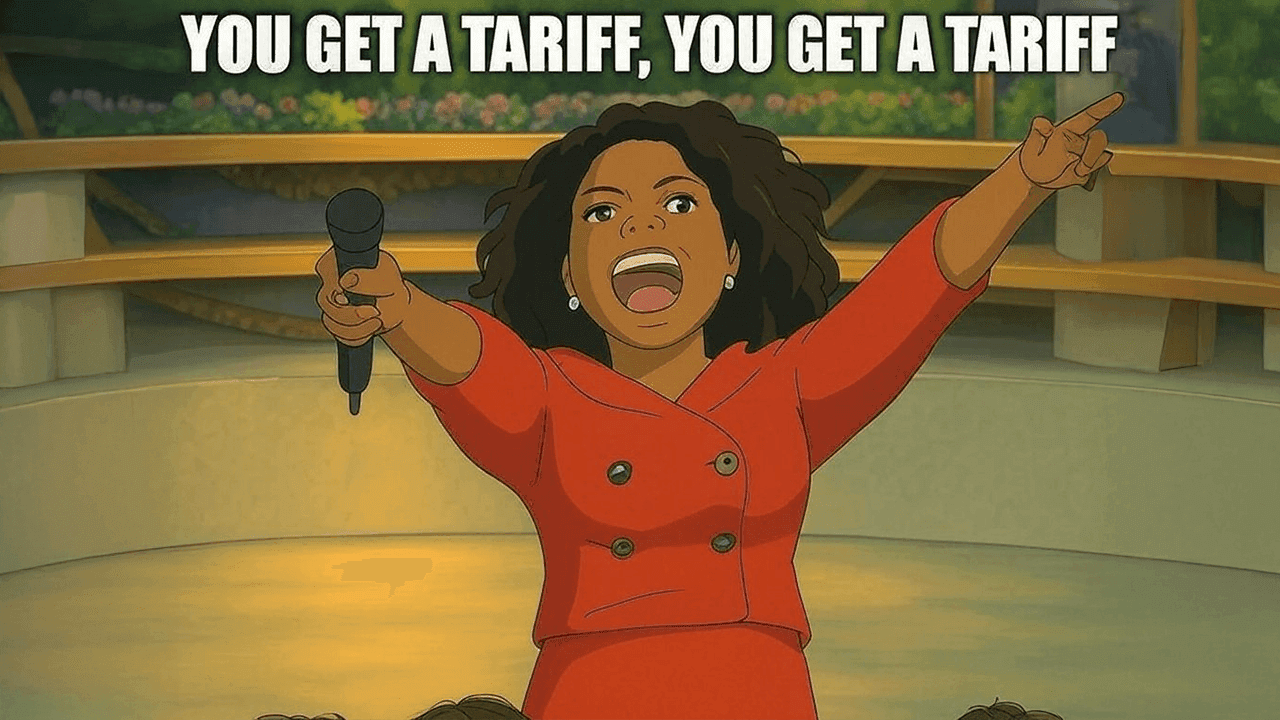
You Get a Tariff!!
WRITTEN BY

SHARE
This editorial is from last week’s edition of the Week in Review newsletter. Subscribe to the weekly newsletter to get the editorial the second it’s finished.
America’s New Potential Tariff Regime
April 2 was Liberation Day in America. The Trump administration announced a sweeping new tariff policy, with most measures set to take effect on April 9. The baseline is a blanket 10% tariff on imports, but a key component of the policy includes “reciprocal tariffs.” The way these reciprocal tariffs have been calculated has already been much maligned. The method takes the U.S. goods trade deficit with a specific country (exports minus imports), divides it by the total value of imports from that country, and then halves that result to set the tariff rate.
For example, with China, the U.S. had a 2024 trade deficit of $295 billion and imported $438 billion in goods. The calculation would be ($295 billion / $438 billion) ≈ 67%, then divided by 2, yielding a tariff of roughly 34%, which aligns with the announced rate.
Once fully implemented, the U.S.-weighted average tariff rate is expected to fall between 23% and 27%, notably higher than the infamous Smoot-Hawley Tariff Act of 1930. Jim Bianco, in a post on X, provided visual context for this:

The day after Liberation Day, April 3, markets plunged as the Dow fell 1,630 points—the worst drop in years. The S&P 500 and Nasdaq saw similar losses, while crypto sank 5.21%, with bitcoin down 6.7%. Wall Street shed $2.85 trillion in value. Meanwhile, Polymarket odds of a U.S. recession jumped from 39% to 49% after the tariff news, with $1.1 million wagered as of Thursday afternoon.
The reaction on Crypto Twitter (CT) and among many in the broader financial punditry could be best characterized as hyperventilating. The fact that not even two full trading days had passed did not stop many from calling for a recession, labeling this as the greatest modern blunder in political history, or even stating that this was the end of American Exceptionalism. I found myself strongly identifying with this post on X about the reaction of many.
The critics of these tariffs might end up being correct, but two days is really a laughable timeframe to be labeling it a failure–or a success. For my part, I think this is likely good for America in the long run, and good for markets in the medium-term. I certainly disagree with people saying this tariff regime is unplanned buffoonery. Treasury Secretary Bessent has been saying over and over that both he and Trump have been laser-focused on bringing down the ten-year Treasury yield, which has been stubbornly high. Look at where it is now.

In the short-term, if these tariffs stick, Arthur Hayes’ prediction he made in my interview might be spot on–we could see the S&P dump to the high 4000s, a 20% correction peak to trough.
While Bitcoin has reacted less negatively to the tariff news than traditional U.S. markets, I’d expect Bitcoin to sell off if the S&P dumps to the 4000s. However, as I stated on this week’s Token Narratives, even if these tariffs in some form or another are here to stay, this can be positive for risk assets. As Joseph Wang, former Federal Reserve employee and current financial pundit, posted on X: “Remember – tariffs are dovish, and big tariffs are very dovish.”
Come May’s FOMC meeting, if tariffs are still around and the economy is justifiably weakened, the expectation of rate cuts will be high. The expectation for multiple rate cuts for the rest of the year will be high. Easing of financial conditions in the U.S. would most likely be good for Bitcoin and other risk assets.