XRP is trading at $3.14 to $3.16 over the past 60 minutes with a market cap of around $187 billion and a 24-hour trading volume of $7.47 billion. The intraday price has fluctuated between $3.12 and $3.32, indicating a narrow trading range amid broader technical signals.
XRP Price Watch: Eyes on $5 Breakout if $3.66 Resistance Falls

This article was published more than a month ago. Some information may no longer be current.
WRITTEN BY

SHARE

XRP
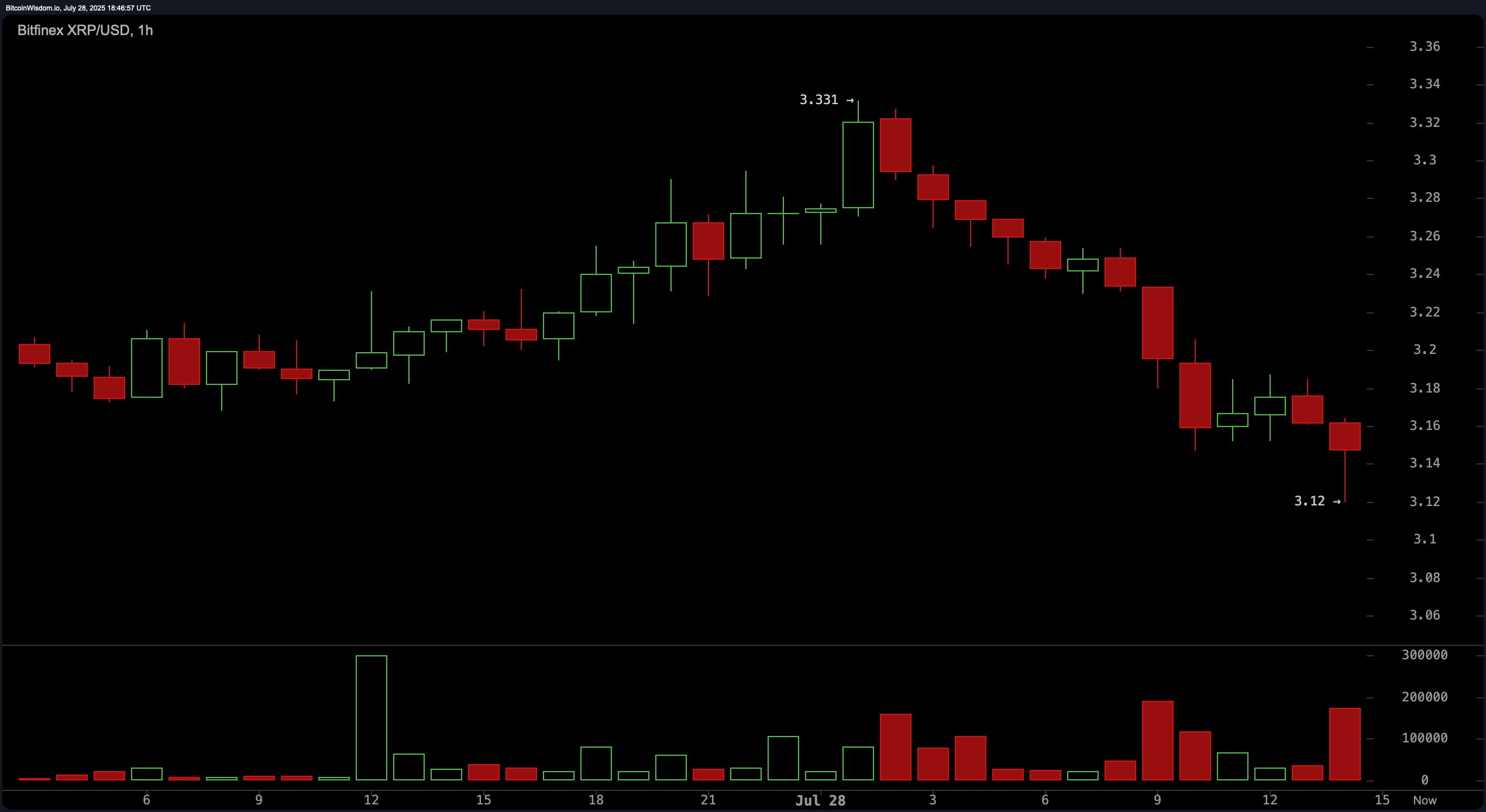
The 1-hour chart reveals XRP is in a short-term downtrend, retreating from $3.331 to $3.12. The chart is characterized by strong bearish candles and modest recovery attempts, highlighting weakening intraday bullish momentum. Immediate support is located at $3.12, a critical level that, if breached, may pave the way for a decline toward $3.00.
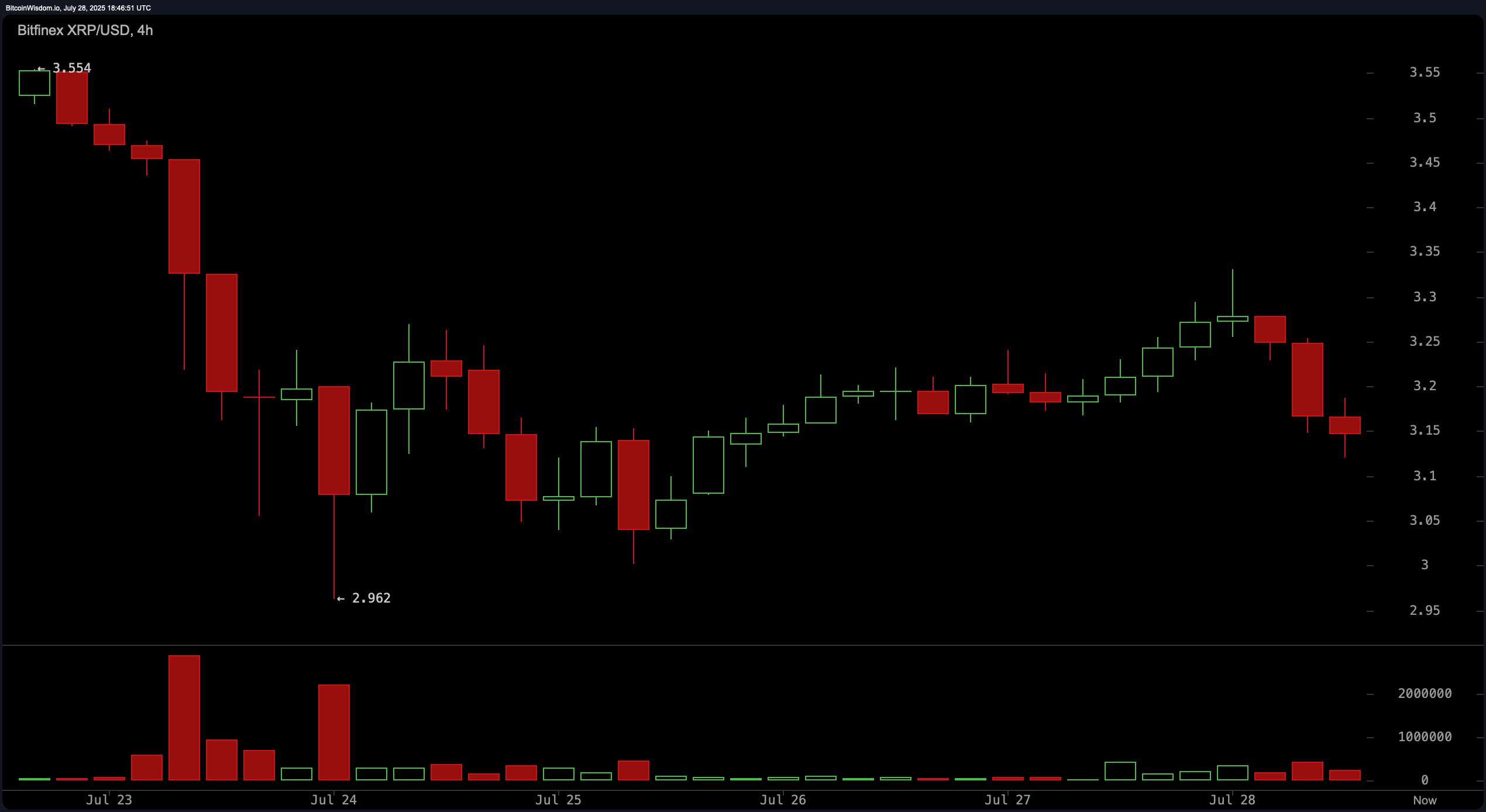
On the 4-hour chart, XRP maintains a bearish stance, with price action declining from $3.55 to a low of $2.96 before staging a mild recovery. The $3.30–$3.35 zone has consistently acted as resistance, with repeated rejections suggesting strong overhead supply. Volume analysis supports a bearish narrative, with sellers dominating recent sessions. Minor support at $3.10 and $3.00 may provide temporary relief, but a convincing break below these levels would likely signal further downside.
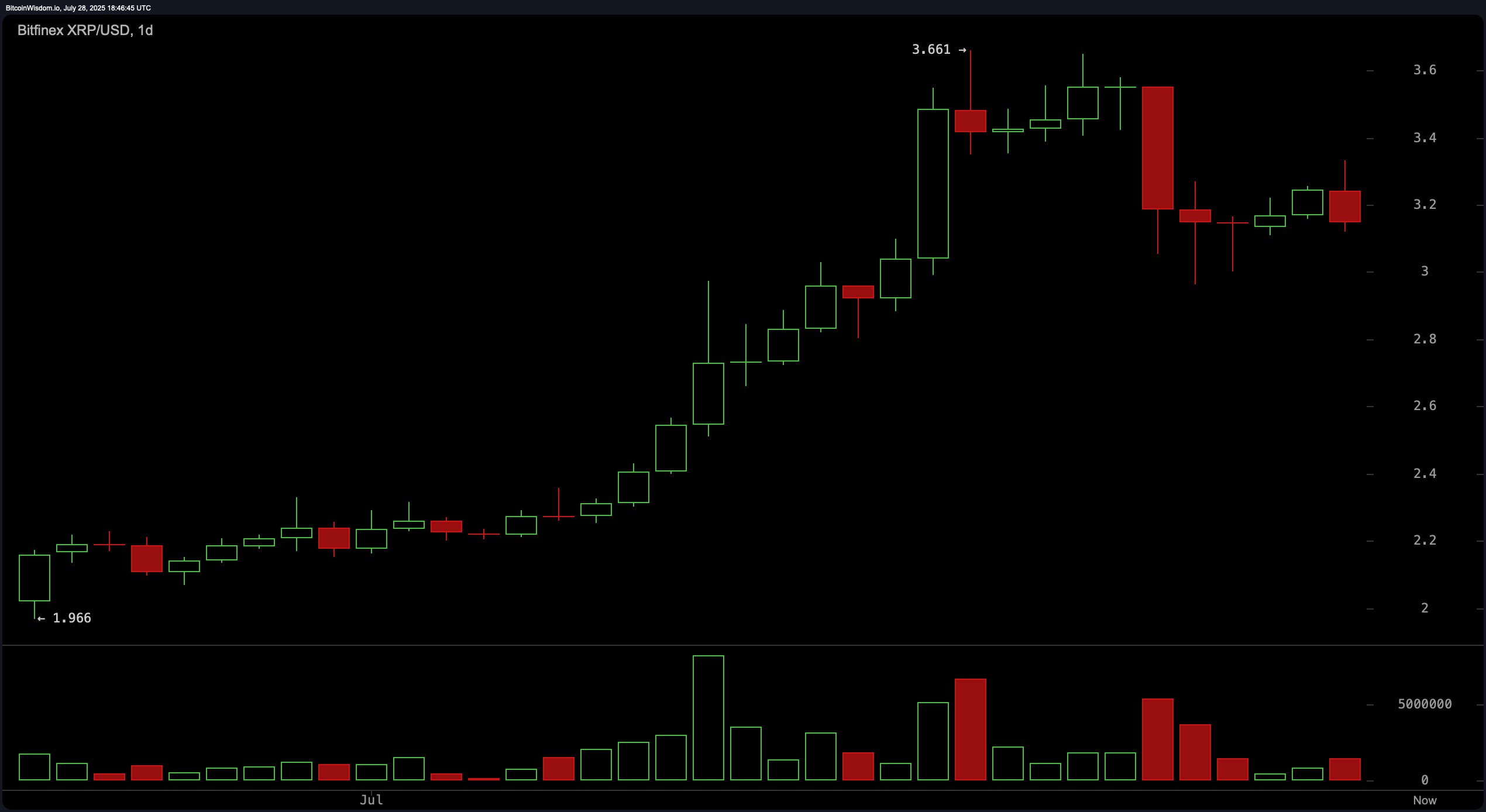
The daily chart shows a broader uptrend extending from approximately $2.00 to a recent high of $3.661, although this has been followed by a sharp correction. Increased volume at the peak could indicate a distribution phase, while the emergence of a bearish engulfing pattern and subsequent red candles point to ongoing selling pressure. Currently, XRP is consolidating within the $3.15–$3.30 band, hovering above key support at $3.00–$3.10. Resistance levels are located at $3.50 and $3.66. Bullish confirmation via a breakout above $3.35, accompanied by strong volume, is essential for any optimistic outlook. A failure to hold $3.00 may lead to a breakdown scenario.
Oscillators are largely neutral, offering no decisive momentum cues. The relative strength index ( RSI) at 58.88, Stochastic at 45.84, commodity channel index (CCI) at 25.31, average directional index (ADX) at 47.34, and the Awesome oscillator at 0.42656 all suggest a lack of clear directional bias. The momentum indicator, however, signals weakness with a value of −0.26665, aligning with a negative signal. The moving average convergence divergence ( MACD) level stands at 0.20821 and also flashes a bearish signal, hinting at continued downward pressure unless a reversal pattern forms.
Moving averages (MAs) present a mixed but increasingly bullish outlook on longer timeframes. Short-term averages, including the Exponential Moving Average (EMA) (10) at $3.20141 and the Simple Moving Average (SMA) (10) at $3.30160, are indicating sell signals, consistent with the current price being below these levels. However, the medium- and long-term moving averages such as the EMA (20) at $3.06266, SMA (20) at $3.10491, EMA (30) at $2.92032, and SMA (30) at $2.81670 all signal a buy. The longer-term trend remains intact, supported by the EMA (50) at $2.73167, SMA (50) at $2.55909, EMA (100) at $2.52586, and SMA (100) at $2.41559. This suggests that while short-term weakness persists, structural strength is still present in the broader market context.
Bull Verdict:
XRP’s broader trend remains structurally bullish, supported by strong buy signals from mid- to long-term moving averages and prior gains from the $2.00 level. If the asset can reclaim the $3.30–$3.35 resistance with volume confirmation, it may resume its upward trajectory toward the $3.50 and $3.66 targets. Momentum indicators will need to shift positively for this scenario to materialize, but underlying strength remains intact.
Bear Verdict:
XRP’s recent price action is tilted toward the bearish side, with consistent rejections at key resistance levels, declining short-term momentum, and sell signals from both the momentum and MACD indicators. A failure to hold support at $3.10 or $3.00 could open the door to further losses, possibly testing sub-$2.95 levels. Until bulls decisively reclaim control, the risk-reward favors short-side strategies.