It’s not clear if all derivative assets that require bitcoin as collateral are fully backed as many assume.
Wrapped Bitcoin Derivatives: Concerns Around Lack of Transparency Emerge

This article was published more than a year ago. Some information may no longer be current.
WRITTEN BY

SHARE

Is the Bitcoin Derivative Asset Market Built on a House of Cards?
Some bitcoin ( BTC) derivatives that claim to be fully backed by the cryptocurrency could be on shaky ground, according to a blog post by Bitcoin research and media firm LX Research.
Most of these assets are in the form of BTC-pegged derivative tokens – representations of native BTC on other blockchains such as Ethereum – a $30 billion market (only accounting for the thirty-eight assets LX Research currently tracks).
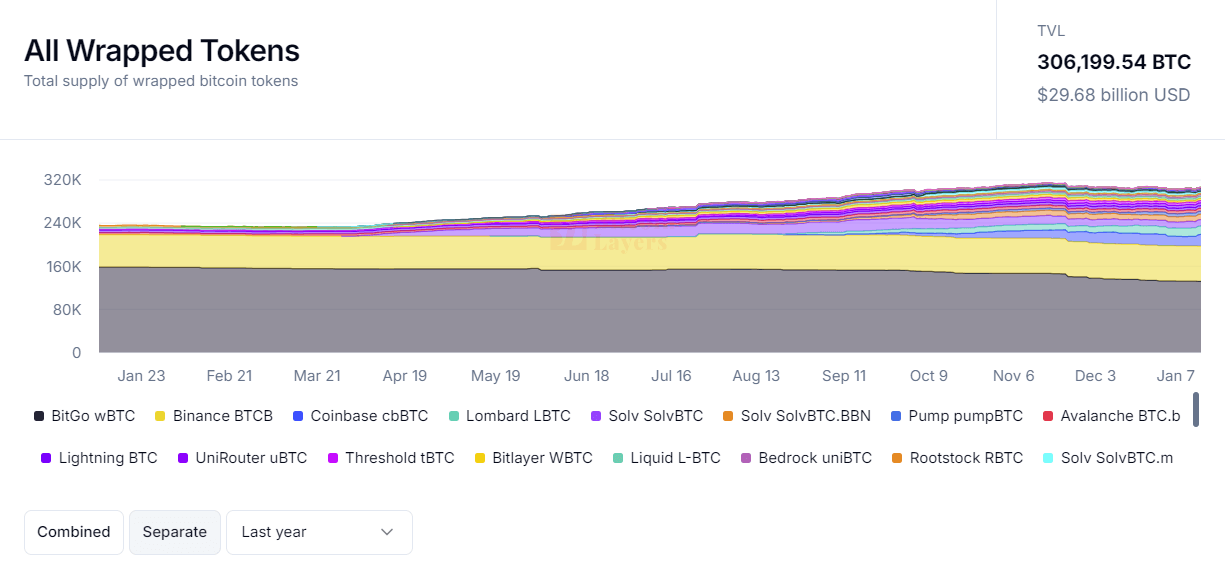
The term “wrapped bitcoin” typically refers to a token issued to users after they deposit a corresponding amount of native BTC with a custodian. The token can then be used for various decentralized finance (defi) purposes such as lending. Users can later return the wrapped token to the issuer and retrieve their bitcoin, after which, the token is burned.
For the model to work, the wrapped token should be fully backed by bitcoin on a 1:1 basis. But what happens when custodians and merchants start to rehypothecate collateral or start issuing wrapped tokens backed by other derivative assets instead of bitcoin? The result could be a bank run, according to LX Research writer Janus.
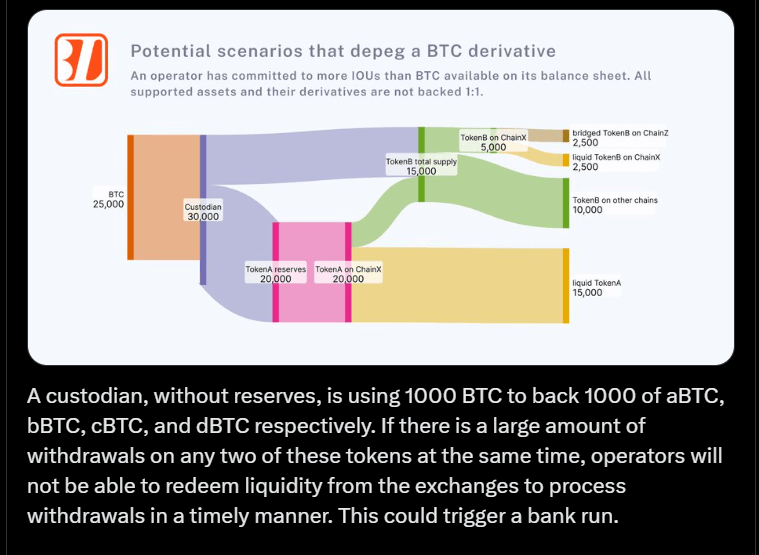
“We’re not sure if all BTC-derivative assets are fully backed,” Janus wrote. He also posted a scenario on X where a custodian mints multiple tokens without sufficient collateral.
“If there is a large number of withdrawals on any two of these tokens at the same time, operators will not be able to redeem liquidity from the exchanges to process withdrawals in a timely manner, Janus explained. “This could trigger a bank run.”
He also noted that the wrapped bitcoin market suffers from centralization risk where multiple projects share the same custodian.
“It’s clear that a number of these protocols are using centralized custodians to ensure that their assets are backed 1:1. And a number of these projects are sharing the same custodian(s),” Janus said.
But there’s more – Janus explains that there’s been an explosion of wrapped tokens in the past year. Many of them are not backed by native BTC, but rather, collateralized by other wrapped tokens, creating a house of cards.
“Projects are not simply using native BTC to fully back their assets. Other derivative assets, such as cbBTC [Coinbase wrapped BTC] and wBTC [BitGo wrapped BTC], are being used as reserve assets for newer derivatives,” Janus explained. “This compounds custodian risk. If a wrapped reserve asset became unbacked, then all of the assets that it backs would also become unbacked.”
Janus posed other questions that require clarity – is the total value locked (TVL) for these assets accurate or fake? Do projects control the native bitcoin backing their wrapped tokens?
To help answer this question, Janus said LX Research is developing a framework for wrapped derivative assets that will be available in matter of days.
“Users of BTC-backed tokens and protocols should understand the risks when interacting with specific assets,” Janus said. “We will be releasing a full framework and corresponding reviews in the coming days.”