Wells Fargo has filed a U.S. trademark for “WFUSD,” a move that signals the banking giant may be preparing to expand deeper into cryptocurrency trading, payments, and blockchain-based financial infrastructure.
Wells Fargo 'WFUSD' Trademark Filing Sparks Speculation About New Bank Stablecoin
WRITTEN BY

SHARE

Wells Fargo Trademark for WFUSD Suggests Major Bank Push Into Crypto Payments
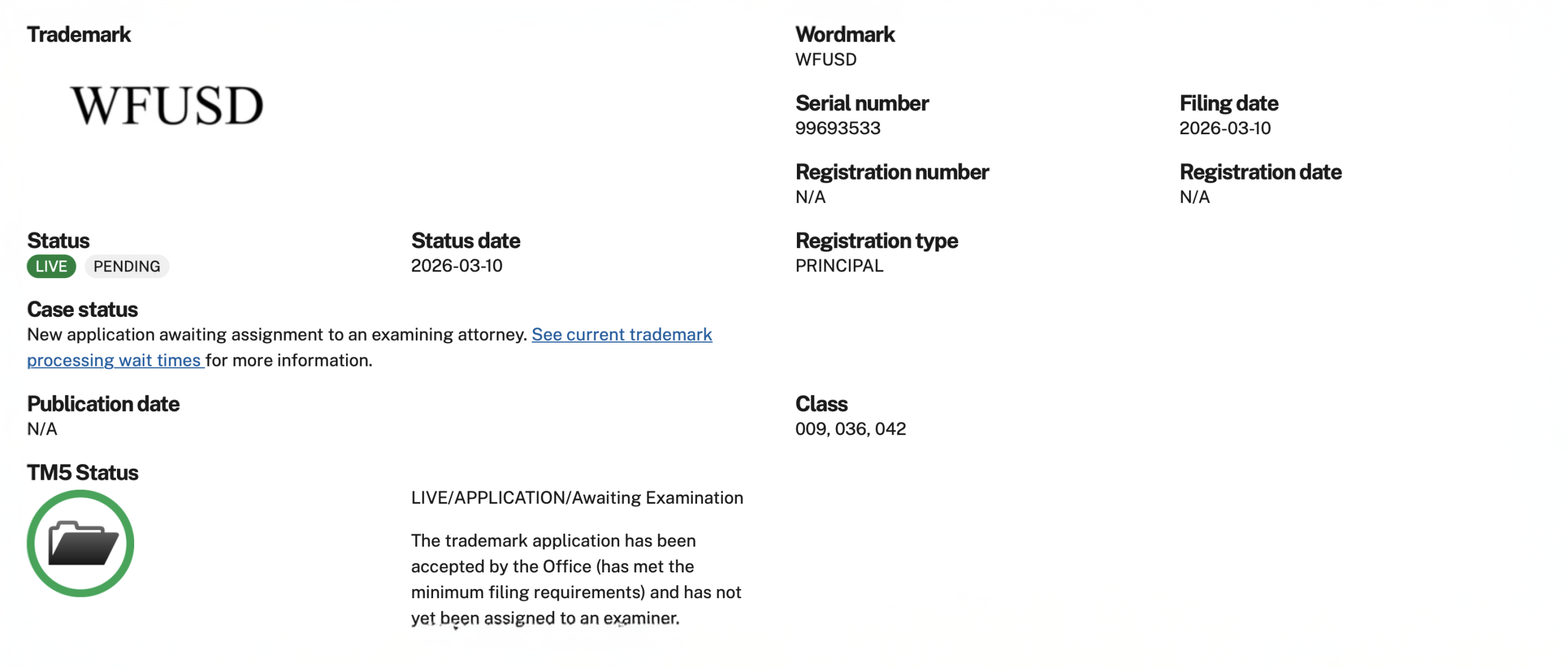
The trademark application, submitted around March 9–10 and appearing publicly in U.S. Patent and Trademark Office records early March 11, covers a wide range of digital asset services, including cryptocurrency payments, trading platforms, tokenization tools, digital wallets, and staking infrastructure. The filing lists Wells Fargo & Company as the applicant and carries the serial number 99693533.
The mark itself is a standard character word mark — meaning there are no design elements or stylized logos attached — but the name has already sparked speculation across financial and crypto circles. Industry observers say the acronym strongly resembles naming conventions used for U.S. dollar–pegged stablecoins, suggesting the bank could be exploring a Wells Fargo–branded digital dollar product.
Trademark filings, however, are often precautionary and do not guarantee a product launch. Wells Fargo has not publicly commented on the application.
According to summaries compiled from the filing, the trademark spans three international classes covering software, financial services, and technology infrastructure. In practical terms, that means the filing touches nearly every corner of the modern digital asset stack — from blockchain software and wallet tools to cryptocurrency trading services and tokenized financial products.
The software category includes downloadable applications designed for digital asset trading, payments, and wallet functionality, as well as blockchain-related software capable of processing stablecoin transactions and other crypto-based payments.
Financial services listed in the filing are equally expansive. They include cryptocurrency exchange services, brokerage for digital asset trading, payment processing for virtual currencies, blockchain-based transaction settlement, staking services, and financial data feeds used by smart contracts.
A third category focuses on technology infrastructure, including software-as-a-service platforms designed for tokenizing assets, running blockchain-based trading networks, and providing encryption, authentication, and data storage services for decentralized applications.
The breadth of the filing suggests Wells Fargo is considering more than just a digital payment token. Instead, the application outlines a potential ecosystem that could support trading, settlement, and tokenization services within a regulated banking environment.
If WFUSD ultimately becomes a stablecoin, it would place Wells Fargo among a growing group of financial institutions exploring tokenized dollars and blockchain-based payments. Stablecoins such as USDC and USDT currently dominate the sector, while Paypal launched its own dollar-backed token, PYUSD, in 2023.
Wells Fargo has quietly experimented with blockchain technology for several years. In 2019, the bank launched a pilot program known as Wells Fargo Digital Cash — a tokenized deposit system built on the R3 Corda blockchain that was designed to facilitate internal cross-border transfers.
The bank has also made strategic investments in the digital asset sector. In 2020 it backed blockchain analytics firm Elliptic, and in 2022, it participated in a funding round for institutional crypto trading platform Talos. Meanwhile, a 2025 report from the Wells Fargo Investment Institute described digital assets as “investable,” highlighting their potential to diversify traditional portfolios.
Reports in 2025 also indicated Wells Fargo participated in discussions with other major banks about a joint stablecoin initiative. Institutions involved in those talks reportedly included JPMorgan, Bank of America, and Citigroup — all exploring tokenized settlement tools or blockchain payment systems.
The WFUSD trademark filing arrives at a moment when U.S. banks are cautiously re-entering the crypto sector following several years of regulatory uncertainty. Lawmakers in Washington have been debating new stablecoin legislation aimed at establishing clearer oversight frameworks for dollar-pegged digital tokens.
As a federally regulated bank, any publicly issued stablecoin from Wells Fargo would likely require approval or supervision from regulators, including the Federal Reserve and the Office of the Comptroller of the Currency (OCC).
The trademark application is still in its earliest stage. It has met minimum filing requirements but has not yet been assigned to an examining attorney at the USPTO. If the process proceeds without complications, registration could take a year or more, depending on review timelines and proof of commercial use.

What Are Stablecoins? A Simple Explanation of the Digital Asset Bridging Crypto and Fiat
Stablecoins occupy a unique space within the realm of finance, straddling the worlds of traditional and cryptocurrency finance. These digital…
Read Now

What Are Stablecoins? A Simple Explanation of the Digital Asset Bridging Crypto and Fiat
Stablecoins occupy a unique space within the realm of finance, straddling the worlds of traditional and cryptocurrency finance. These digital…
Read NowWhat Are Stablecoins? A Simple Explanation of the Digital Asset Bridging Crypto and Fiat
Read NowStablecoins occupy a unique space within the realm of finance, straddling the worlds of traditional and cryptocurrency finance. These digital…
For now, WFUSD remains a filing rather than a product. Still, the move indicates Wells Fargo is positioning itself for a financial system where blockchain networks, tokenized assets, and digital dollars increasingly intersect with traditional banking rails.
In other words, the old guard of finance appears to be inching onto the blockchain — one trademark application at a time.
FAQ 🔎
- What is WFUSD?
WFUSD is a trademark filed by Wells Fargo that appears to cover cryptocurrency payments, trading platforms, tokenization services, and blockchain infrastructure. - Is Wells Fargo launching a stablecoin?
The trademark suggests that possibility, but the bank has not confirmed any stablecoin or crypto product tied to the WFUSD name. - When was the WFUSD trademark filed?
USPTO records show the application was submitted around March 9–10, 2026 and appeared publicly March 11. - What crypto services does the WFUSD filing include?
The filing references digital wallets, crypto trading, staking, blockchain payment systems, and software platforms for tokenizing financial assets.