It was a split week for crypto exchange-traded funds (ETFs) as bitcoin funds stormed back into positive territory with a combined $446 million in net inflows for the week. On the other hand, ether products extended their losing streak with $244 million in net outflows, as investor sentiment remained cautious.
Weekly ETF Report: Bitcoin ETFs Rebound With $446 Million as Ether Funds Bleed

This article was published more than a month ago. Some information may no longer be current.
WRITTEN BY

SHARE

Crypto ETFs Split: Bitcoin Roars Back, Ether Stays in the Red
Bitcoin ETFs: Weekly Net Inflow – $446 Million
Bitcoin ETFs concluded the past week on a high note, with inflows spread across most issuers and strong participation from institutions. Blackrock’s IBIT was once again the dominant force, leading all funds with an impressive $324.34 million in weekly inflows as institutional appetite remained robust.
Ark & 21shares’ ARKB followed as a major contributor, pulling in $53.97 million to extend its midweek surge. Fidelity’s FBTC also delivered a solid performance, adding nearly $52.40 million in net inflows. Bitwise’s BITB and Vaneck’s HODL chipped in with $39.55 million and $38.57 million each, continuing their streak of consistent entries.
Grayscale’s Bitcoin Mini Trust brought in about $24.64 million, a modest but positive weekly inflow for the fund. Invesco’s BTCO and Franklin Templeton’s EZBC each posted smaller but steady gains, contributing $18.86 million and $6.48 million, respectively. Wrapping up the week was Valkyrie’s BRRR with $4.67 million net weekly inflow.
The week’s only setback was Grayscale’s GBTC, which recorded $117.11 million in redemptions. Bitcoin ETFs closed the week firmly positive with $25.87 billion traded and $149.96 billion in net assets, underscoring renewed strength after the previous week’s net loss of $1.2 billion.
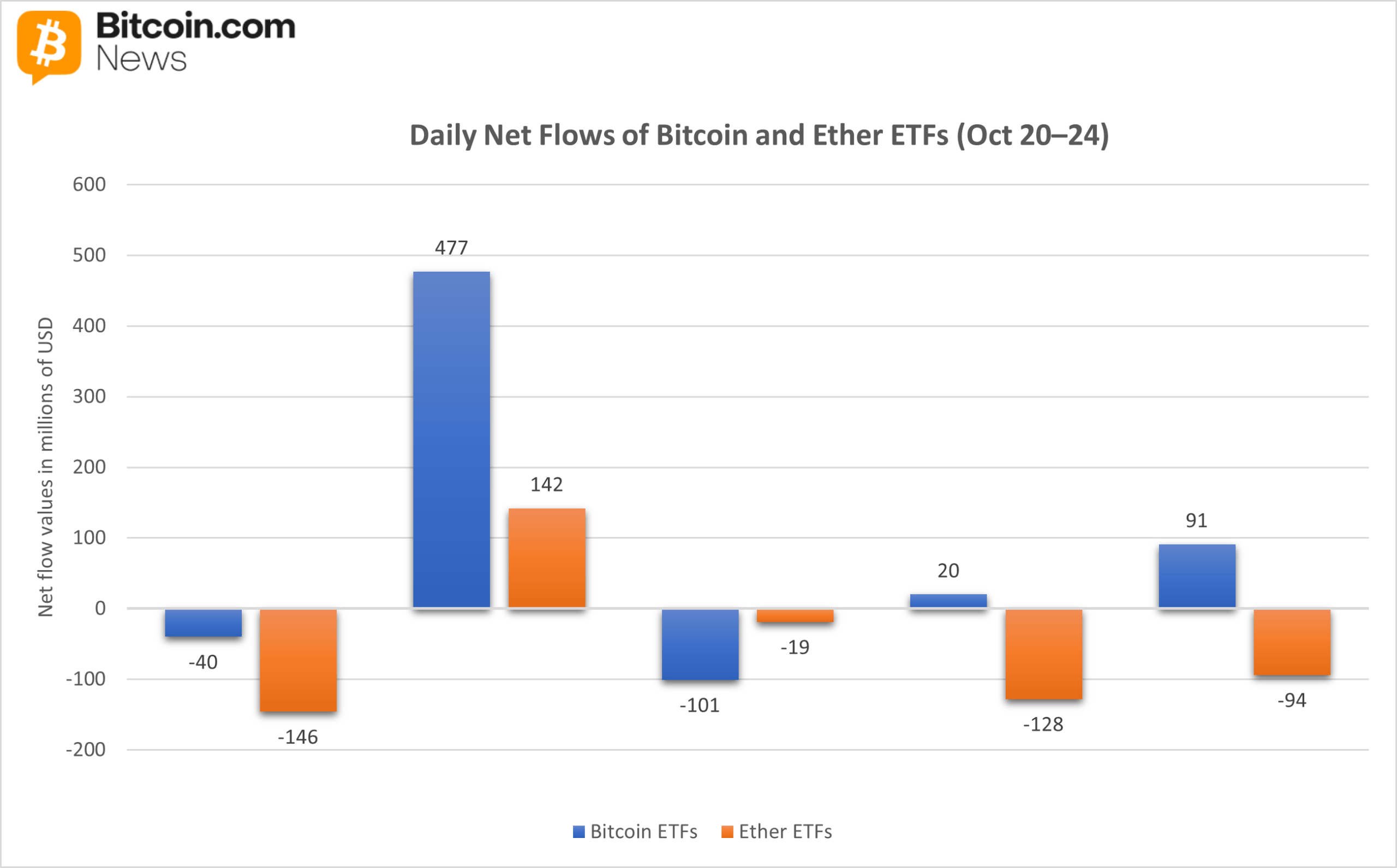
Ether ETFs: Weekly Net Outflow – $244 Million
Ether ETFs, on the other hand, faced a week of across-the-board redemptions with no fund closing in the green.
Fidelity’s FETH led the outflows with a heavy $95.25 million exit, continuing its recent trend of investor withdrawals. Blackrock’s ETHA followed with $89.03 million in redemptions, erasing the prior week’s gains.
Both Grayscale’s ETHE and its Ether Mini Trust struggled as well, with $26.03 million and $23.50 million in weekly exits, respectively, reflecting persistent selling pressure. Bitwise’s ETHW saw another $8.85 million drain, while Vaneck’s ETHV lost $1.25 million.
Despite healthy trading volumes of $10.88 billion, ether ETFs ended the week with net assets slipping to $26.39 billion, signaling ongoing rotation away from ethereum exposure.
Market Takeaway
The week of October 20–24 reflected a deepening divergence between bitcoin and ether sentiment. Investors appeared to renew confidence in bitcoin’s market stability, while ether funds remained under pressure from sustained redemptions. With macro conditions tightening and bitcoin maintaining dominance, the flow gap between the two asset classes continues to widen, a trend closely watched by ETF analysts heading into late October.
FAQ 💸
- Why did bitcoin ETFs see strong inflows this week?
Bitcoin ETFs attracted $446 million in net inflows as institutional demand rebounded, led by Blackrock’s IBIT. - Why are ether ETFs still facing outflows?
Ether funds lost $244 million as investors continued rotating out amid cautious market sentiment. - Which issuers led ETF activity this week?
Blackrock, Ark & 21Shares, and Fidelity drove bitcoin inflows, while Fidelity and Blackrock led ether redemptions. - What does this mean for the crypto market?
The widening flow gap shows investors favoring bitcoin’s stability over ether’s weaker near-term momentum.