Ethereum co-founder Vitalik Buterin is calling for a new generation of decentralized autonomous organizations ( DAOs) that move beyond token-holder voting, arguing that today’s dominant DAO model is inefficient, fragile, and prone to political capture.
Vitalik Buterin Says DAOs Need a Rethink Beyond Token-Holder Voting
WRITTEN BY

SHARE

Buterin Pushes for Smarter DAOs That Move Past Simple Token Voting
Buterin laid out his critique in a detailed post on X, writing, “We need more DAOs — but different and better DAOs,” while warning that the concept has narrowed into “a treasury controlled by token holder voting,” a structure he said merely “works” rather than solves deeper governance problems.
According to Buterin, token-based governance has proven vulnerable to manipulation, particularly in systems that rely on subjective decisions. He noted that whales can influence outcomes and that “a token-based oracle cannot have a cost of attack higher than its market cap,” making it ill-suited to secure high-value systems without extracting excessive economic rent.
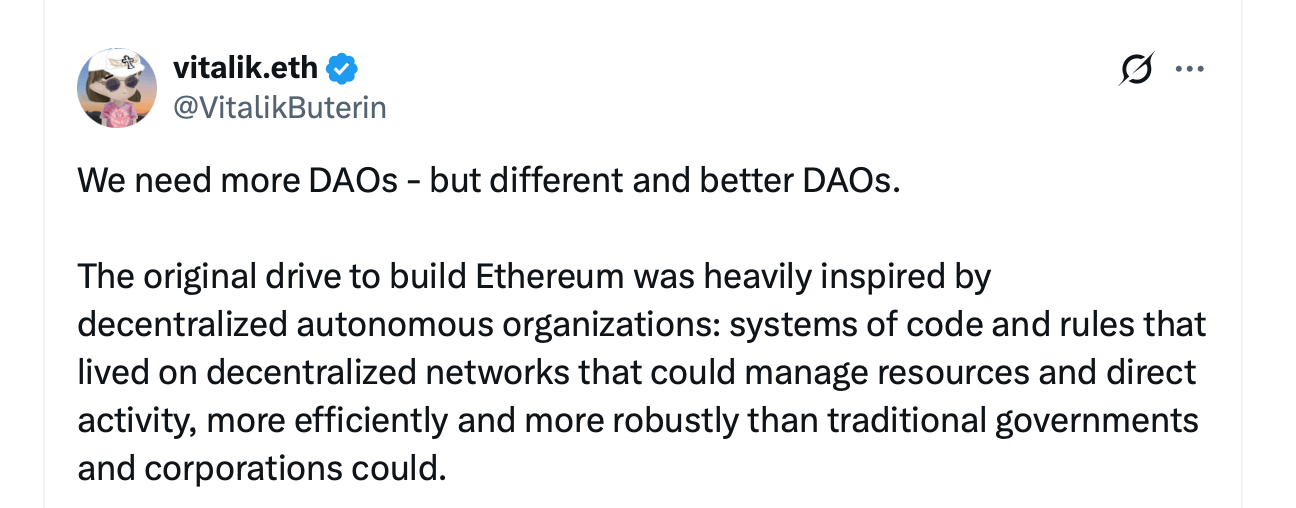
Buterin argued that better DAOs are essential infrastructure, especially for oracles, onchain dispute resolution, and curated lists such as approved applications, interfaces, and contract addresses. He also pointed to DAOs as practical tools for quickly launching short-term projects and sustaining long-term maintenance when original teams step away.
To frame the problem, Buterin leaned on his “convex versus concave” decision-making model, suggesting that different governance challenges require different structures. Concave problems benefit from broad participation and compromise, while convex problems demand decisive leadership kept in check by decentralized safeguards.
Also read: Bitcoin and Ether ETFs Post $1.9 Billion Weekly Inflow Despite Late Pullback
He also flagged two structural hurdles that plague DAO governance today: privacy and decision fatigue. Without privacy, he warned, governance becomes “a social game,” while constant voting leads to declining participation over time. According to data compiled by deepdao.io, the combined treasury holdings of DAOs currently total $13.6 billion, with Mantle topping the list by balance sheet size.
Looking ahead, Buterin said advances in zero-knowledge proofs, carefully constrained artificial intelligence, and improved communication tools could unlock a governance renaissance — provided DAOs are designed with social coordination in mind, not just code. “In all cases, we need new designs,” he wrote, adding that governance, communication, and tooling deserve equal weight.
FAQ ❓
- What is Vitalik Buterin criticizing about current DAOs?
He says most DAOs rely on token-holder voting that is inefficient, vulnerable to capture, and overly political. - Why does Buterin say token voting is risky?
He argues whales can manipulate outcomes and that token-based systems cap security at their market value. - What kinds of DAOs does Buterin want to see?
DAOs focused on oracles, dispute resolution, curated lists, and long-term project maintenance. - How could future DAOs improve governance?
By using privacy tools, reducing decision fatigue, and designing systems that support human judgment rather than replacing it.