


The U.S. government transferred nearly 4,000 bitcoin to Coinbase Prime on July 13, raising questions about whether the roughly $250 million movement reflected custody management, administrative consolidation, or preparations for a sale.
US Government Moves Nearly 4,000 BTC to Coinbase Prime, Onchain Data Shows
WRITTEN BY

SHARE

Key Takeaways
- U.S. government-linked wallets transferred nearly 4,000 bitcoin, worth approximately $250 million, to Coinbase Prime on July 13.
- Arkham linked the largest movements to bitcoin seized in the Ryan Farace and BTC-e federal cases.
- Coinbase Prime supports custody and trading, so the transfers do not prove the government sold the bitcoin.
Why Did Nearly 4,000 Government-Held Bitcoin Move on July 13?
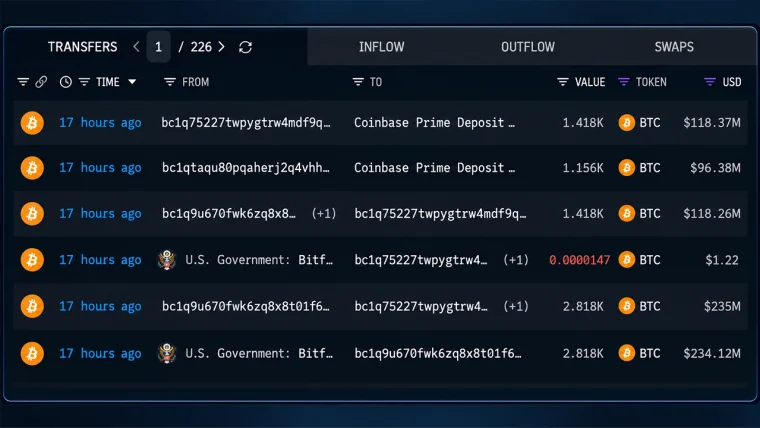
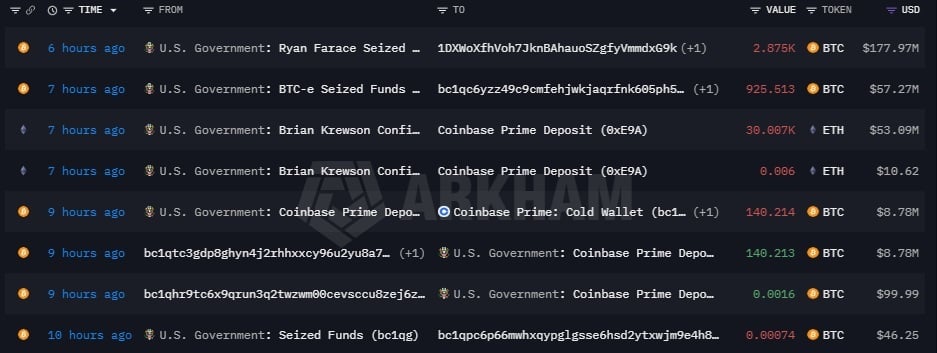
Arkham Intelligence data showed U.S. government-linked wallets transferring nearly 4,000 bitcoin to Coinbase Prime, the firm’s crypto brokerage for institutional investors, in several transactions on July 13. The combined assets were valued at roughly $250 million during the activity. The movement placed federally controlled bitcoin inside infrastructure supporting institutional custody and trading.
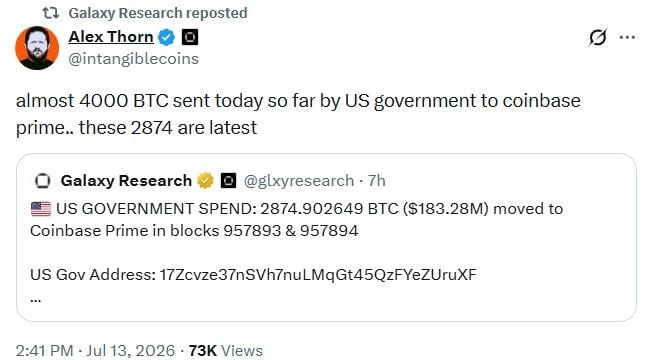
Galaxy Digital head of research Alex Thorn highlighted the transfers on X after they appeared in Arkham Intelligence data, drawing wider attention to the government’s on-chain activity.
The largest transfers included approximately 2,875 BTC labeled by Arkham as “Ryan Farace Seized Funds” and about 926 BTC identified as “BTC-e Seized Funds.” Another transfer moved about 140 BTC into Coinbase Prime, bringing the day’s observed bitcoin transfers to around 3,941 BTC. Arkham assigns those descriptions through blockchain tracing and public records.
Farace’s attribution closely matches the 2,874.90419597 BTC federal agents seized in 2021. Prosecutors said Ryan Farace, also known as “Xanaxman,” and his father attempted to launder bitcoin derived from drug trafficking. Authorities separately seized another 58.742155166 BTC connected to Farace.
BTC-e operated from 2011 until law enforcement closed the cryptocurrency exchange in 2017. The Justice Department said the platform processed more than $9 billion in transactions and handled proceeds linked to hacking, ransomware, identity theft, narcotics trafficking, and other crimes. Alexander Vinnik, one of BTC-e’s operators, pleaded guilty in 2024 to conspiracy to commit money laundering.
Did the Government Already Authorize a Sale?
A federal forfeiture notice published in January 2024 announced the government’s intention to dispose of approximately 2,933.64 BTC connected to the Farace proceedings. That total combined the roughly 2,875 BTC seizure with the additional 58.74 BTC. The notice also opened a period during which third parties could assert legal interests in the forfeited property.
The notice indicates that the government had begun the legal process required to dispose of the Farace-linked assets. It strengthens the possibility that the July 13 transfer relates to an authorized sale. However, legal authority to dispose of property and a transfer into Coinbase Prime do not establish that a market sale occurred.
Why Was Brian Krewson’s Name Attached to the Ether?
The activity also included approximately 30,007 ether from an address labeled “Brian Krewson Confiscated Funds.” The label does not establish that Krewson owned the assets or was charged or convicted in connection with them. A Justice Department civil forfeiture complaint alleged that he managed wallets holding cryptocurrency tied to Christopher Castelluzzo and Luke Atwell while they were incarcerated.
The complaint alleged that Castelluzzo and Atwell used narcotics proceeds to purchase 30,000 ether for about $9,000. It said Krewson maintained access to the assets on their behalf. The action sought forfeiture of the cryptocurrency itself and did not charge Krewson with a crime.
Does the Coinbase Prime Transfer Signal a Sale?
The Coinbase Prime transfer, by itself, does not confirm a sale. Coinbase announced in July 2024 that the U.S. Marshals Service selected Coinbase Prime to provide custody and advanced trading services for the agency’s centrally managed large-cap digital assets. The Marshals Service administers assets seized and forfeited through the Justice Department’s Asset Forfeiture Program.
Coinbase Prime’s dual role makes it a logical destination for bitcoin the government plans to hold, manage, or dispose of. Confirmation of a sale would require an agency announcement, disposal record, identifiable distribution to buyers, or other evidence showing that trades were executed. Arkham attributed 328,225 BTC, worth more than $20 billion at the time of writing, to U.S. government-linked wallets.

The U.S. government controls nearly $23 billion in bitcoin, making it one of the world’s largest holders as massive seizures…
Read Now: US Government Holds 328,372 BTC as Onchain Data Confirms $23B Federal Crypto Stockpile