U.S. banking rules on bitcoin face mounting scrutiny as Strategy CEO Phong Le urges regulators to revisit Basel capital standards, warning current risk weights could hinder America’s ambitions to lead the global digital asset market.
Strategy CEO Calls for Rethink of Basel’s 1,250% Bitcoin Risk Capital Treatment
WRITTEN BY

SHARE

Strategy CEO Warns 1,250% Bitcoin Treatment by Basel Could Undermine America’s Crypto Ambitions
Strategy (Nasdaq: MSTR) CEO Phong Le shared on social media platform X on Feb. 19 a call for U.S. regulators to review Basel capital rules. He pointed to bitcoin’s 1,250% risk weight under Basel III standards. Le argued that this capital treatment materially affects how banks handle the asset.
He wrote:
“The Basel Accords set global bank capital standards and risk-weighting rules for assets. These frameworks materially shape how banks engage with digital assets, including bitcoin.”
Le added: “They are developed by the Basel Committee of central banks and regulators across 28 jurisdictions — the US is just one.” He further stated: “If the US wants to be the Crypto Capital of the World, our implementation of Basel capital treatment deserves careful review.”
His comments responded to Chief Risk Officer Jeff Walton of Strive, who also shared on X: “If the US wants to be the ‘ crypto capital’ of the world, the banking regulations need to change. Risk is mispriced.”
A chart shared by Walton illustrates Basel III-style risk weights under a standardized U.S. approach. It listed cash, physical gold, and sovereign debt at 0%. Investment-grade corporate debt ranged from 20% to 75%, while unrated corporate loans were shown at 100%. High-yield corporate debt carried a 150% weight. Public equity ranged from 250% to 300%, and private equity was listed at 400% or more. Bitcoin, categorized as unsecured crypto exposure, was shown at 1,250%, the highest level on the chart.
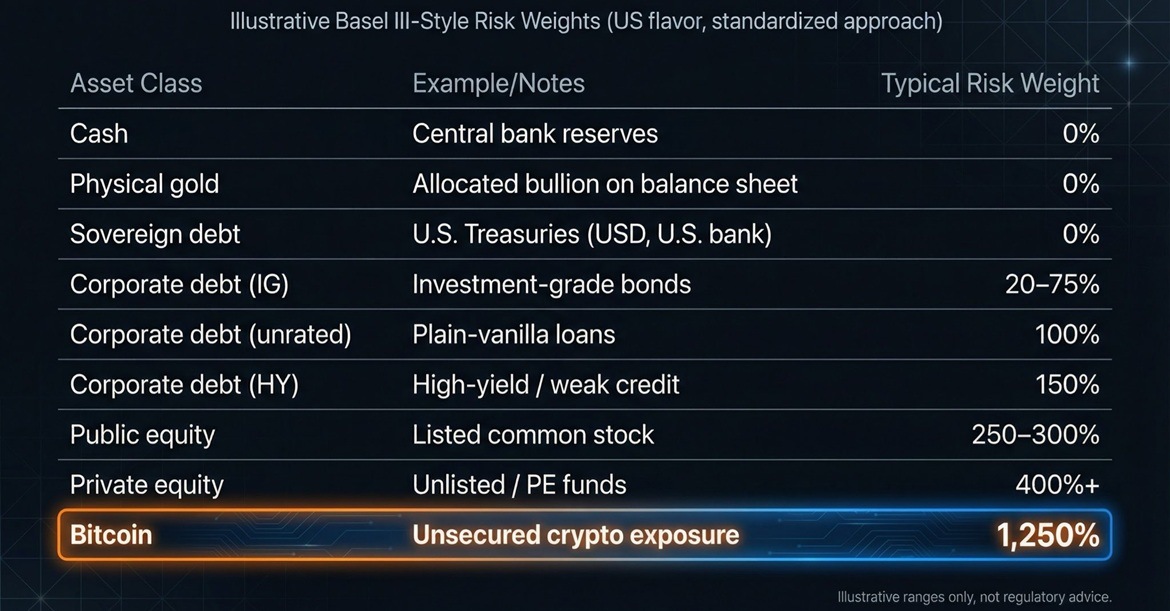
Under current Basel guidance, higher risk weights require banks to hold proportionally more regulatory capital against specific assets. This affects balance sheet allocation and return on equity. A 1,250% risk weight significantly increases capital charges relative to traditional asset classes. That treatment can limit banks’ willingness to hold bitcoin directly or expand custody, trading, and lending services tied to digital assets.
Supporters of reassessment argue that market infrastructure, custody solutions, and institutional participation have matured. Others emphasize price volatility, liquidity dynamics, and operational considerations as reasons for conservative standards. The debate reflects broader policy questions about financial stability and the United States’ ambitions in the global digital asset market.

Michael Saylor Tells Ray Dalio: If World Order Breaks Down, Own Bitcoin
Strategy Executive Chairman Michael Saylor told billionaire Ray Dalio to own bitcoin after the billionaire warned the post-World War II…
Read Now

Michael Saylor Tells Ray Dalio: If World Order Breaks Down, Own Bitcoin
Strategy Executive Chairman Michael Saylor told billionaire Ray Dalio to own bitcoin after the billionaire warned the post-World War II…
Read NowMichael Saylor Tells Ray Dalio: If World Order Breaks Down, Own Bitcoin
Read NowStrategy Executive Chairman Michael Saylor told billionaire Ray Dalio to own bitcoin after the billionaire warned the post-World War II…
FAQ ⏰
- Why is Phong Le calling for a review of Basel capital rules?
He argues that current Basel risk-weighting standards materially affect how U.S. banks handle bitcoin and digital assets. - How do Basel risk weights impact banks’ bitcoin exposure?
Higher risk weights increase the capital banks must set aside, discouraging bitcoin holdings and related services. - What comparison did Jeff Walton highlight about bitcoin’s risk weight?
He cited gold at 0%, public equity at 300%, and bitcoin at 1,250% under current regulatory treatment. - Why does the Basel debate matter for the U.S. crypto market?
It shapes domestic banking requirements that influence America’s competitiveness in the global digital asset market.