


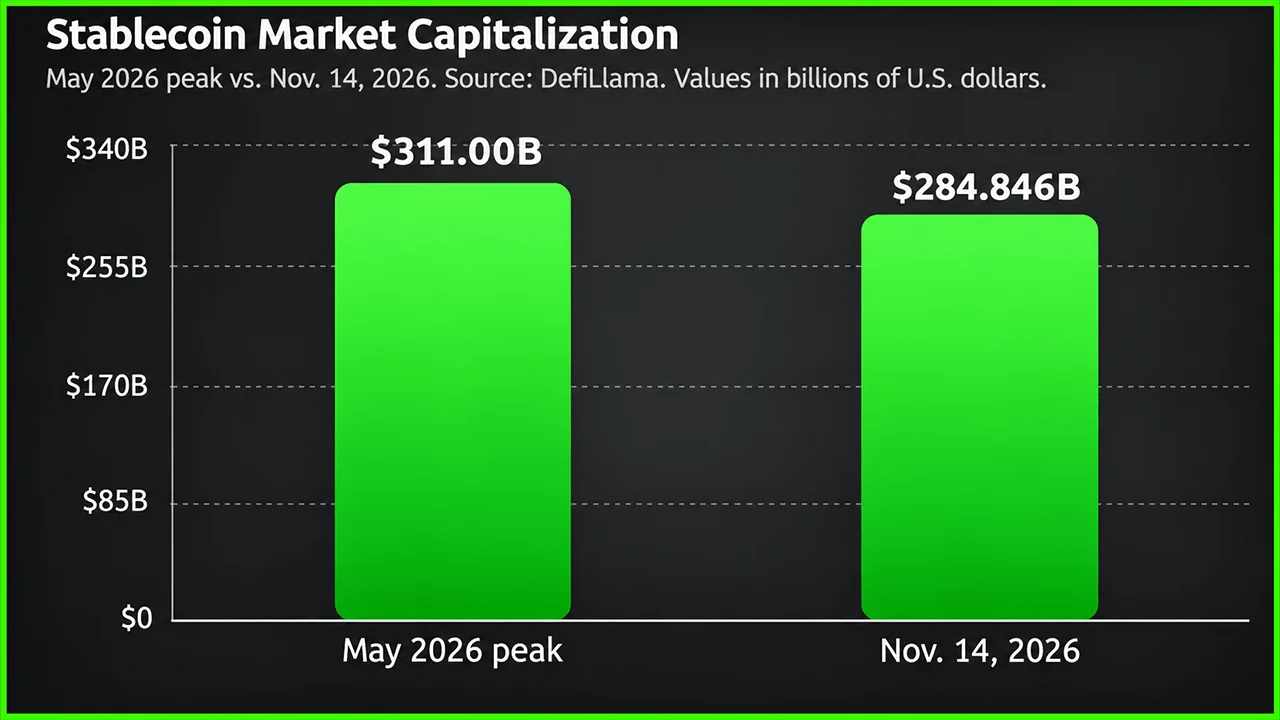
The stablecoin economy has surrendered $26.15 billion since its May 2026 peak, while tokenized U.S. Treasury funds are also contracting. Market data captured by Bitcoin.com News on Saturday, Nov. 14, reveals mounting pressure across two important segments of blockchain-based dollar liquidity, raising questions about available capital and dry powder.
2022 Vibes: $26 Billion Vanishes From Stablecoin Market Since May Peak
WRITTEN BY

SHARE
Key Takeaways
- Stablecoin capitalization has fallen 8.41% from its May peak of $311 billion, reaching $284.846 billion.
- Tether and USDC collectively command 85.8% of stablecoin supply, despite both recording monthly declines.
- Tokenized U.S. Treasury funds have contracted 5.36% over 30 days, with several prominent institutional products recording substantial reductions.
The Stablecoin Sector’s Steepest Drop Since 2022
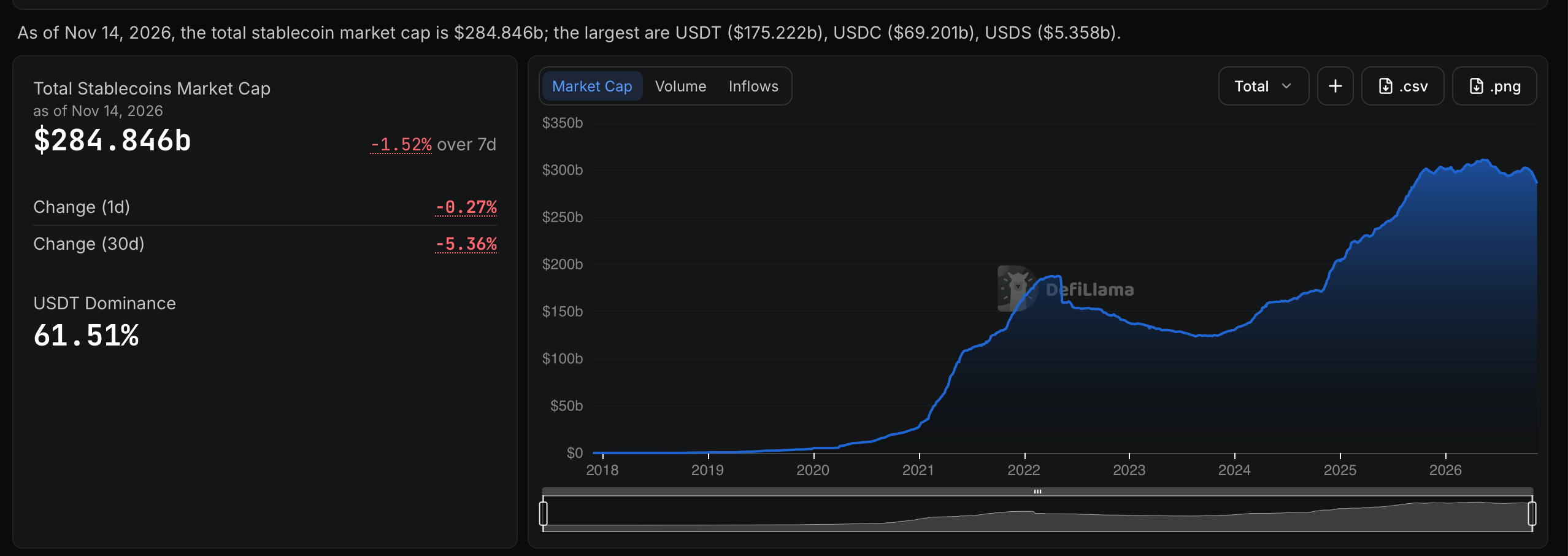
According to Defillama statistics reviewed by our news desk on Saturday morning, stablecoin capitalization has declined 5.36% over 30 days, 1.52% over seven days and 0.27% during the preceding 24 hours. The market now retains approximately 91.59% of its May valuation, reflecting a persistent retreat from its earlier high.
Tether’s USDT remains the dominant stablecoin, commanding $175.222 billion this weekend despite declining 4.7% over 30 days. Circle’s USDC follows at $69.201 billion, reflecting a 4.9% monthly contraction. Combined, these two heavyweights account for $244.423 billion in circulating stablecoin supply.
Several competitors have suffered considerably sharper reductions. Sky Dollar (USDS) declined 22.04%, while World Liberty Financial‘s USD1 shed 24.79%. Aave’s GHO dollar-pegged stablecoin recorded a particularly severe 61.47% contraction, and USD.AI retreated 54.56%.
Nevertheless, the downturn has not been universal. Ripple’s RLUSD stablecoin managed to expand by 15.12%, Ethena’s USDe gained 3.04%, and Open USD (OUSD) advanced 18.52%. Among smaller offerings, M by M0 recorded a 26.02% increase. While $26.15 billion has left the stablecoin sector since mid-May, the analytics provider Glassnode says $17 billion was erased over the last 30 days.
Tokenized U.S. Treasury Funds Join the Retreat
The contraction extends into tokenized government securities. According to RWA.xyz figures collected by Bitcoin.com News Saturday morning, tokenized U.S. Treasury funds collectively represent $13.91 billion in distributed value, reflecting a 5.36% decline over the last 30 days. The category encompasses 123 distinct assets and 86,320 holders, with its ten largest products accounting for approximately 85.4% of distributed value.
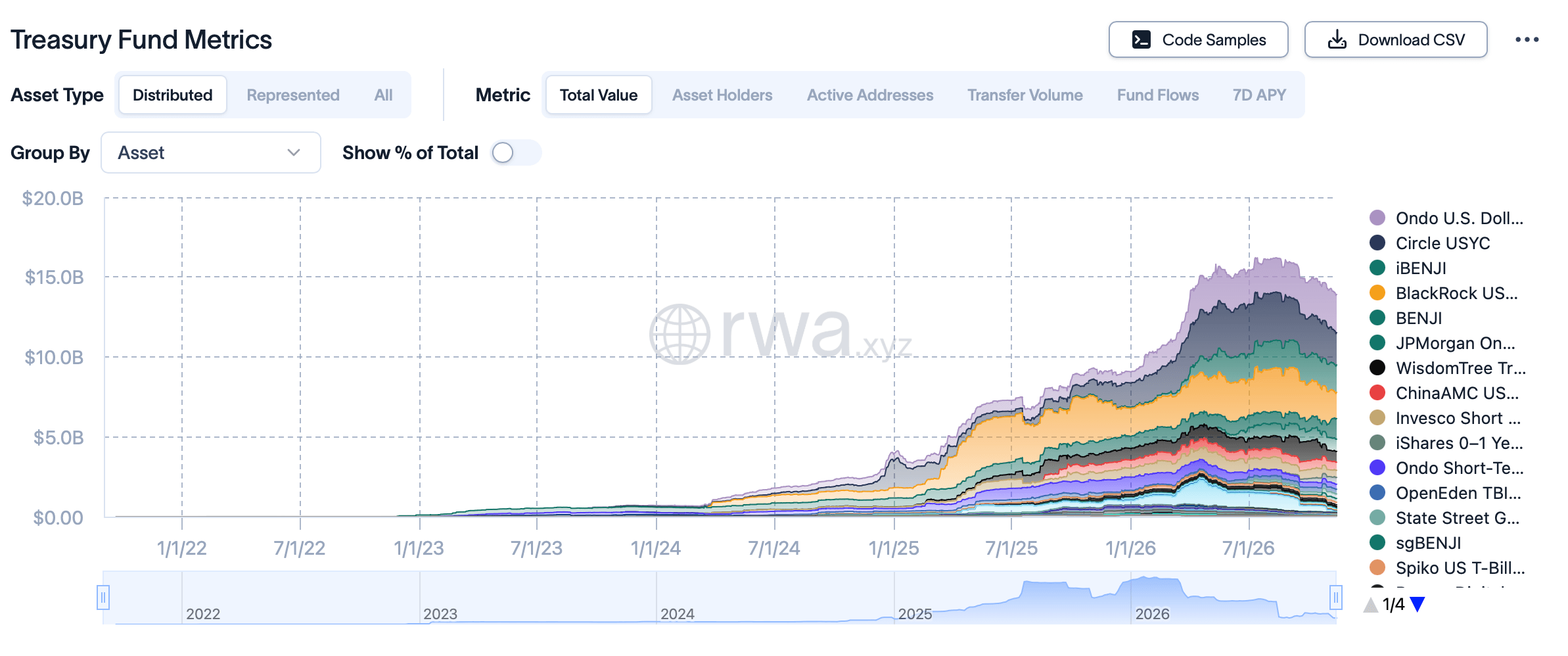
Several prominent institutional offerings experienced substantial reductions. Blackrock’s BUIDL fund declined 24.39% over 30 days to $1.654 billion, while Circle’s USYC contracted 15.46% to $2.016 billion. Wisdomtree’s WTGXX recorded an even steeper 36.43% decline, while Invesco’s USTB shed 26.63%. Conversely, Franklin Templeton’s BENJI expanded 88.38%, Ondo’s SHVon climbed 43.84%, and JPMorgan’s JLTXX gained 4.03%.
What Does Shrinking Stablecoin Supply Mean for Crypto Liquidity?
Stablecoins serve as trading capital, settlement instruments, and collateral throughout cryptocurrency markets. Declining supply can indicate redemptions, diminished speculative demand and reduced purchasing power available for bitcoin and alternative digital assets. Tokenized Treasuries perform overlapping functions but generally distribute investment yields, making their simultaneous contraction particularly noteworthy.
However, falling capitalization does not necessarily establish widespread capital flight. Institutional reallocations, transfers between issuers, and changing collateral preferences can influence supply without corresponding withdrawals from the cryptocurrency ecosystem.
Despite this, with both categories retreating, the availability of blockchain-based dollar liquidity still warrants closer attention. While the figures alone cannot establish where redeemed capital ultimately went, it leaves an important distinction between shrinking token supplies and a definitive exodus of money from cryptocurrency markets.

Bitcoin's descent below $70,000 this week has exposed a market grappling with institutional withdrawals, deteriorating liquidity, and mounting economic uncertainty.…
Read Now: Bitcoin Price Faces 10 Bearish Threats as 10 Recovery Catalysts Begin Taking Shape

About the author
WRITTEN BYJamie RedmanNews Lead
Jamie Redman is the News Lead at Bitcoin.com News and a financial technology journalist based in Massachusetts.