


Stablecoin transaction volume has surpassed Visa in raw terms, Binance Research said, signaling rapid growth in blockchain-based payments. The data highlights expanding adoption, though much of the activity still reflects trading and liquidity flows rather than real-world payment usage.
Stablecoins Move Toward Mainstream Payments as Binance Cites Visa-Beating Volume
WRITTEN BY

SHARE

Key Takeaways:
- Binance Research said stablecoins processed $33T, exceeding Visa in raw transfer volume.
- Fireblocks data shows banks accelerating stablecoin use across FX, custody, and payments.
- Richard Teng said stablecoins cut costs and delays in cross-border payments.
Binance Research Shows Stablecoins Surpass Visa in Raw Volume
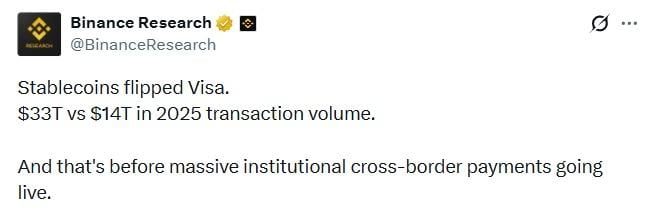
Stablecoins are strengthening their role in global payments as transaction activity moves closer to mainstream financial network scale. Binance Research, the market analysis unit of crypto exchange Binance, said April 21 that stablecoins processed about $33 trillion in 2025, compared with roughly $14 trillion in Visa payments volume, highlighting how blockchain-based settlement is gaining visibility in cross-border finance.
Binance Research stated on social media platform X that stablecoin transaction activity has moved ahead of legacy payment networks in overall scale. The post acknowledged that raw volume includes on-chain noise, while stressing that long-term growth trends offer a clearer signal of network evolution than headline figures alone. “Yes, the raw figure includes on-chain noise. The point is the trajectory — stablecoin rails are now operating at payments-network scale,” the firm explained.
Fireblocks data showed rising institutional focus. About 60% of banks target cross-border payments and FX. Another 52% prioritize real-time settlement. Around 37% focus on treasury optimization. Custody and collateral use cases each sit near 30%. This reflects broader integration beyond simple transfers. Binance Research stated:
“Banks aren’t exploring. They’re deploying.”
The data indicates a transition from pilot programs to active implementation within banking operations. Cost efficiency remains a central driver. Binance Research detailed that a $10,000 cross-border transfer using stablecoins typically carries near-zero fees and settles almost instantly, compared with about $70 and 12 hours via fintech platforms, $150 and 72 hours through SWIFT, $300 and 48 hours via card networks, and roughly $350 and 24 hours using digital money transfer operators. “The gap is structural, not marginal,” the firm stressed.
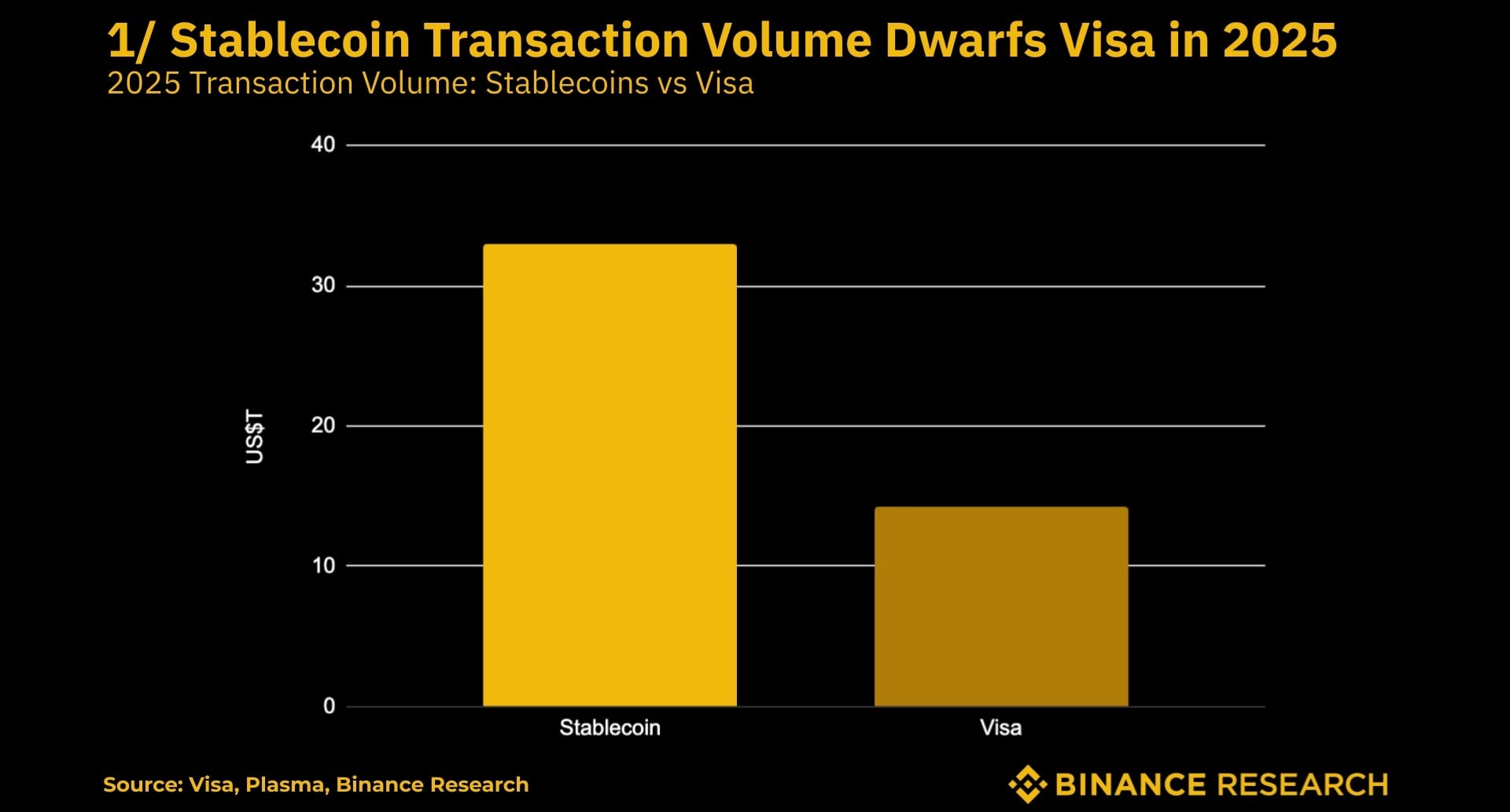
However, the comparison with Visa carries an important caveat, as the two figures measure fundamentally different types of activity. Research from McKinsey estimates stablecoins moved about $35 trillion in 2025, yet only about $390 billion reflected actual payments, with the rest tied largely to trading, liquidity flows, and other blockchain-native activity. This distinction underscores that headline transaction values may overstate real-world commercial usage. Accordingly, while stablecoins surpass Visa in raw transfer value, the comparison is less definitive when narrowed to consumer and business payment activity.
Regulatory Momentum Supports Stablecoin Adoption
Binance Co-CEO Richard Teng’s remarks at Hong Kong Web3 Festival on April 20 further highlight the role of stablecoins in addressing cross-border payment inefficiencies. He described them as a practical answer to legacy payment friction. Teng’s statements came as Hong Kong granted its first fiat-backed stablecoin issuer licenses to HSBC and Anchorpoint Financial under the city’s Stablecoins Ordinance.
He opined:
“Stablecoins represent that alternative. It’s totally built on blockchain. If you do a transfer on stablecoin, it’s instantaneous at a fraction of the cost.”
The executive also argued that regulatory fragmentation remains a hurdle, even as jurisdictions—including the U.S., the European Union, Japan, the UAE, and Hong Kong—develop clearer rules. He pointed to compliance standardization as a necessary step toward scaling cross-border adoption. Binance Research, meanwhile, maintained that the payments case is becoming harder to dismiss as stablecoins move from headline transaction totals toward more organic usage. Taken together, institutional adoption, regulatory progress, and growing payment utility suggest stablecoins are gaining traction as a viable layer for global payment infrastructure.

Over the past seven days, the stablecoin economy padded its coffers with another $2.983 billion, gliding past the $315 billion…
Read Now: Stablecoin Economy Crosses $315B as Circle’s USYC Leads Weekly Gains