Bitdeer Technologies Group launched its Sealminer A4 series of bitcoin mining rigs on Tuesday, with the flagship model reaching 9.45 joules per terahash, placing it among the most power-efficient machines announced by any major manufacturer.
Sealminer A4 Series Debuts as Bitdeer Hits New Bitcoin Mining Efficiency Record
WRITTEN BY

SHARE
Key Takeaways:
- Bitdeer launched the Sealminer A4 Ultra Hydro on April 7, 2026, hitting 9.45 J/TH efficiency, among the best figures in the industry.
- The A4 series, powered by Bitdeer’s SEAL04 chips, improves on the A3 series’ 12.5 J/TH, cutting power costs for miners facing tight post-halving margins.
- BTDR shares gained approximately 2.8% on launch day, with no shipment dates or pricing disclosed yet.
Sealminer A4 Ultra Hydro Delivers 886 TH/s at 9.45 J/TH for Bitcoin Miners
The Singapore-based company released the A4 lineup through its Sealminer brand, the in-house ASIC division that Bitdeer uses to develop and produce its own mining hardware. The series runs on Bitdeer’s latest SEAL04 chips, built on advanced process nodes, and represents the company’s clearest step yet toward competing directly with established hardware makers like Bitmain and MicroBT.
Three models make up the A4 series, each targeting different deployment conditions. The A4 Ultra Hydro, the flagship hydro-cooled unit, delivers 886 terahash per second (TH/s) at 8,372.7 watts with a rated efficiency of 9.45 J/TH. The A4 Pro Hydro reaches 680 TH/s at 7,412 watts at 10.9 J/TH. The A4 Pro Air, the air-cooled option, produces 336 TH/s at 3,662.4 watts, also rated at 10.9 J/TH.
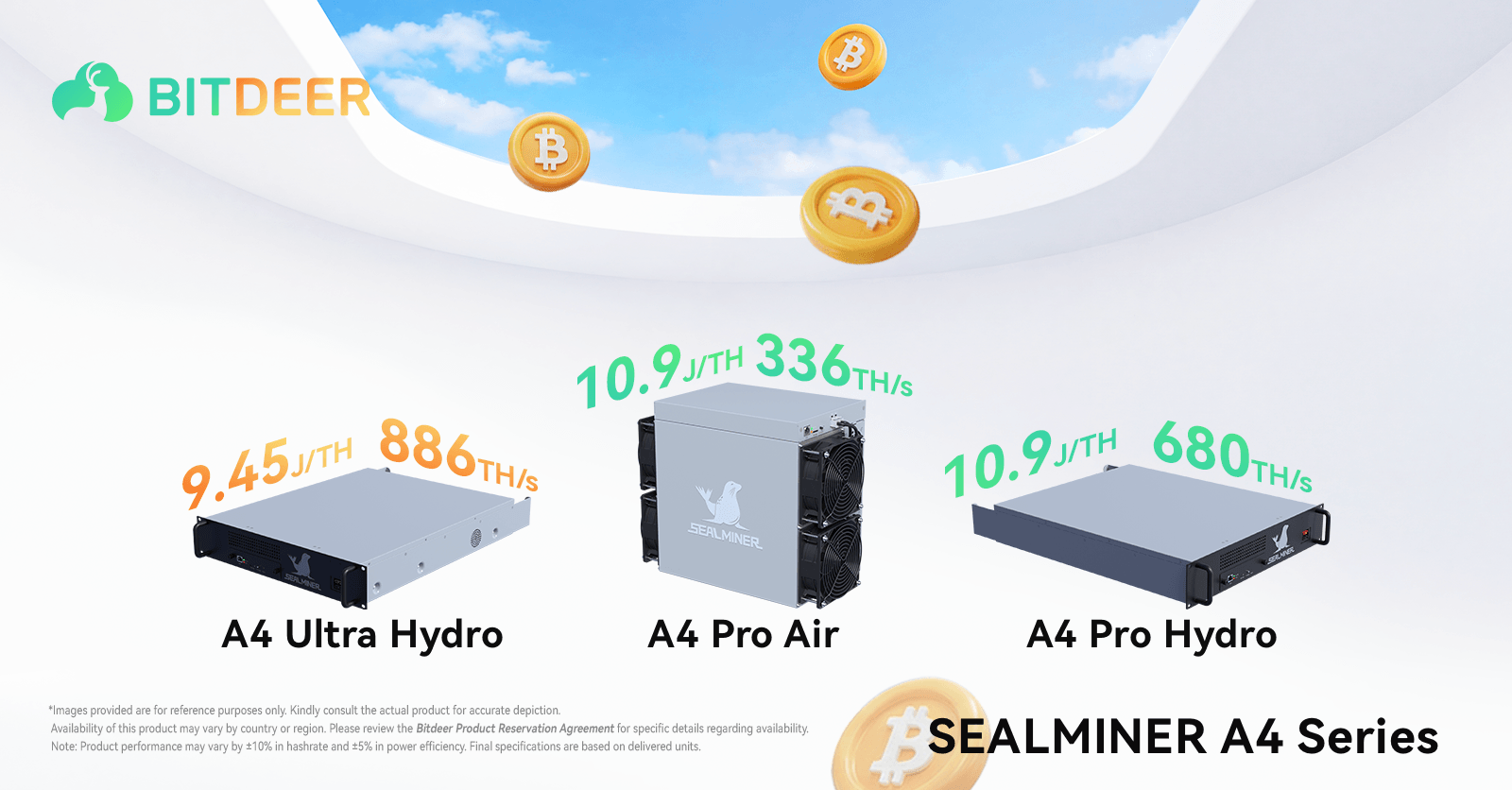
Bitdeer notes that power efficiency carries a tolerance of plus or minus 5%, and hashrate and power consumption carry a tolerance of plus or minus 10%. The A4 Ultra Hydro’s 9.45 J/TH rating marks a notable improvement over Bitdeer’s previous generation. The Sealminer A3 series, launched in September 2025, achieved between 12.5 and 14 J/TH.
Earlier A2 Pro units ran at 14.9 J/TH. Each generation has moved closer to the sub-10 J/TH threshold that Bitdeer had been targeting at the machine level. Lower efficiency figures directly reduce electricity costs per bitcoin mined. That matters to operators right now. Bitcoin hashprice has remained under pressure since the April 2024 halving cut block rewards from 6.25 BTC to 3.125 BTC, compressing margins for miners running older, less efficient hardware.
The hydro-cooled models are designed for high-density data center deployments where heat management is a constraint. Both hydro units offer a low-noise profile alongside optimized thermal performance, which Bitdeer says supports machine stability and uptime at scale. The A4 Pro Air provides flexibility for sites that cannot support liquid cooling infrastructure.
Bitdeer operates as a vertically integrated provider, managing chip design, machine production, and data center operations across the United States, Norway, Bhutan, and Ethiopia. The A4 rigs are expected to support both external hardware sales and Bitdeer’s internal self-mining fleet, which the company has been expanding through successive Sealminer deployments.
BTDR shares dipped approximately 1% on the announcement day, not too consistent with how the stock has responded to prior hardware launch events. Bitdeer did not disclose pricing, pre-order details, or shipment timelines in the announcement. Bitdeer’s announcement page had not yet been updated with A4 details at the time of reporting.
The A4 launch extends a chip development roadmap that Bitdeer has described as targeting approximately 5 J/TH at the chip level in future generations. The company has previously shown sub-10 J/TH results in chip-level benchmarks under optimized conditions, with the A4 bringing that performance into commercially delivered hardware.

Japan’s Next Crypto Boom May Be Institutional
Japan’s crypto market is shifting from retail frenzy to regulated finance. New stablecoin rules, tougher disclosure plans, and a formal…
Read Now

Japan’s Next Crypto Boom May Be Institutional
Japan’s crypto market is shifting from retail frenzy to regulated finance. New stablecoin rules, tougher disclosure plans, and a formal…
Read NowJapan’s Next Crypto Boom May Be Institutional
Read NowJapan’s crypto market is shifting from retail frenzy to regulated finance. New stablecoin rules, tougher disclosure plans, and a formal…
Bitdeer’s vertical integration strategy means it controls costs and specifications across the full supply chain rather than sourcing chips from third-party foundries or purchasing machines from competitors. That model gives the company more control over hardware output and timing, though it also concentrates R&D risk internally.
No production volume targets or delivery schedules were provided alongside the announcement.