


An Ohio woman recovered her entire loss after a fake Microsoft support call directed her to send money through a crypto ATM. The case illustrates how computer warnings can become payment demands that move cash into fraudsters’ digital wallets.
Ohio Returns $15,300 Lost at Crypto ATM in Fake Microsoft Scam
WRITTEN BY

SHARE
Key Takeaways
- A 63-year-old Ohio woman received her entire $15,300 loss back.
- BCI has assisted with 309 cases involving $5.6 million in kiosk losses.
- Agents traced and froze the stolen funds before securing a warrant.
Fake Microsoft Hotline Led to a $15,300 Crypto Transfer
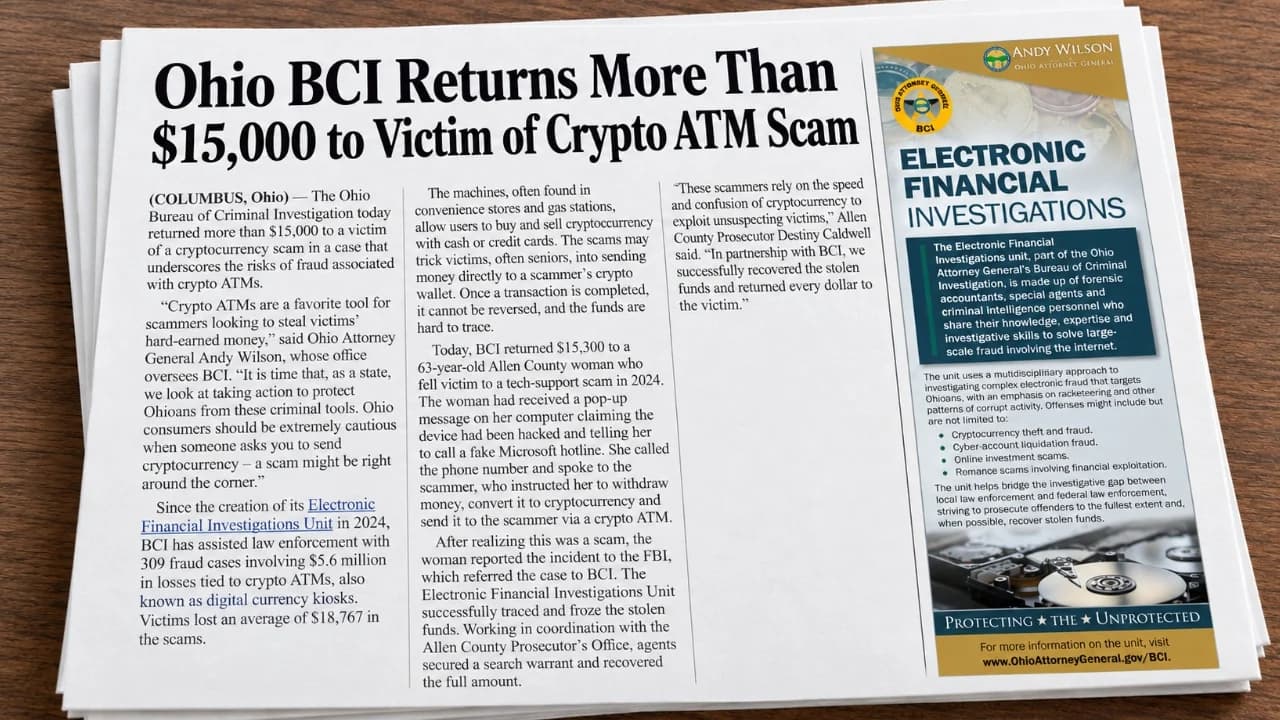
A 63-year-old Allen County woman received $15,300 back on Oct. 8 after investigators recovered money stolen through a cryptocurrency ATM scam. The Ohio Bureau of Criminal Investigation (BCI), the state’s criminal investigative agency, detailed the full recovery of her stolen funds as officials urged action to protect consumers.
The fraud began in 2024 when a computer pop-up claimed her device had been hacked and directed her to a fake Microsoft hotline. The person answering instructed her to withdraw money, convert it into cryptocurrency, and send it through a crypto ATM.
The announcement carried a warning from Ohio Attorney General Andy Wilson, whose office oversees BCI. He said:
“Crypto ATMs are a favorite tool for scammers looking to steal victims’ hard-earned money.”
The woman contacted the Federal Bureau of Investigation (FBI) after recognizing the deception, and the federal agency referred her case to BCI. Its Electronic Financial Investigations Unit traced and froze the stolen funds. Agents then coordinated with the Allen County Prosecutor’s Office and secured a search warrant.
Ohio Investigators Confront Millions in Crypto ATM Losses
Since its creation in 2024, BCI’s specialized unit has assisted law enforcement with 309 fraud cases involving $5.6 million in crypto ATM losses. The attorney general’s office reported an average victim loss of $18,767. These machines, also called digital currency kiosks, commonly operate in convenience stores and gas stations.
An earlier Ohio investigation also began with a fraudulent computer message and instructions to deposit cash into a bitcoin ATM. In that case, a 75-year-old Worthington resident lost $280,000 before investigators recovered $130,000 from the crypto scam, marking the unit’s first recovery disclosed in October 2024.
Nationally, the FBI recorded more than 13,400 complaints involving cryptocurrency kiosks in 2025, with reported losses exceeding $388 million. Its cryptocurrency kiosk complaint data, released May 15, cautions that some cases included other transaction methods, so the entire loss total cannot be attributed solely to the machines.
Alongside computer-support impersonation, supposed legal emergencies can pressure people into using the same payment channel. A Georgia woman lost $4,900 after a fake jury duty threat, having been told she needed to pay to avoid arrest. Ohio’s announcement also identified fabricated bail requests and warrants as pretexts for demanding deposits.
Ohio Seeks Action as Alabama Requires Scam Refunds
Wilson urged Ohio to consider state action protecting consumers from criminals who use cryptocurrency kiosks to obtain fraudulent payments. Such machines convert deposited cash into cryptocurrency sent to a designated wallet. When that destination belongs to a scammer, the victim’s completed transfer cannot simply be reversed.
Ohio’s warning identified older people as frequent targets, with cash demands typically ranging from $500 to $20,000. These bitcoin and crypto impersonation scams can involve blackmail or requests to help an online romantic partner the target has never met. The office encouraged immediate reporting of suspected fraud to local law enforcement.
Other states have adopted reimbursement requirements, including Alabama’s crypto ATM scam refund protections, which took effect Oct. 1. Qualifying new customers can recover the full transaction value plus fees, while existing consumers receive half the value, including all fees, subject to reporting requirements.
Allen County Prosecutor Destiny Caldwell described the coordinated investigation’s outcome: “In partnership with BCI, we successfully recovered the stolen funds and returned every dollar to the victim.”
Ohio’s six-step crypto fraud rescue plan puts victims in control, arming them with powerful tools to freeze wallets, preserve evidence,…
Read Now: Hit by a Crypto Scam? Ohio Offers 6 Steps to Take Before It Gets Worse