


The technology trade group representing more than 1,300 companies renewed its push for Senate approval of the CLARITY Act after bipartisan committee action. Lawmakers now face decisions on revised ethics provisions and other disputes before a floor vote.
Consumer Technology Association Urges Senate Vote on CLARITY Act
WRITTEN BY

SHARE
Key Takeaways
- CTA urged the Senate to bring the CLARITY Act to the floor without delay.
- The group said clear crypto rules would encourage investment and innovation.
- Ethics protections and stablecoin rewards remain central Senate disputes.
Technology Group Presses for Senate Action
The Consumer Technology Association (CTA), representing more than 1,300 technology companies, is urging the Senate to advance the CLARITY Act and establish clear federal rules for digital assets. The influential trade group marked its 100th anniversary in 2024.
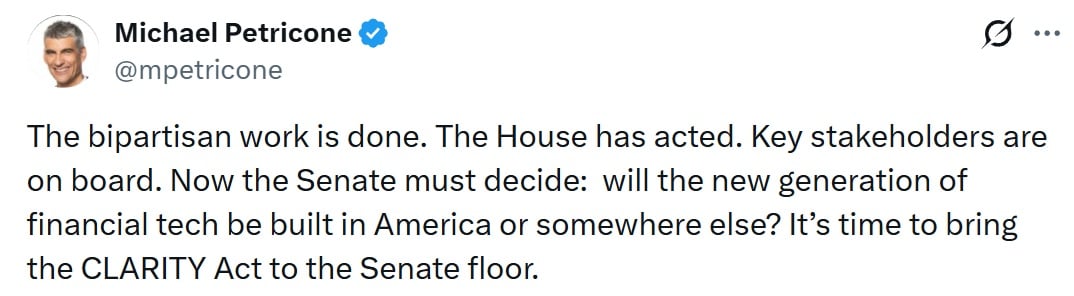
Michael Petricone, CTA’s senior vice president of government affairs, stated on X on July 28 that the House completed its work, industry stakeholders support the legislation, and the Senate now must determine whether financial technology innovation develops in the United States or overseas.
CTA maintained that regulatory certainty would encourage investment, strengthen consumer protections, expand innovation, and reinforce American leadership in blockchain technology. The organization also argued that businesses need clear federal rules governing digital assets before committing long-term capital and developing new financial products.
The appeal builds on CTA’s June 17 letter supporting Senate passage. The House approved the legislation with broad bipartisan support in 2025, shifting responsibility for the next major step to the Senate.
Senate Negotiations Center on Ethics Rules
U.S. Senator Cynthia Lummis (R-WY) has released updated CLARITY Act text combining work from the Senate Banking and Agriculture committees. The revisions address market oversight, consumer protections, and the division of regulatory authority over digital assets.
The proposal still faces opposition over ethics and enforcement. U.S. Senator Elizabeth Warren (D-MA), the Senate Banking Committee’s ranking member, said the revised language leaves major conflicts of interest unresolved.
Those disagreements now shape the bill’s path to a vote. Supporters view the measure as a durable framework for investment and competition, while critics want stronger safeguards before Congress establishes new rules for the crypto market.
Political Pressure Builds Ahead of Senate Vote
The CLARITY Act remains stalled in the Senate as lawmakers negotiate unresolved provisions. A White House ethics agreement sought to narrow one area of conflict, while former House Financial Services Committee Chairman Patrick McHenry has described passage as a question of when, not if.
SEC Chair Paul Atkins has also backed congressional action, arguing that legislation would provide more durable rules than regulation led primarily by federal agencies.
Stablecoin Fight Shapes Final Debate
Advocacy groups have pledged to score senators’ CLARITY Act votes, increasing political pressure ahead of the November midterm elections.
Banks are focused on a narrower dispute involving stablecoin rewards. More than 130 banking leaders have urged lawmakers to prevent payment stablecoins from functioning like interest-bearing accounts, warning that deposit losses could affect funding for mortgages, farms, small businesses and local communities.

Blackrock, the world's largest asset manager, backed the CLARITY Act as the Senate races against its legislative calendar, putting Wall…
Read Now: Blackrock Backs the CLARITY Act — Congress Is Running Out of Time to Pass It