Following a peak in onchain fees, bitcoin miners experienced a significant decline in the hashprice, which fell from a daily rate of $114 per petahash on Sunday to a markedly lower $79 per petahash by Tuesday. To date, the network’s hashrate has experienced a modest decline, though nothing too substantial yet, following the completion of the fourth reward halving.
Post-Halving Fallout: Bitcoin Hashprice Slides 30%, Miners’ Earnings Hit

This article was published more than a year ago. Some information may no longer be current.
WRITTEN BY

SHARE

Reward Reduction Leads to Tougher Times for Bitcoin Miners
Bitcoin miners now receive lower U.S. dollar revenue for their mined output compared to the first week before the halving. Data from Luxor’s hashrateindex.com show that the hashprice, or the expected value of 1 petahash per second (PH/s) of hashing power per day, maintained above $105 per PH/s on average, the week before block 840,000. On April 15, four days before the reward halving, the hashprice stood at $108 per PH/s.
During a period of historically high fees, the hashprice reached $182 per petahash on April 20. However, by the end of the next day, it had fallen to $114. Since that time, it has further declined to just above $79 per petahash, marking a 30% decrease in value. On Sunday, miners were earning an average of 5.105 BTC per block reward, which has since decreased.
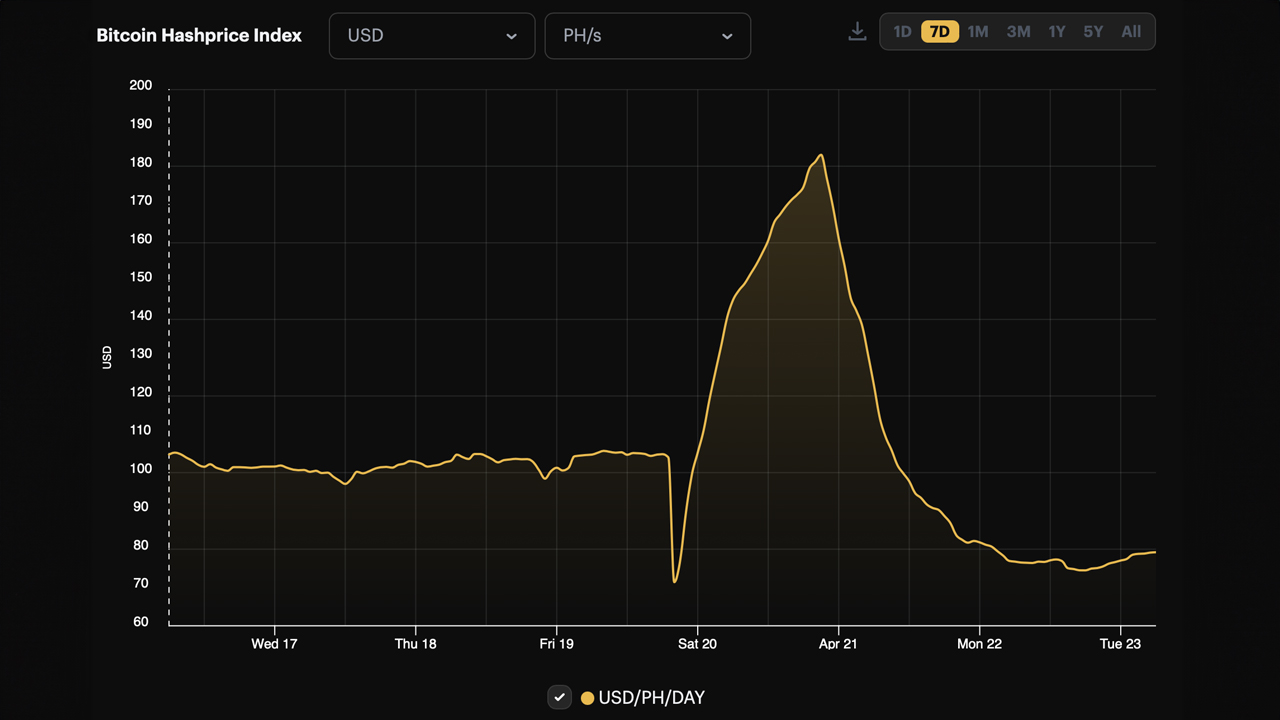
Between block heights 840,179 and 840,417, spanning 239 BTC blocks, miners garnered an average of 4.95 BTC from both subsidy and fees collected during that period. This indicates that, on average, between blocks 840,179 and 840,417, the average sum of fees per block amounted to approximately 1.82 BTC. On the day of the halving, Bitcoin’s hashrate peaked at an all-time high of 655 exahash per second (EH/s). However, it has since decreased to 631 EH/s by April 23 at 6 a.m. EDT.
As the dust settles following Bitcoin’s fourth halving, the implications for miners and the broader ecosystem are becoming clearer. Despite a drop in hashprice and a slight dip in hashrate, Bitcoin’s network resilience remains unshaken. The reduction in block rewards has initiated a critical test of efficiency and sustainability for miners. Moving forward, their ability to adapt to lower revenues and optimize operations will likely define the landscape of cryptocurrency mining.
What do you think about the mining revenue losses miners are experiencing? Share your thoughts and opinions about this subject in the comments section below.