


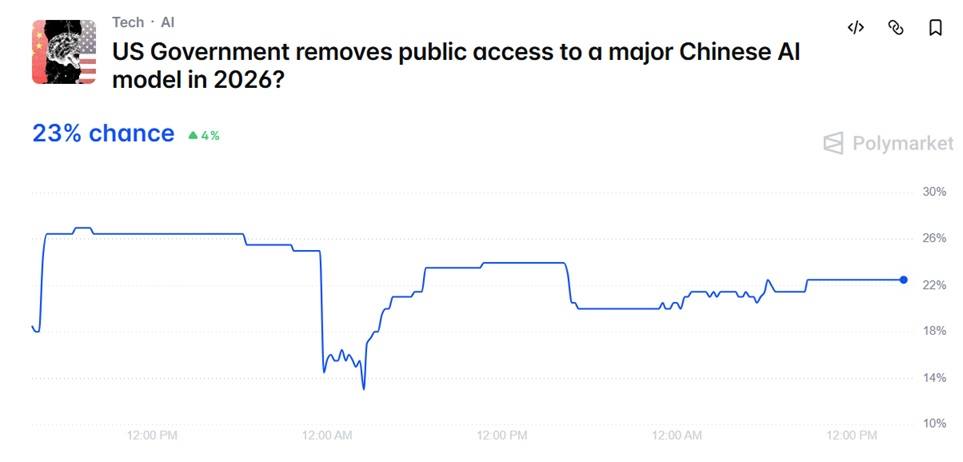
Polymarket traders are pricing a one-in-three chance that the U.S. government formally cuts off public access to a major Chinese artificial intelligence (AI) model before the end of 2026, as Washington’s scrutiny of Deepseek and its peers intensifies.
Polymarket: 23% Odds US Government Blocks a Major Chinese AI Model in 2026
WRITTEN BY

SHARE

Key Takeaways
- Polymarket traders put 23% odds on the U.S. removing public access to a major Chinese AI model by Dec. 31.
- Commerce Department bureaus have already barred Deepseek from staff devices over data security fears.
- Virginia, Texas and New York have blocked Deepseek for state employees as scrutiny widens.
Washington’s Case Against Chinese Models
The market, created earlier this month, asked whether the U.S. government would remove public access to a major Chinese AI model in 2026. It resolves “yes” if the federal government passes legislation, issues an executive order, imposes an export control, or takes any other formal action that generally cuts off U.S. public access to such a model by Dec. 31, 2026.
The near one-in-four pricing captures a genuine policy tug-of-war. Momentum for restrictions is building in Washington, but traders appear skeptical that a broad ban is enforceable, since open-weight models can be freely mirrored and re-hosted by third parties outside any single government’s reach.
The federal government has already moved against Deepseek in narrower ways. Several Commerce Department bureaus barred the Chinese chatbot from government devices, instructing employees not to download or access the app over data-security concerns. Lawmakers have pushed further with the bipartisan ‘No Adversarial AI Act, ‘ potentially prohibiting federal agencies from using AI models developed in China, Russia, Iran or North Korea, while Representatives Josh Gottheimer and Darin LaHood introduced legislation targeting Deepseek earlier in the cycle.
The pressure is not confined to Washington. Virginia, Texas and New York are among the states that have imposed device bans of their own. The industry has lent its voice as well, with OpenAI calling Deepseek “state-controlled” and urging bans on “PRC-produced” models in a policy proposal to the White House.
Prediction Markets as a Policy Barometer
Odds markets on U.S. policy have become a fixture of the news cycle. In this regard, Bitcoin.com News recently reported that Polymarket traders have put 20% odds on the U.S. government confirming alien life in 2026. Similarly, more than $200 million has been wagered across Kalshi and Polymarket on Iran conflict outcomes. Whatever their predictive power, these prices distill scattered policy signals into a single number that moves in real time.
There are caveats though, as the Chinese AI model market is young, and as with any newly listed contract, odds can swing sharply on modest volume. Resolution also hinges on interpretation (i.e. a sweeping export control might qualify while another device ban would not), the kind of fine print that often decides these markets.
The swing factors to watch are Commerce Department decisions on foreign AI services, state-level expansions beyond government-device bans, and any verified data-security incident tied to Chinese-hosted inference. The market runs through Dec. 31 and if Washington’s recent trajectory is any guide, the current 23% figure may not sit still for long.

The possibility of alien disclosure has risen, with Polymarket traders estimating a 20% chance for alien life to be confirmed…
Read Now: Polymarket Odds Hit 20% for the US Government to Confirm Alien Life in 2026