In contrast to its historic peak in daily transfer volume last year, Bitcoin’s transactional activity in 2025 has dwindled to its lowest level in over eight months. During particularly sluggish intervals on certain days this year, blocks on the Bitcoin blockchain have been processed irregularly, creating an unpredictable environment for mining participants.
Once Bustling, Now Barely Moving: Bitcoin’s Blockchain Continues to See a Sharp Drop in Transfers

This article was published more than a year ago. Some information may no longer be current.
WRITTEN BY

SHARE
Bitcoin’s Onchain Slowdown: Fewer Transactions, Lower Fees, and Dormant Holdings
Bitcoin’s daily transfer volume has slowed considerably this year, a stark departure from the record-breaking activity seen in 2024. The highest single-day transaction count last year occurred on Apr. 23, when 927,010 transfers were processed. In contrast, the busiest day in 2025 thus far was Jan. 9, with 534,013 transactions. Since Oct. 2024, the monthly average has been steadily declining.
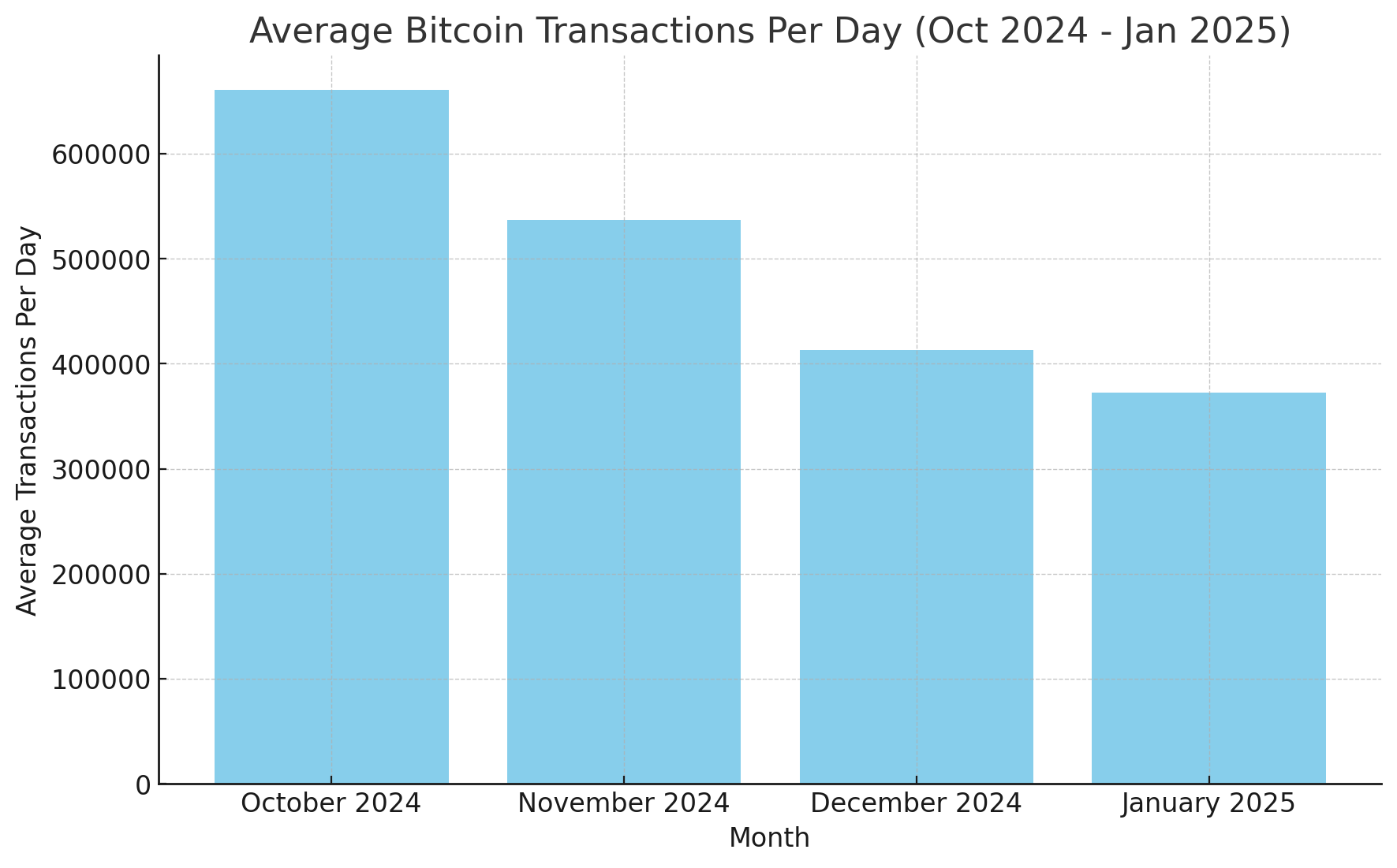
In Oct., Bitcoin saw an average of 660,682 daily transactions, which dropped to 536,874 in Nov., 413,021 in Dec., and 372,468 in Jan. By Feb. 15 at 7:30 a.m. Eastern Time, mempool.space showed that after block height 883,885, only a single block had been filled. Block 883,885 itself was only three-quarters full, with just 921 pending transfers in the mempool.
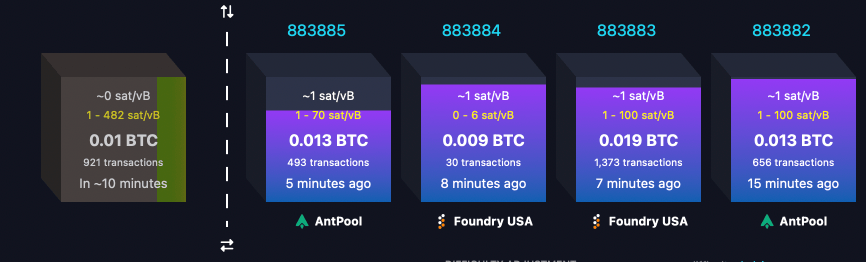
While block 883,886 reached full capacity, blocks 883,887 and 883,888 remained less than half full. Transaction fees have also been far lower than last year. At 7:30 a.m. ET on Feb. 15, mempool.space indicated that a high-priority transfer cost roughly 1 satoshi per virtual byte (sat/vB), or about $0.14 per transaction. Activity and fees tend to increase in the afternoon and early evening, varying by time zone.
Several factors have contributed to this decline in Bitcoin’s transactional activity, with one of the most significant being the diminished presence of Ordinals and Runes. As of 8:00 a.m. on Saturday, approximately 85.68 million Ordinal inscriptions exist, yet daily minting has dwindled to nearly imperceptible levels. The same applies to Runes, which were once anticipated to revolutionize token minting on Bitcoin, though BRC20s have ultimately outperformed them.
Another major factor is the reduced frequency of fund transfers on the Bitcoin blockchain. Many holders are waiting for more favorable prices, exchanges are consolidating payments into batch transactions, and custodians control vast reserves of BTC that remain untouched. U.S. exchange-traded funds (ETFs) alone have accumulated over 1 million BTC since Jan. 11, 2024, with these holdings largely sitting idle onchain—potentially for years to come.
A slowing tide in Bitcoin’s network suggests a cautious market adjusting to shifting investor behavior and evolving use cases. Observers note that a strategic consolidation by custodians and a waning enthusiasm for non-fungible inscriptions hint at a potential stabilization phase. Market and onchain participants may soon witness renewed dynamics, encouraging further exploration of underlying digital asset ecosystems. No matter how you feel, this activity trend warrants close observation.