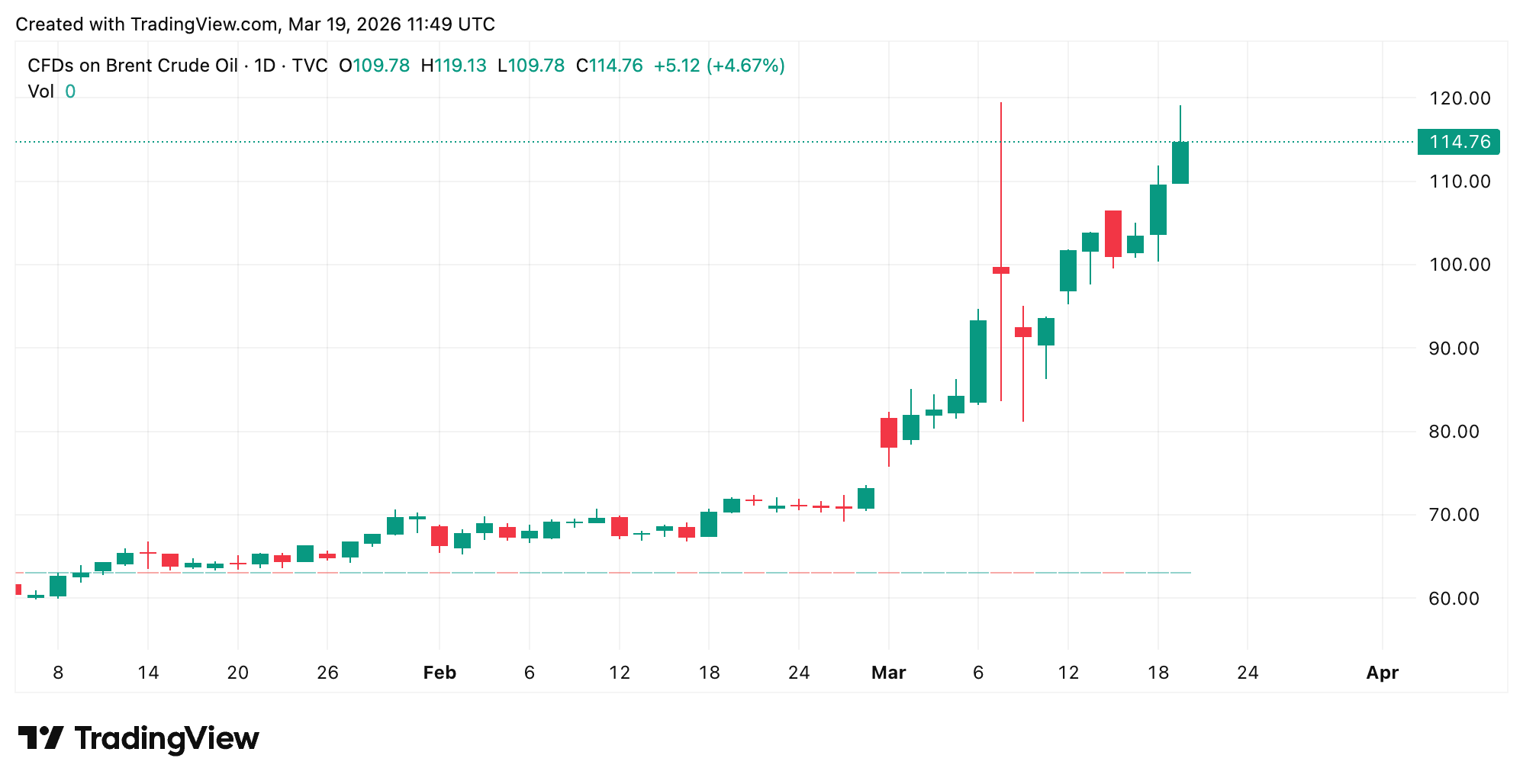
Brent crude climbed above $116 per barrel on Thursday as coordinated strikes on Gulf energy infrastructure rattled global supply expectations and intensified fears of a prolonged disruption.
Oil Rockets Toward $120 as Middle East Strikes Hammer Energy Infrastructure
WRITTEN BY

SHARE

Crude Oil Prices Spike as Supply Shock Replaces Shipping Disruptions
The global benchmark briefly touched $116 before easing slightly, capping a dramatic climb of more than 60% since late February, when prices hovered below $73. The latest move follows a wave of Iranian missile and drone strikes targeting critical oil and gas facilities across Qatar, Kuwait, the United Arab Emirates (UAE), and Saudi Arabia.
The escalation marks a turning point in the conflict that began Feb. 28, when U.S. and Israeli forces launched Operation Epic Fury, targeting Iranian nuclear and military infrastructure. While early exchanges avoided major production hubs, that restraint collapsed this week after strikes hit Iran’s South Pars gas field, the world’s largest.
Iran responded swiftly, declaring Gulf energy infrastructure “legitimate targets” and issuing warnings to evacuate facilities across the region. Within hours, key sites tied to global supply chains came under fire.
In Qatar, missiles struck Ras Laffan Industrial City, the world’s largest LNG export hub responsible for nearly one-fifth of global shipments. Fires and damage were reported, though production had already been curtailed earlier in the conflict.
Kuwait reported drone strikes on facilities tied to the Mina al-Ahmadi and Mina Abdullah refineries, both of which experienced fires that were later contained. No casualties were reported, though the incidents added to mounting concerns over regional output stability.
In the UAE, shutdowns hit the Habshan gas facilities and Bab oil field following missile threats and debris from interceptions. Saudi Arabia reported limited damage after an aerial attack targeted the SAMREF refinery in Yanbu, while additional missiles aimed at Riyadh were intercepted.
The market reaction was swift. Brent crude jumped as much as 11% within a day before stabilizing in the $114 to $116 range. West Texas Intermediate lagged, trading near $96 to $98, as U.S. strategic reserve releases tempered domestic price pressure.
Natural gas markets also reacted sharply. European benchmark prices rose between 16% and 35% in a single session, reflecting fears that disruptions are shifting from shipping routes to actual production losses.
The Strait of Hormuz, which carries roughly 20% of global oil flows, remains largely blocked, cutting regional exports by at least 60% compared with pre-conflict levels. Analysts now warn that the situation has evolved beyond logistics constraints into a direct supply shock.
Energy experts say the difference matters. Supply outages tied to infrastructure damage are far more difficult to restore than rerouting tankers or adjusting shipping lanes, raising the stakes for both markets and policymakers.

Iranian Drone Strikes Trigger Spike in European Natural Gas Prices
European natural gas prices spiked on Monday after Qatar halted all liquefied natural gas production following Iranian drone strikes on…
Read Now

Iranian Drone Strikes Trigger Spike in European Natural Gas Prices
European natural gas prices spiked on Monday after Qatar halted all liquefied natural gas production following Iranian drone strikes on…
Read NowIranian Drone Strikes Trigger Spike in European Natural Gas Prices
Read NowEuropean natural gas prices spiked on Monday after Qatar halted all liquefied natural gas production following Iranian drone strikes on…
U.S. officials are reportedly weighing options to reopen tanker routes, while Gulf producers attempt to reroute exports where possible. Still, the loss of capacity, combined with ongoing attacks, has left markets pricing in further escalation.
Analysts note that prices could push toward $130 if strikes expand or persist, while any diplomatic breakthrough could ease pressure. For now, traders are reacting to real disruptions, not just geopolitical risk.
FAQ 🛢️🛢️
- Why are oil prices rising in the U.S.?
Oil prices are increasing due to Middle East attacks disrupting global supply and blocking key shipping routes. - What is the Strait of Hormuz and why does it matter?
It is a critical shipping lane for about 20% of global oil, and its disruption limits worldwide supply. - How high could gas prices go in the U.S.?
Analysts estimate gasoline could reach $4.50 to $6 per gallon if disruptions continue. - What caused the latest spike in oil prices?
Missile and drone strikes on major Gulf oil and gas facilities triggered fears of sustained production losses.