


Musk reiterated today that orbital data centers are the endgame for artificial intelligence (AI) infrastructure, as SpaceX races to build satellites that would deliver 1 gigawatt (GW) of space-based compute per year by late 2027.
Elon Musk Says Space Is 'the Only Way to Scale' AI as SpaceX Chases 1 Gigawatt in Orbit by 2027
WRITTEN BY

SHARE
Key Takeaways
- Elon Musk said space is the only way to scale AI as SpaceX targets 1 GW of orbital compute by 2027.
- SpaceX’s AI1 satellite spans 70 meters and carries up to 150 kW of interchangeable compute capacity.
- SpaceX, which holds 18,712 BTC, hit a $2.1T valuation on its June 12 Nasdaq debut.
“Space is the Only Way to Scale at Scale”
He first declared the same earlier in February, when his AI startup xAI merged with SpaceX ahead of the rocket maker’s public listing. The logic, Musk has argued, is energy. Terrestrial data centers are increasingly constrained by power grids and land, while solar panels in orbit collect roughly five times more power than on the ground and face no nights or weather. “Space has the advantage that it’s always sunny,” he noted recently.
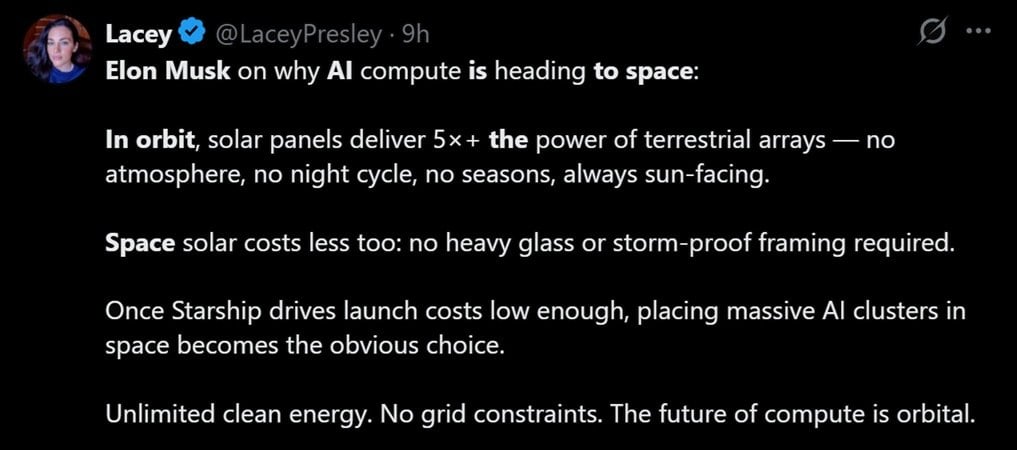
The fresh remarks land on top of a rapid buildout. SpaceX unveiled its 11-million-square-foot Gigasat factory in Bastrop, Texas, on June 8, a facility dedicated to mass-producing “AI satellites” from 2027. The company is targeting 1 GW of orbital AI compute per year by late 2027, with Musk saying he hopes to scale toward 100 GW annually by 2030 and eventually terawatt-level computing (though he has cautioned investors to take the timeline “with a grain of salt.”)
A day after the factory reveal, the company detailed AI1, its first-generation orbital data center craft. The satellite spans about 70 meters, wider than a Boeing 747, and carries a compute payload averaging 120 kilowatts (kW), peaking at 150 kW, with an interchangeable chip design not locked to a single supplier. “The AI satellite is much simpler than a Starlink satellite,” Musk said at the reveal.
Big Tech may already be circling, with the Wall Street Journal reporting in May that Google had entered exclusive talks with SpaceX on launching orbital data centers, and SpaceX has filed with the Federal Communications Commission (FCC) for up to 1 million satellites projecting 100 GW of capacity.
Wall Street and Bitcoin Stakes
The orbital pitch is now a public-market story. SpaceX raised about $75 billion in its June 12 Nasdaq debut and closed the day at a $2.1 trillion valuation, making Musk the world’s first trillionaire, as Bitcoin.com News reported.
The company’s S-1 prospectus leaned heavily on AI infrastructure demand, citing strained terrestrial grids. Cathie Wood’s ARK has since grabbed 3.3 million SpaceX shares, and Musk has projected the firm could reach $1 trillion in annual revenue by 2030.
The story also carries a direct crypto angle given SpaceX holds 18,712 BTC, a bitcoin treasury worth roughly $1.29 billion, while Tesla holds another 11,509 BTC (putting two of Musk’s companies among the largest corporate bitcoin holders on U.S. markets).
Skeptics See a Longer Road
Not everyone is sold on the timeline though, with experts voicing their doubts and arguing that thermal management, launch cadence, radiation, and repair logistics mean meaningful orbital compute could be decades away, even as the bulk of AI capital continues to flow into terrestrial sites.
If the Bastrop factory begins shipping complete AI satellites by late 2027 as promised, Musk’s “only way to scale” claim gets its first real-world test and SpaceX’s $2 trillion-plus valuation gets its first proof point beyond rockets.
Elon Musk's net worth climbed to roughly $1.3 trillion as SpaceX shares extended a blistering post-listing rally toward a $3…
Read Now: Elon Musk’s Net Worth Hits $1.3 Trillion as SpaceX Nears $3 Trillion Valuation