

Monero ( XMR), the leading privacy-focused cryptocurrency by market cap, faces an unprecedented threat as rival project Qubic prepares to attempt control of over 51% of its mining hashrate starting Aug. 2.
Monero Faces Looming 51% Attack Threat From Rival Blockchain Qubic
WRITTEN BY

SHARE

Monero Community Faces Another Challenge
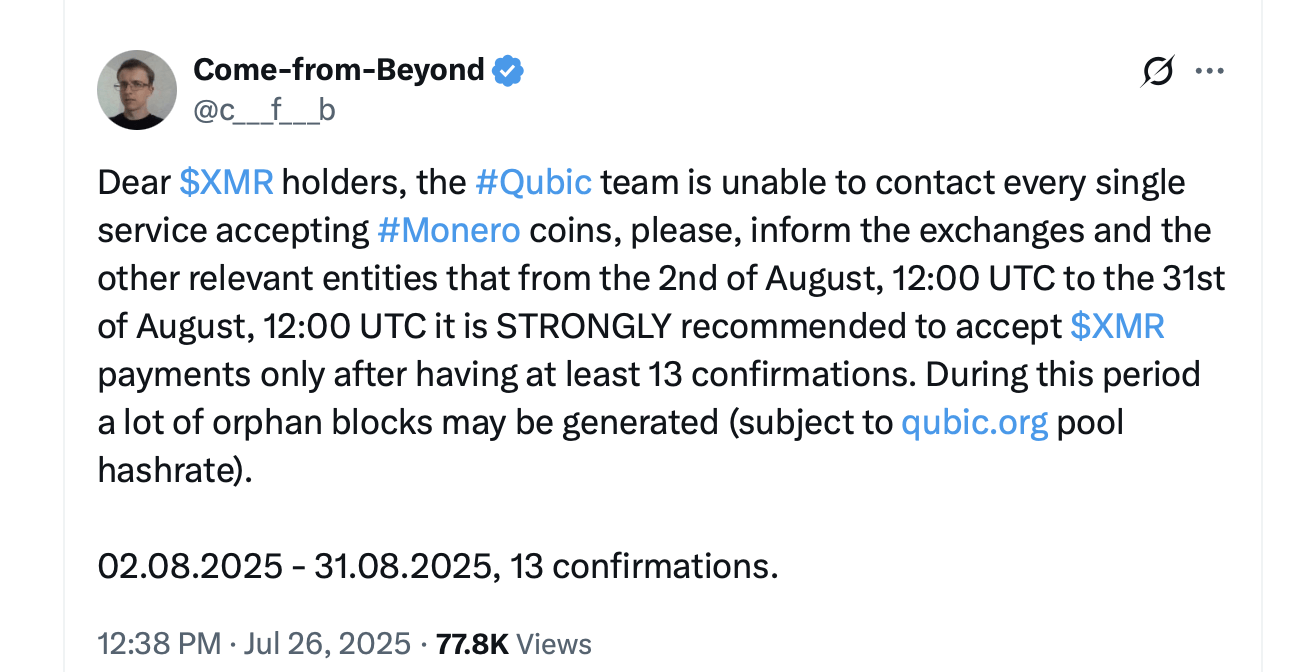
Qubic founder Sergey Ivancheglo (known as CFB) has hinted at a planned 51% attack on social media this week. The operation aims to dominate Monero’s network until Aug. 31, potentially enabling double-spending, transaction censorship, or orphan blocks. CFB claims this demonstrates Qubic’s Useful Proof of Work (uPoW) technology rather than attempting to destroy Monero.
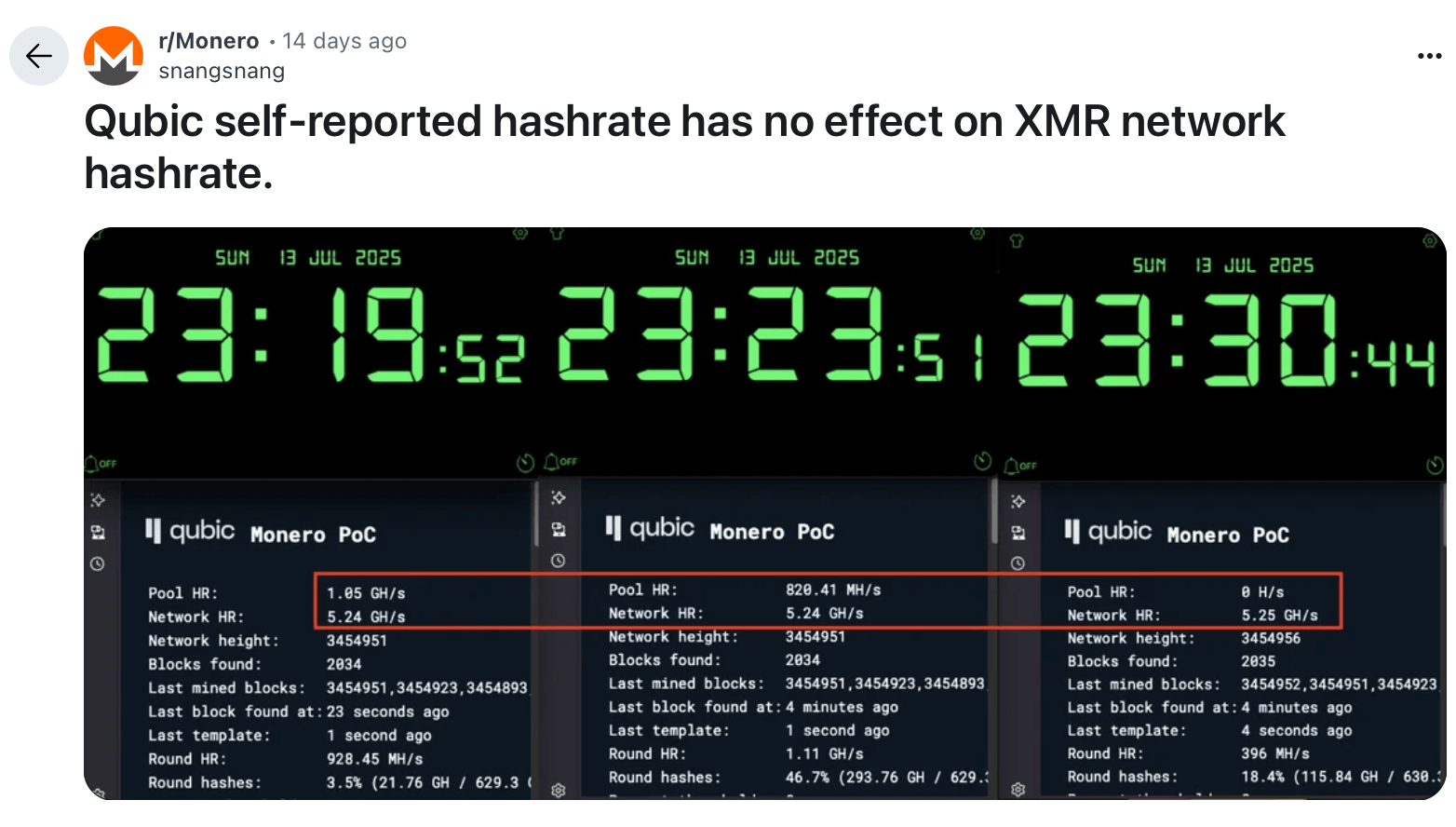
Qubic’s uPoW system allows its “AI miners” to simultaneously secure its network and mine Monero during idle cycles. Rewards from mining XMR are converted to USDT, used to buy Qubic’s QUBIC tokens, and burned – creating a profitable deflationary model. This integration, active since May 2025, has drawn significant Monero mining power. Qubic’s share of Monero’s global hashrate fluctuated between 20-40% in July, nearing levels triggering community alarm.
As of Sunday, July 27, 2025, Qubic is flexing its muscle, commanding 26.96% of Monero’s 6.12 gigahash per second (GH/s) hashrate. Monero advocates allege Qubic artificially inflates its “self-reported” hashrate (“spoofing”) and parasitizes their network. They warn that a successful 51% attack could devastate trust in Monero, widely used for private transactions.
“Let’s take this seriously and not wait till it’s too late to try and act on it,” a Redditor posting on the r/monero subreddit said.
Past threats (like MineXMR in 2022) were mitigated by decentralization and calls for pool migration. CFB advised exchanges via X to require 13 XMR transaction confirmations instead of 10 during the test. The project insists Qubic provides “economic incentive,” not harm, and that Monero’s privacy uniqueness will shield its price. Qubic supporters echo this view, framing it as uPoW validation. The Monero community is divided on responses: Some urge switching to decentralized pools like P2Pool; others suggest protocol changes.
XMR advocates fear users may migrate to alternative networks like Zcash or Zano if Monero confidence erodes. Others argue that chasing ASIC resistance has always been a futile effort. Neutral observers call this a stress test for both projects and proof-of-work vulnerabilities. If Qubic succeeds without damage, it could validate uPoW; if chaos ensues, it may reinforce Monero’s resilience despite short-term price risks.
As of July 27, Qubic hasn’t sustained 51% control, but its hashrate has fluctuated near critical thresholds.