



Michael Saylor shared a 953-hour reading curriculum outlining the ideas that shaped his views on leadership, markets, technology, and Bitcoin, giving followers a roadmap to the intellectual framework behind his long-term investment philosophy.
Michael Saylor Publishes 953-Hour Leadership Curriculum Culminating in Bitcoin
WRITTEN BY

SHARE

Key Takeaways
- Michael Saylor published a 38-work curriculum requiring up to 953 hours of reading.
- The program spans history, economics, technology, war, and concludes with Bitcoin.
- The curriculum includes Saylor’s own book, The Mobile Wave, alongside works from prominent historians and economists.
Saylor Explains Why He Published the Curriculum
Strategy Inc. (Nasdaq: MSTR) Executive Chairman Michael Saylor published the curriculum on July 25 on X as a guide for leaders making consequential decisions across business, politics, finance, and technology.
Drawing on his education, technology career, and work with Bitcoin, the Strategy executive chairman connected those experiences to the curriculum’s framework. The reading list prepares leaders to oversee institutions, markets, energy systems, communication networks, artificial intelligence, and monetary protocols.
Saylor wrote:
“Human prosperity is not produced by good intentions alone. It emerges when scientific understanding, engineering, energy, capital, markets, property rights, and effective institutions work together.”
His authority for assembling the reading list rests partly on a career combining technology, corporate leadership, authorship, and Bitcoin advocacy.
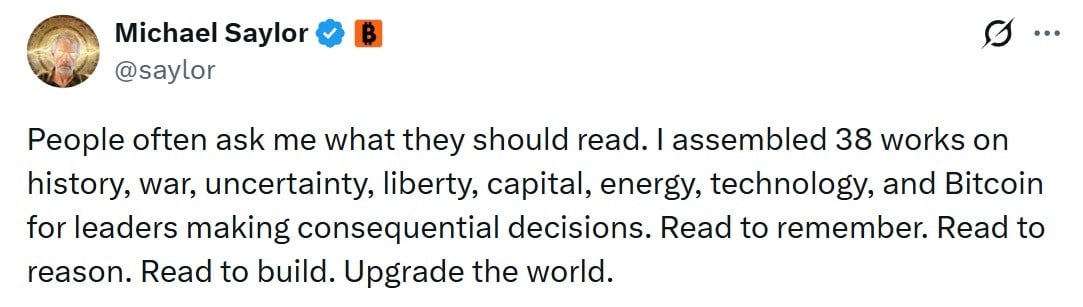
In a follow-up post on X, Saylor explained that people frequently ask what they should read, prompting him to compile 38 works covering history, war, uncertainty, liberty, capital, energy, technology, and Bitcoin for decision-makers responsible for making consequential decisions. He encouraged readers to “Read to remember. Read to reason. Read to build. Upgrade the world.”
A Reading Plan Lasting up to 31 Months
Titled “Upgrade the World,” the curriculum estimates readers will spend between 755 and 953 hours completing the program, or roughly 13 to 31 months depending on daily reading time. The project aims to develop leadership judgment through the study of history, economics, institutions, energy, technology, and monetary systems before major choices influence millions of people.
Saylor clarified:
“The point is to acquire several thousand years of accumulated experience before making decisions capable of affecting millions of people.”
The program divides its 38 works across eight themes, with civilizational history receiving the largest time commitment at an estimated 294 to 359 hours. Human action, liberty, and political power account for another 189 to 239 hours.
The curriculum’s emphasis on institutions, capital, and monetary systems also aligns with Saylor’s broader view that bitcoin adoption is entering a bigger game across credit markets, institutions, and global finance.
History and Economics Lead the Curriculum
Rather than focusing exclusively on Bitcoin, the curriculum begins with broad studies of civilization and leadership. Its selections include Will and Ariel Durant’s The Story of Civilization, Jared Diamond’s Guns, Germs, and Steel, John Keegan’s A History of Warfare, Nassim Nicholas Taleb’s Incerto series, and several works by economist Murray Rothbard.
The reading list also features Ron Chernow’s biographies of John D. Rockefeller and the Morgan banking dynasty, Daniel Yergin’s history of the oil industry, and David Deutsch’s work on scientific progress.
His own 2012 book, The Mobile Wave, joins the collection as a test of how accurately it anticipated mobile computing’s impact and whether its analytical methods withstand later scrutiny.
Bitcoin Caps the Reading List
Bitcoin occupies the culmination of the broader reading program. The final section recommends Saifedean Ammous’ The Bitcoin Standard before directing readers to Satoshi Nakamoto’s original Bitcoin white paper.
That sequence reflects Saylor’s central argument that readers should study civilization, war, incentives, energy, capital, institutions, and digital transformation before evaluating bitcoin’s role in society, including his vision of BTC as a global digital capital asset by 2036.
The Strategy executive chairman added:
“To understand Bitcoin fully, one must understand what it protects, what it replaces, what it consumes, what it coordinates, and which forms of power it constrains.”
He characterized the reading list as a foundation for further study, emphasizing that its purpose is to strengthen judgment before leaders make decisions capable of affecting millions of people.
Readers Are Encouraged to Challenge the Authors
Critical reading remains central to the program, which asks participants to compare competing perspectives without treating any author as a final authority.
Each work invites examination of what its framework reveals, where its reasoning simplifies reality, and which choices would shift if its core arguments proved correct.
The curriculum ultimately functions as Saylor’s proposed foundation for leadership judgment, with Bitcoin appearing only after readers examine the historical, economic, technological, and institutional systems surrounding it.
Strategy founder Michael Saylor published a lengthy essay Saturday rejecting BIP 110, a proposed Bitcoin softfork that would temporarily restrict…
Read Now: Saylor Rejects BIP 110, Warns Softfork Threatens Bitcoin’s Neutral Rules