


Privacy coins have broken away from a weak crypto market, with zcash and monero delivering gains while bitcoin remains below its October peak. Fresh sector data points to a rotation amid privacy demand, institutional access, and persistent network use.
Privacy Coins Outrun Bitcoin as Market Rotates Into Zcash and Monero

This article was published more than a month ago. Some information may no longer be current.
WRITTEN BY

SHARE
Key Takeaways
- Privacy coins gained 213% after bitcoin’s October 2025 peak.
- Zcash accounted for about 62% of the privacy sector on Sept. 7.
- Monero activity remains elevated despite major exchange delistings.
Privacy Coins Separate From the Broader Crypto Market
Market leadership has rotated toward privacy coins as most major cryptocurrencies remain below their October 2025 levels. A Bitfinex analysis published Sept. 11 highlighted the shift, drawing on data Glassnode published on Sept. 7. Among the 25 largest crypto assets, only zcash, Hyperliquid’s HYPE, monero, and WhiteBIT’s WBT traded above their Oct. 6 levels.
Glassnode’s privacy-coin sector data showed the category gained 213% since bitcoin reached its record above $126,000 on Oct. 6, 2025. The basket also advanced 90% over the preceding month. Over the previous year, the sector’s combined market value increased from $7.1 billion to $33.6 billion.
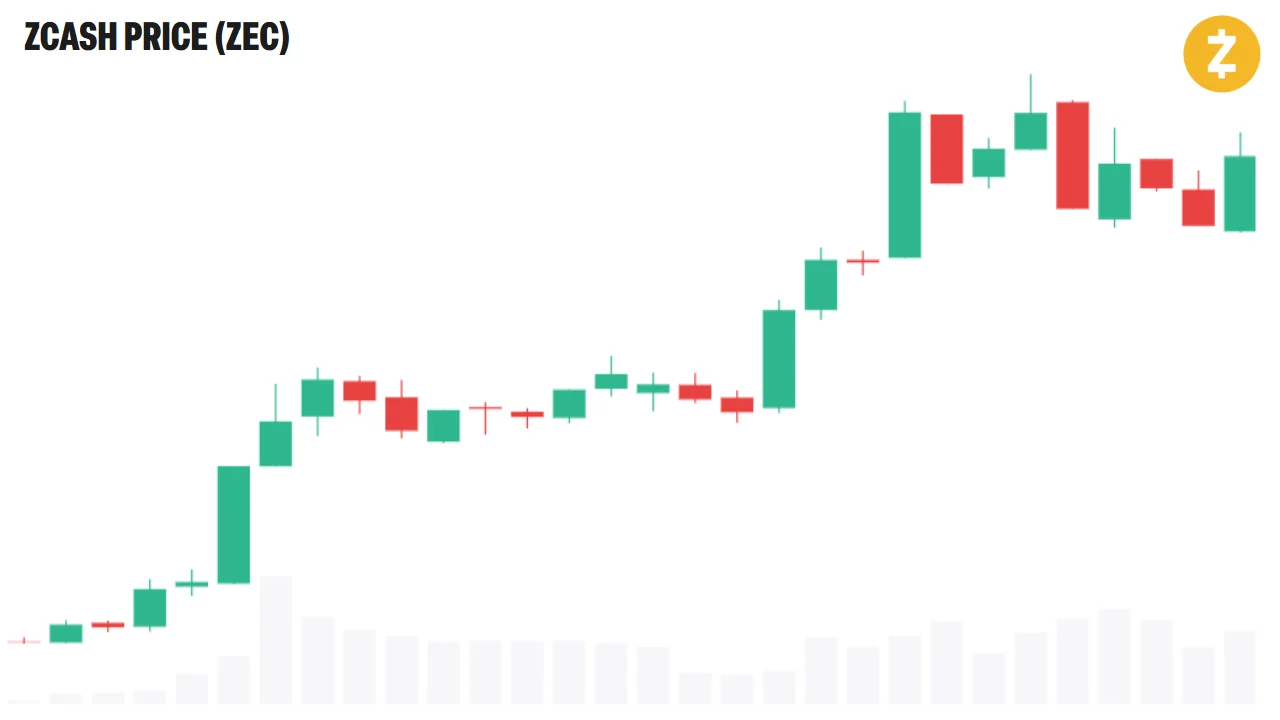
Zcash accounted for about 62% of the privacy sector’s value in Glassnode’s Sept. 7 snapshot after delivering the largest gain in the group. ZEC rose more than 25-fold over the past year, while its market-cap ranking climbed from 82nd to seventh in Glassnode’s tally. The token traded above $1,000 in early September as leveraged short liquidations and exchange-traded product inflows accompanied the rally.
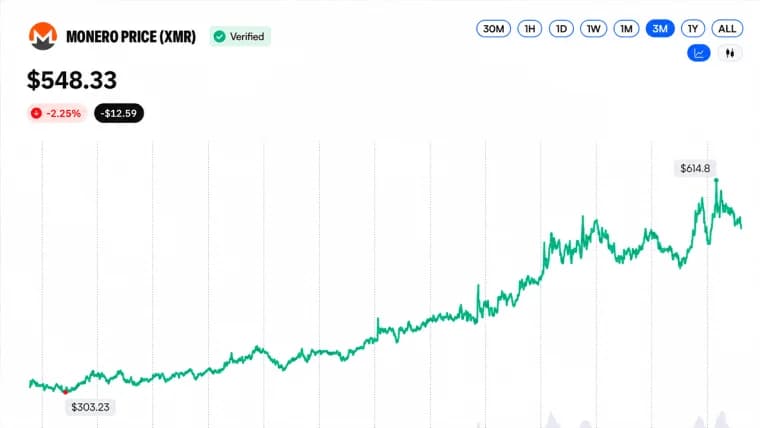
The advance extends beyond zcash, reducing the likelihood that one token entirely explains the category’s performance. Glassnode’s privacy basket excluding ZEC gained approximately 85% during the past year, while monero roughly doubled. XMR had already broken its previous price record in January, establishing momentum before the latest Zcash-driven leg of the sector’s ascent.
Zcash and Monero Take Different Routes
Institutional access to zcash widened on Aug. 25 when Grayscale converted its existing trust into an exchange-traded product listed on NYSE Arca. The Zcash ETF began trading under ticker ZCSH, providing spot ZEC exposure through brokerage accounts. Investors own shares in the product rather than ZEC directly, and the fund is not registered under the Investment Company Act of 1940.
A Sept. 8 filing with the U.S. Securities and Exchange Commission (SEC) disclosed that DCG International Investments Ltd., a Digital Currency Group subsidiary affiliated with the fund’s sponsor, acquired roughly $100 million of ZCSH shares in exchange for 85,705.32563297 ZEC. That contribution counted toward the more than $500 million in assets Grayscale said the fund held two weeks after launch, alongside more than $70 million in cumulative inflows.
The Zcash protocol combines transparent transactions with an optional shielded pool that conceals senders, recipients, and amounts through zero-knowledge proofs. Viewing keys allow holders to disclose selected transaction information to auditors, counterparties, or regulators. Rising prices have also improved network economics, with Zcash mining rewards estimated at twice Bitcoin’s daily rewards per machine under Grayscale’s specified assumptions.
Monero follows a different model by concealing transaction details at the protocol level, without offering a transparent transaction option. Ring signatures, stealth addresses, and confidential transactions obscure the sender, recipient, and transferred amount. The design provides privacy by default, while also creating obstacles for exchanges operating under regulations that require transaction monitoring and customer screening.
Persistent Use Meets Regulatory Pressure
Exchange restrictions have reduced access to Monero without eliminating its underlying activity. TRM Labs found that Monero transaction volumes during 2024 and 2025 remained significantly above early 2020 and 2021 levels. The blockchain intelligence company characterized usage as persistent despite delistings by several major centralized exchanges.
These competing approaches illustrate how privacy coins conceal transaction information while producing different compliance and market-access trade-offs. Zcash permits selective disclosure, whereas Monero applies privacy automatically. Regulatory pressure remains a risk for both models, with the European Union’s anti-money-laundering rules scheduled to prohibit crypto-asset service providers from keeping accounts that allow transaction anonymization or increased obfuscation, including through anonymity-enhancing coins, beginning July 10, 2027.

Zcash mining is suddenly running like an industrial business again as ZEC trades near multi-year highs and specialized mining machines…
Read Now: Zcash Hashrate Goes Vertical as $870 ZEC Price Wakes ASIC Giants