


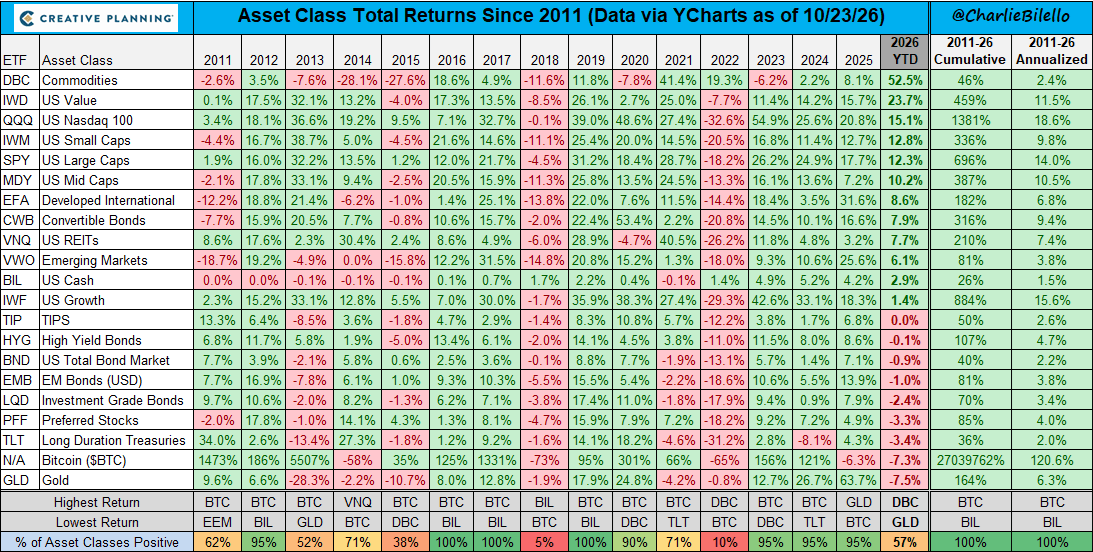
Bitcoin and gold, two assets often bought as hedges against monetary stress, are both sitting at the bottom of the 2026 performance table. Bitcoin is down 7.3% year-to-date and gold 7.5%, a combination market strategist Charlie Bilello says has never happened before in a calendar year.
Bitcoin Falls 7.3%, Gold 7.5% as Both Rank Last Among Major Assets in 2026
WRITTEN BY

SHARE
Key Takeaways
- Bitcoin and gold are 2026’s worst major assets, down 7.3% and 7.5%, respectively.
- Charlie Bilello says both finishing a year at the bottom together would be unprecedented.
- A rebound in either asset could reopen the gap between bitcoin’s risk profile and gold’s hedge role.
Bitcoin, Gold Fall Together as Stocks, Bonds, and Cash Pull Ahead
Bitcoin and gold have rarely looked this similar for the wrong reason.
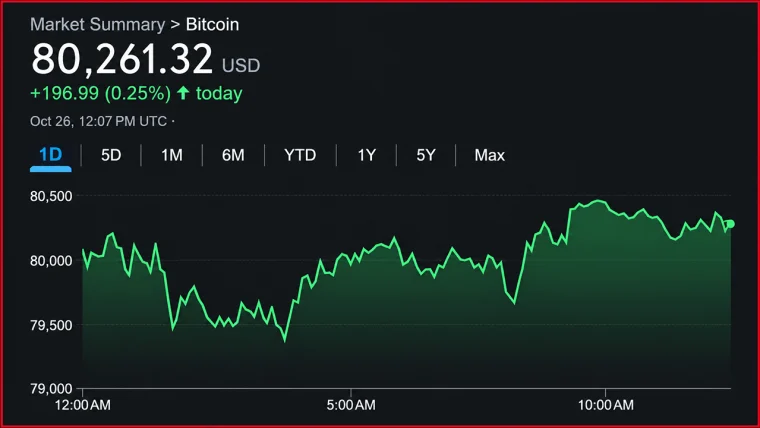
The two assets are the worst-performing major asset classes so far in 2026, with bitcoin down 7.3% and gold down 7.5% as of Friday, Oct. 23, according to Creative Planning Chief Market Strategist Charlie Bilello.
“This is something we haven’t seen before in any calendar year,” Bilello wrote on X.
The pairing is striking because crypto investors often frame bitcoin as “digital gold,” while the two assets can also behave very differently during periods of stress. This year, both are trailing stocks, bonds, and even cash.
Bitcoin and Gold Share an Unusual Losing Streak
The comparison becomes more notable when viewed against their long-term performance.
Since 2011, bitcoin has delivered an annualized return of 120.6% across the assets tracked in the comparison, according to data shared by Bilello. Gold, by contrast, has returned about 6.3% annually over the same period.
Yet both have struggled in 2026.
For gold, the drop also follows an exceptionally strong 2025, when the precious metal surged 63.7%. That makes this year’s decline a sharp reversal after one of its strongest recent runs.
For bitcoin, the weakness shows that crypto’s long-term outperformance does not eliminate the risk of extended drawdowns.
Gold Miners Are Flashing an Extreme Signal
The pressure is even more visible in gold equities.
Roughly 92% of stocks in the GDX gold miners ETF are now trading below their 50-day moving average, according to The Kobeissi Letter. That share has risen by 80% in just 21 sessions.
About 90% of GDX constituents are also below their 200-day moving average, the highest proportion in three months. Similar conditions appeared in March and December 2024. GDX then rallied 21.5% and 15.4%, respectively, over the following month.
That history does not guarantee another rebound, but it shows how stretched the current selloff has become.
The Bigger Question Is What Breaks First
For investors, the unusual part is not simply that bitcoin and gold are down. It is that both are weakening at the same time despite serving different roles in many portfolios.
Gold is traditionally treated as a defensive asset. Bitcoin is still often traded as a higher-volatility crypto asset, even as its store-of-value narrative grows.
Their joint underperformance creates a rare market setup.
If either begins to recover, then investors will be watching whether the divergence reappears. If both remain weak, however, then 2026 could become a defining test of the hedge narratives surrounding each asset.
Coinbase, which says it safeguards roughly 12% of all bitcoin, has laid out the technical and operational hurdles bitcoin must…
Read Now: Coinbase Maps Bitcoin’s Quantum Risks While Safeguarding 12% of BTC