


Welcome to Latam Insights, a compilation of the most relevant crypto news from Latin America over the past week. In this edition, Brazil proposes guardrails against CBDC abuse, Bitfinex highlights the tokenization potential in Venezuela, and Rain reports massive growth in Latam’s stablecoin adoption.
Latam Insights: Inside Brazil’s CBDC Privacy Bill and Latin America’s $1.5 Trillion Stablecoin Economy
WRITTEN BY

SHARE
Key Takeaways
- Bia Kicis backed Bill 4212/25 to limit Central Bank of Brazil CBDC control and protect paper money markets.
- Bitfinex Securities stated tokenization will next help Venezuelan firms tap into millions in international markets.
- Rain reported Latam transacted $1.5T from 2022 to 2025, next cementing stablecoins as market dollar proxies.
Brazil Proposes Rigid Guardrails to Stop Government Abuse of Central Bank Digital Currency
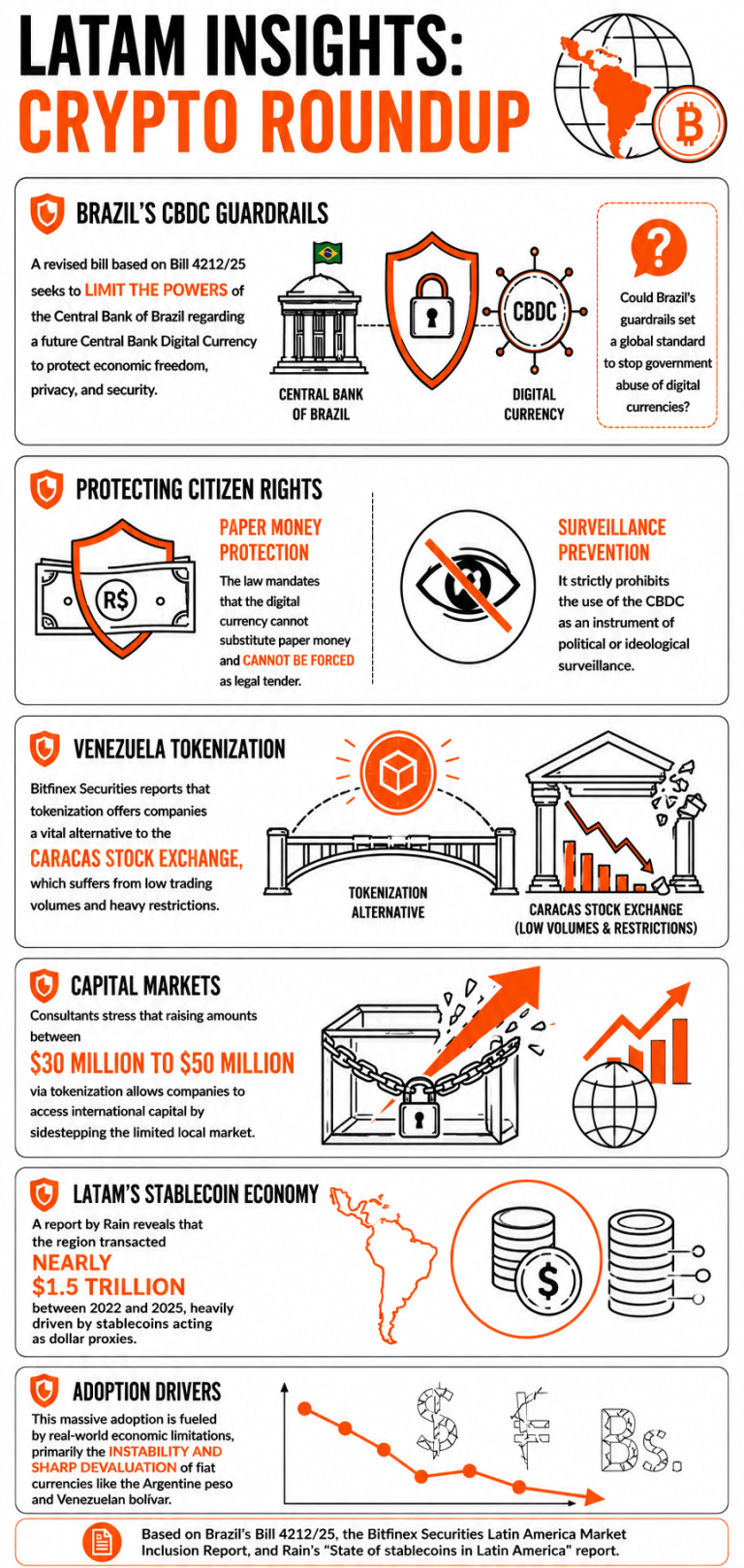
A bill that seeks to reduce the powers of the Brazilian state if a central bank digital currency (CBDC) is approved passed the Economic Development Committee of the Chamber of Deputies in a revised form.
The project, based on Bill 4212/25, originally introduced by Deputy Bia Kicis and modified by rapporteur Lafayette de Andrada, seeks to limit the powers of the Central Bank of Brazil and other financial institutions linked to a future CBDC to protect economic freedom, privacy, and citizens’ security.
The law establishes that a digital currency issued by the central bank cannot substitute for paper money, cannot be forced as legal tender, and cannot be used as an instrument of political or ideological surveillance.
Furthermore, in its fifth article, the legislator stresses that governing bodies must ensure that “digital currency does not result in financial exclusion, always guaranteeing alternatives accessible to the population without access to digital media.”
Bitfinex Report Highlights Tokenization as the Key to Venezuela’s Economic Rebuild
In its Securities Latin America Market Inclusion Report, Bitfinex Securities has highlighted the tokenization opportunities arising in Venezuela after the arrest of President Nicolas Maduro in January.
According to experts, this tech might help prop up traditional stock markets, such as the Caracas Stock Exchange, and assist companies needing significant capital to reach international markets, sidestepping the low trading volumes and restrictions of the index, which has participation from only 40 companies.
Jose Miguel Farias, a fundraising consultant, stressed that any company raising large amounts of funds, from $30 million to $50 million, would be “aiming for an amount that represents a significant fraction of what the local market moves in several months.
$1.5 Trillion Transacted: Rain Report Reveals the Massive Scale of Latam’s Stablecoin Economy
Rain, a company that provides the infrastructure for issuing stablecoin-backed crypto cards, has revealed significant growth in the use of these tools in Latam.
In its recent “State of stablecoins in Latin America” report, Rain declared that the region had transacted nearly $1.5 trillion between 2022 and 2025, with the majority of these flows intermediated by stablecoins, a testament to their adoption as dollar proxies in the region.
This adoption, unlike in other regions, is driven by their ability to solve concrete problems originating from the economic limitations some of these countries experience.
Among these key drivers are the instability and sharp devaluation of currencies in the region, including the Argentine peso and the Venezuelan bolívar, which have lost a large share of their value in recent years.

Welcome to Latam Insights, a compilation of the most relevant crypto news from Latin America over the past week. In…
Read Now: Latam Insights: The US Claims Pix Restricts Trade, Plus Chile’s Massive $88M Crypto Takedown