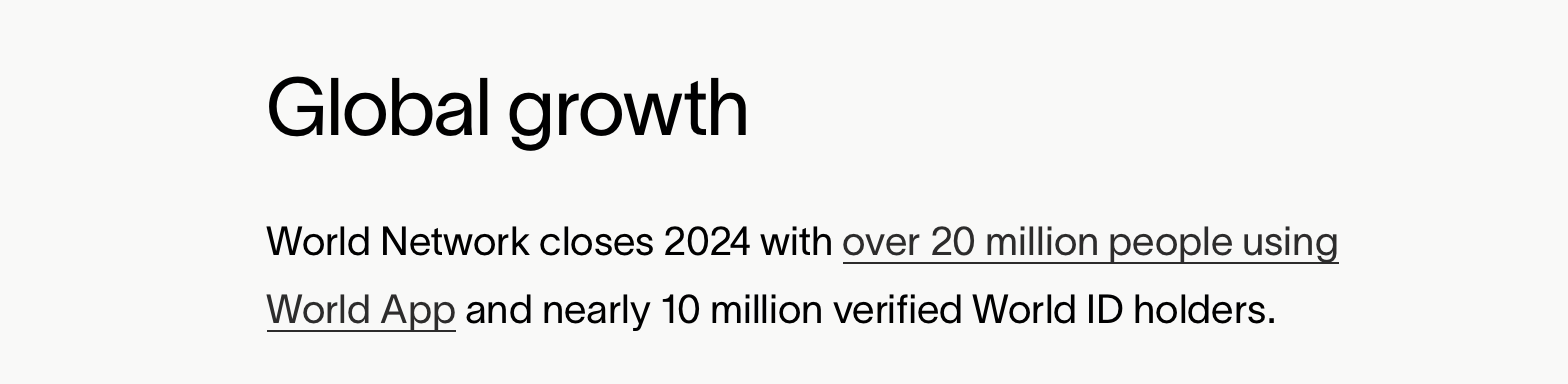
World, formerly recognized as Worldcoin, disclosed the project achieved progress in 2024, marking a transformative chapter for the initiative. The network grew to encompass over 20 million participants, including 10 million verified human users expanding its global footprint.
Key Developments Propel World Network to 20M Participants in 2024

This article was published more than a year ago. Some information may no longer be current.
WRITTEN BY

SHARE

World Advances Blockchain Technology Amid Rapid Network Growth
In a 2024 summary, the World.org blog reported that San Francisco hosted the “New World” event in October, presenting what it called key developments. Among these were the Nvidia-powered Orb for identity verification, World App 3.0 with Mini Apps, and World ID 3.0, described as improvements to privacy and credential handling. The blog noted that the event marked the official rebranding from Worldcoin to World, claiming it captured the attention of live attendees and online viewers alike.
Earlier in the year, World introduced its Secure Multi-Party Computation (SMPC) protocol, which it described as a step forward for digital privacy. The technology encrypted and fragmented user data, purportedly protecting anonymity and enabling the deletion of outdated iris codes. The blog further stated that in 2024, the next iteration, Anonymized Multi-Party Computation (AMPC), was set to go further in restricting access to fragmented sensitive data, though details of its effectiveness remain to be seen.
In April, the project announced World Chain, a layer two ( L2) blockchain designed to cut costs and quicken transaction speeds. By October, the blockchain had officially launched, incorporating what World termed “priority blockspace for humans,” a feature aimed at streamlining transactions for verified users. This focus on simplified transactions aligns with the project’s stated objective of prioritizing community needs.
By the end of the year, World claimed to have extended its global footprint through verification campaigns in nations such as Austria, Brazil, and Malaysia. The addition of Mini Apps within the World App reportedly boosted daily engagement, which the project positioned as evidence of its utility and expansion. While these developments are presented as laying a strong foundation for 2025, questions linger about the broader implications of World’s role in blockchain technology and digital identity initiatives.
Nation-State Inquiries
2024 also brought intensified regulatory scrutiny. Authorities in multiple nations examined the project’s handling of biometric data, privacy safeguards, and legal compliance. In Kenya, the National Assembly found World in violation of local statutes, including the Data Protection Act of 2019, following the suspension of activities in 2023. In July 2024, Kenyan police said the agency ended its investigation into the matter.
Meanwhile, Hong Kong’s Privacy Commissioner launched an investigation in January into the project’s iris-scanning practices, later concluding a breach of the Personal Data (Privacy) Ordinance and issuing an enforcement directive to cease operations. In Spain, regulators compelled World to halt biometric data collection and erase previously gathered information under GDPR guidelines. Similar privacy-focused investigations persisted in France and Germany. Colombia began evaluating data management practices, while South Korea imposed penalties in September for regulatory infractions.
World’s developments in 2024 illustrate its ambition to reshape digital identity and blockchain technology. Yet, as milestones blend with government scrutiny, the project’s path forward highlights the fragile balance between innovation and regulation. Its ability to address compliance and safeguard user trust will likely define its impact, serving as a litmus test for how blockchain initiatives can navigate global oversight and scale responsibly with user data.