On March 1, Chainalysis observed that Iran’s largest crypto exchanges were offline, a report consistent with the complete disruption of the internet connection coming from the regime. TRM Labs found that Iran’s crypto transaction volumes fell by 80% since February 28, when the first strike happened.
Iran's Conflict and Internet Disruptions Hit Local Crypto Industry
WRITTEN BY

SHARE
Iran’s Crypto Industry in Containment Mode After Airstrikes
Iran, one of the largest crypto economies in the world, has been severely affected following the joint strikes that the U.S. and Israel are conducting against the Iranian regime.
Chainalysis noted that, after the first wave of strikes happened on February 28, Nobitex and Ramzinex, two of the largest cryptocurrency exchanges in the country, were offline. The reports are consistent with what internet observatory Netblocks has registered, with 99% of Iran’s connectivity affected for over 60 hours at the time of writing.
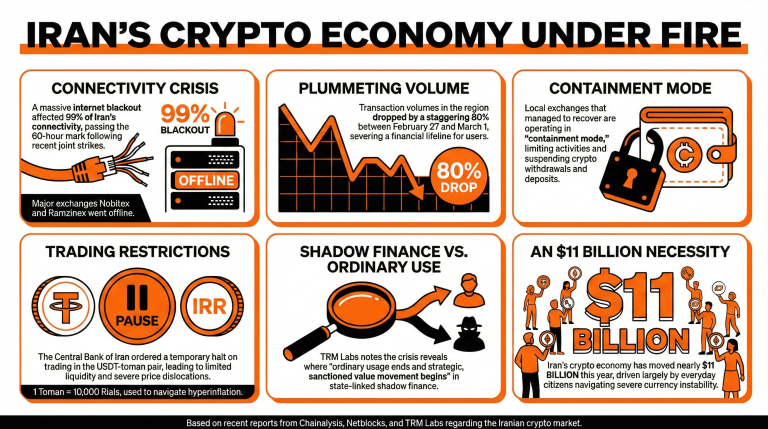
This has made it difficult for users to access their funds on local exchanges, cutting a lifeline for people in need of dollars amidst a war economy. TRM Labs, which recently published a report on how Iran’s crypto economy is reacting to the ongoing conflict, found that transaction volumes dropped by 80% between February 27 and March 1.
Nonetheless, TRM Labs clarified that local exchanges could recover and operate in containment mode, limiting their activities and some even suspending crypto withdrawals and deposits until further notice.
Another issue affected the market as the Central Bank of Iran ordered the halting of trading in the USDT-toman pair. The toman is a superunit of the Iranian rial valued at 10,000 rials, commonly used for currency devaluation purposes.
After this restriction was lifted, local exchanges operated with limited liquidity, experiencing corresponding price dislocations consistent with a correction.
About these post-strike movements, Global Head of Policy at TRM Labs Ari Redbord stated:
“The current environment will reveal where ordinary usage ends and strategic, sanctioned value movement begins, and it underscores why understanding the interplay between crypto and state-linked shadow finance is more important than ever.”
Iran’s crypto economy has moved nearly $11 billion this year, much of which TRM Labs attributes to “everyday Iranians navigating currency instability and restricted access to the traditional banking system.”
Israeli Markets Hit All-Time Highs Amid Military Conflict With Iran
Israeli markets achieved record peaks on March 2, 2026, bucking a global downturn despite the onset of a joint U.S.-Israeli…
Read Now

Israeli Markets Hit All-Time Highs Amid Military Conflict With Iran
Israeli markets achieved record peaks on March 2, 2026, bucking a global downturn despite the onset of a joint U.S.-Israeli…
Read NowIsraeli Markets Hit All-Time Highs Amid Military Conflict With Iran
Read NowIsraeli markets achieved record peaks on March 2, 2026, bucking a global downturn despite the onset of a joint U.S.-Israeli…
FAQ
-
How have recent strikes affected Iran’s crypto economy?
Iran’s crypto economy has been severely impacted, with transaction volumes dropping by 80% between February 27 and March 1 after the strikes began. -
What happened to major cryptocurrency exchanges in Iran following the strikes?
Two major exchanges, Nobitex and Ramzinex, went offline due to a significant internet blackout affecting 99% of Iran’s connectivity. -
What restrictions did the Central Bank of Iran impose on trading?
The Central Bank ordered a halt on trading in the USDT-toman pair, complicating access to necessary funds for many users. -
What is the significance of Iran’s current crypto activity?
With nearly $11 billion moved this year, Iran’s crypto activity reflects how ordinary citizens are navigating currency instability and limited banking access.