The exchange oversees 3.84 million in staked ether ( ETH) which accounts for 11.42% of all staked ETH.
Inside Coinbase’s Validator Operations: 120K Nodes and Counting

This article was published more than a year ago. Some information may no longer be current.
WRITTEN BY

SHARE

Coinbase Releases Performance Metrics for Its 120,000 Validators
Cryptocurrency exchange Coinbase (Nasdaq: COIN) released its inaugural Ethereum Validator Report last week, giving the public an inside glimpse into the firm’s staking operations for the first time.
Coinbase is the second largest staker of ether ( ETH), second only to liquid staking behemoth Lido. America’s largest exchange stated in its most recent shareholder letter published in February, that its goal in 2025 is to grow its subscription and services revenue, the latter of which includes staking. That revenue clocked in at $2.3 billion in 2024.
And now, with 120,000 validators under its care, 3.84 million ETH staked, worth more than $8 billion at current prices, and performance metrics that exceed industry averages across the board, Coinbase certainly looks and plays the part of a marquee Ethereum staking provider.
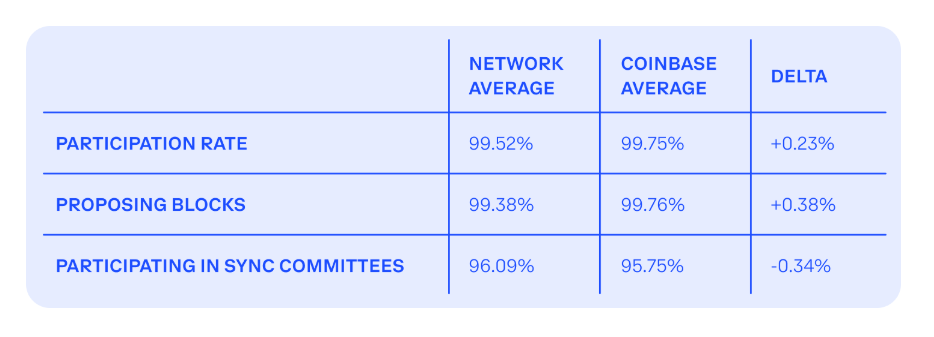
The firm’s validators were online and available 99.75% of the time, and processed transactions at a 99.75% “participation rate.” Coinbase proposed blocks at a 99.76% rate, above the corresponding network average of 99.38%. Participation in so-called “sync committees” that help light clients sync blockchain data more effectively, was the only area where Coinbase was below the network average.
COIN closed the day at 203.04, up 6.94% over 24 hours.