Over the past decade, SoFi has evolved far beyond its original roots as a student loan refinancing company. Founded in 2011, the company gradually expanded into a comprehensive financial ecosystem that now includes checking and savings accounts, personal loans, mortgages, investing tools, insurance products, credit cards, and financial planning services.
SPONSORED CONTENT
This article was written by Bitcoin.com News on behalf of SoFi. This is sponsored content produced by the Bitcoin.com News editorial team.
Hands-on Review by Bitcoin.com - Digging Into SoFi’s Crypto Banking Strategy
SHARE
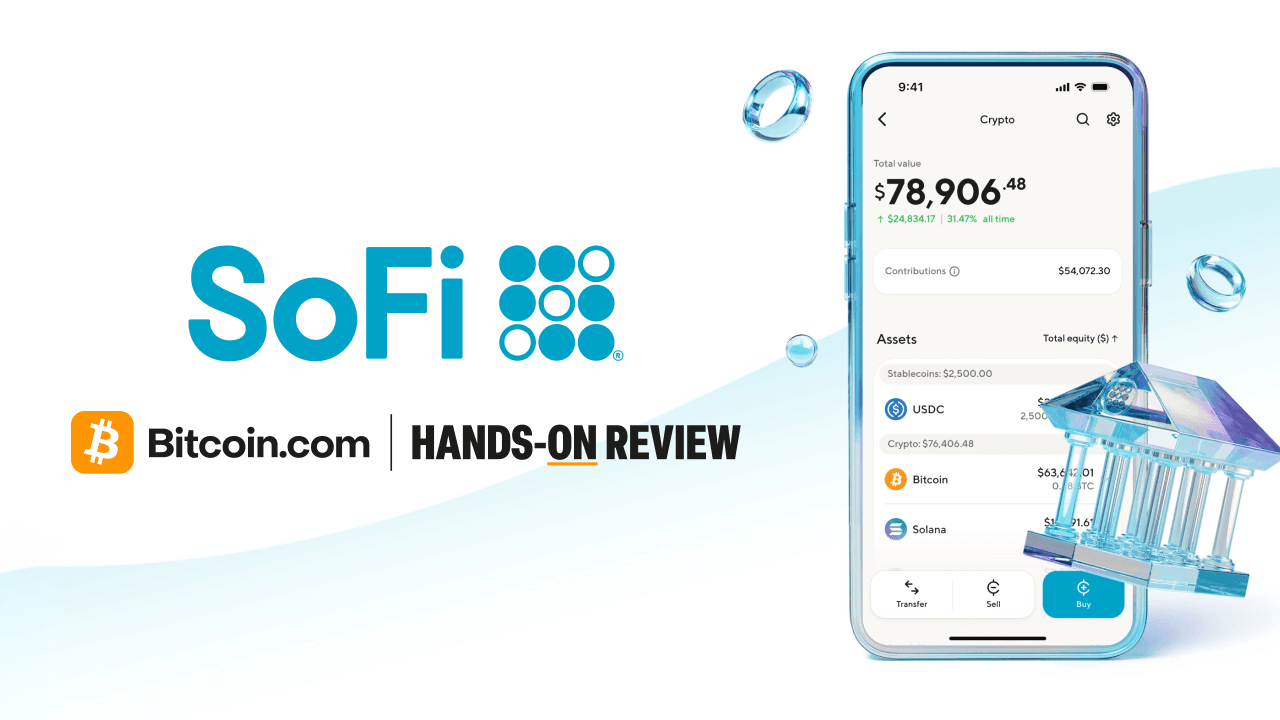
Today, SoFi positions itself as a centralized financial hub where users can manage multiple parts of their financial lives in one place. Banking, borrowing, investing, saving, and now crypto all sit inside the same ecosystem.
That strategy becomes especially clear when looking at SoFi Crypto.
The company takes a different approach from crypto-native exchanges focused on advanced trading depth, positioning digital assets as an integrated feature inside a federally regulated banking environment.
In many ways, the product is built around one core idea: bringing crypto into mainstream digital banking.
Where Crypto Meets Modern Banking
SoFi describes its crypto experience as a place “where crypto meets modern banking,” and that positioning shapes nearly every part of the product.
Instead of requiring users to move between separate exchanges, bank accounts, and external financial apps, SoFi brings those services together inside a single platform. Users can buy, sell, and hold cryptocurrencies while managing checking accounts, savings balances, investing portfolios, and other financial products within the same environment.
That integrated structure is one of the platform’s strongest differentiators.
Funding crypto purchases is directly tied to SoFi Checking and Savings accounts, allowing users to move funds instantly into crypto trades without the delays commonly associated with external bank transfers. Users can also fund their crypto accounts using Google Pay or Apple Pay. The experience is streamlined, with onboarding, funding, and account management all operating within a connected ecosystem.
Rather than asking users to enter a separate crypto-native environment, SoFi is focused on placing digital assets alongside its existing suite of financial services.
A Crypto Experience Built Around Accessibility
SoFi Crypto currently supports more than 25 cryptocurrencies, including Bitcoin, Ethereum, Solana, XRP, Cardano, Dogecoin, Chainlink, Avalanche, and USDC.
Compared with large exchanges offering hundreds of tokens, the selection is more curated. But that narrower lineup also aligns closely with SoFi’s mainstream positioning. The platform is focused on recognizable cryptocurrencies that newer or more traditional investors are already likely familiar with.
The overall experience prioritizes accessibility over complexity.
Opening a SoFi Crypto account is straightforward, requiring standard identity verification and a connected SoFi Checking and Savings account. Once linked, users can fund trades instantly and manage crypto alongside the rest of their finances inside the app.
The platform also includes educational prompts and in-app guidance aimed at helping users better understand how crypto buying, selling, and holding works. Recurring purchases are available as well, allowing users to automate dollar-cost averaging strategies on a schedule that fits their preferences.
That recurring investment functionality suits SoFi’s likely audience: longer-term retail users interested in gradual exposure to digital assets, not high-frequency active trading.
Crypto Through a Federally Regulated Bank
One of SoFi Crypto’s biggest selling points is not necessarily its trading tools or token count. It is the banking structure surrounding the product.
SoFi operates as a nationally chartered U.S. bank and emphasizes the safeguards, familiarity, and compliance standards associated with that structure. In a crypto industry that has experienced major exchange collapses, regulatory disputes, and ongoing trust concerns over the past several years, those qualities may resonate with users seeking a more familiar entry point into digital assets.
The product is especially relevant for:
- traditional finance users,
- first-time crypto buyers,
- existing SoFi banking customers,
- and users who prefer accessing crypto through a federally regulated institution.
That positioning places SoFi Crypto closer to integrated fintech investing experiences than highly technical crypto trading platforms built primarily for advanced users.
At the same time, the company carefully distinguishes its banking protections from the crypto assets themselves. Cryptocurrencies held within SoFi Crypto are not FDIC-insured or SIPC-protected and are not considered bank deposits.
That distinction is important because while the banking structure may create additional operational familiarity and oversight, the underlying market risks associated with digital assets still remain.
Simplicity Over Trading Complexity
One of the clearest themes throughout the SoFi Crypto experience is simplification.
The interface avoids much of the technical complexity found on many crypto trading platforms. Instead of deep order books, advanced charting systems, or highly specialized trading tools, the environment prioritizes simplicity and ease of use.
The platform operates 24/7, allowing users to trade at any time, while the fee structure follows the same straightforward approach. SoFi currently charges a flat 1% fee on crypto buy and sell transactions.
The company also explains that transaction pricing may include a spread between live market pricing and execution pricing. According to SoFi, that structure helps secure transaction settlement at the moment an order is placed while simplifying execution for users.
Again, the emphasis is on ease-of-use and clarity rather than advanced trader optimization.
Several parts of the product reinforce this design philosophy:
- instant funding through linked SoFi accounts,
- recurring purchases,
- simplified onboarding,
- educational guidance,
- and a curated asset selection focused on larger cryptocurrencies.
The experience is designed to reduce friction wherever possible.
Convenience Versus Control
The connected account structure also reveals how deeply integrated SoFi Crypto is within the company’s financial ecosystem. Users must connect SoFi Checking and Savings accounts to fully access the crypto product, reinforcing its role as part of a unified banking experience.
That integration creates several conveniences:
- instant settlement,
- simplified transfers,
- centralized account management,
- and fewer moving parts between banking and investing activities.
The product’s custodial structure follows the same approach.
Users can buy, sell, and hold crypto within the SoFi environment, but the experience is designed around managed convenience rather than extensive self-custody functionality. For many mainstream users, that may feel more straightforward than managing private keys independently through external wallets.
At the same time, the platform is not primarily focused on advanced DeFi integrations, extensive trading customization, or highly technical crypto-native functionality. Instead, SoFi Crypto feels intentionally optimized around accessibility, familiarity, and integrated financial management.
A Broader Blockchain Strategy
SoFi’s relationship with crypto also extends beyond retail trading alone.
The company previously stepped away from crypto services in 2023 due to regulatory conditions tied to its banking charter before later re-entering the market as U.S. guidance around digital assets and banking infrastructure evolved.
That relaunch aligns with a wider blockchain strategy.
In recent years, SoFi has explored blockchain-powered remittances, stablecoin infrastructure, and future blockchain integrations tied to its broader financial services ecosystem.
Initiatives involving SoFiUSD, blockchain-enabled transfers, and infrastructure partnerships suggest the company views blockchain technology as an increasingly important component of modern financial services.
Viewed through that lens, SoFi Crypto fits into a long-term effort to integrate digital assets into mainstream financial rails.
Closing Insights
SoFi Crypto is designed for users who want crypto exposure inside a familiar banking environment. Integrated financial management, simplified onboarding, instant funding, recurring investing, and the ability to manage multiple financial products within one connected app all contribute to the overall experience.
Its strongest differentiator may ultimately be the way it blends crypto with a federally regulated banking structure. That familiarity could make digital assets easier to incorporate into everyday financial life.
At the same time, the product’s overall design reflects clear priorities. SoFi Crypto centers on accessibility, convenience, and mainstream usability.
In that sense, SoFi is not trying to reinvent crypto trading itself. Its focus is on making crypto a natural extension of modern digital banking.
_________________________________________________________________________
Bitcoin.com accepts no responsibility or liability, and shall not be liable, whether directly or indirectly, for any loss, damage, claim, cost, or expense of any kind, whether actual, alleged, or consequential, arising out of or in connection with the use of, or reliance upon, any content, goods, or services referenced in this article. Any reliance placed on such information is strictly at the reader’s own risk.