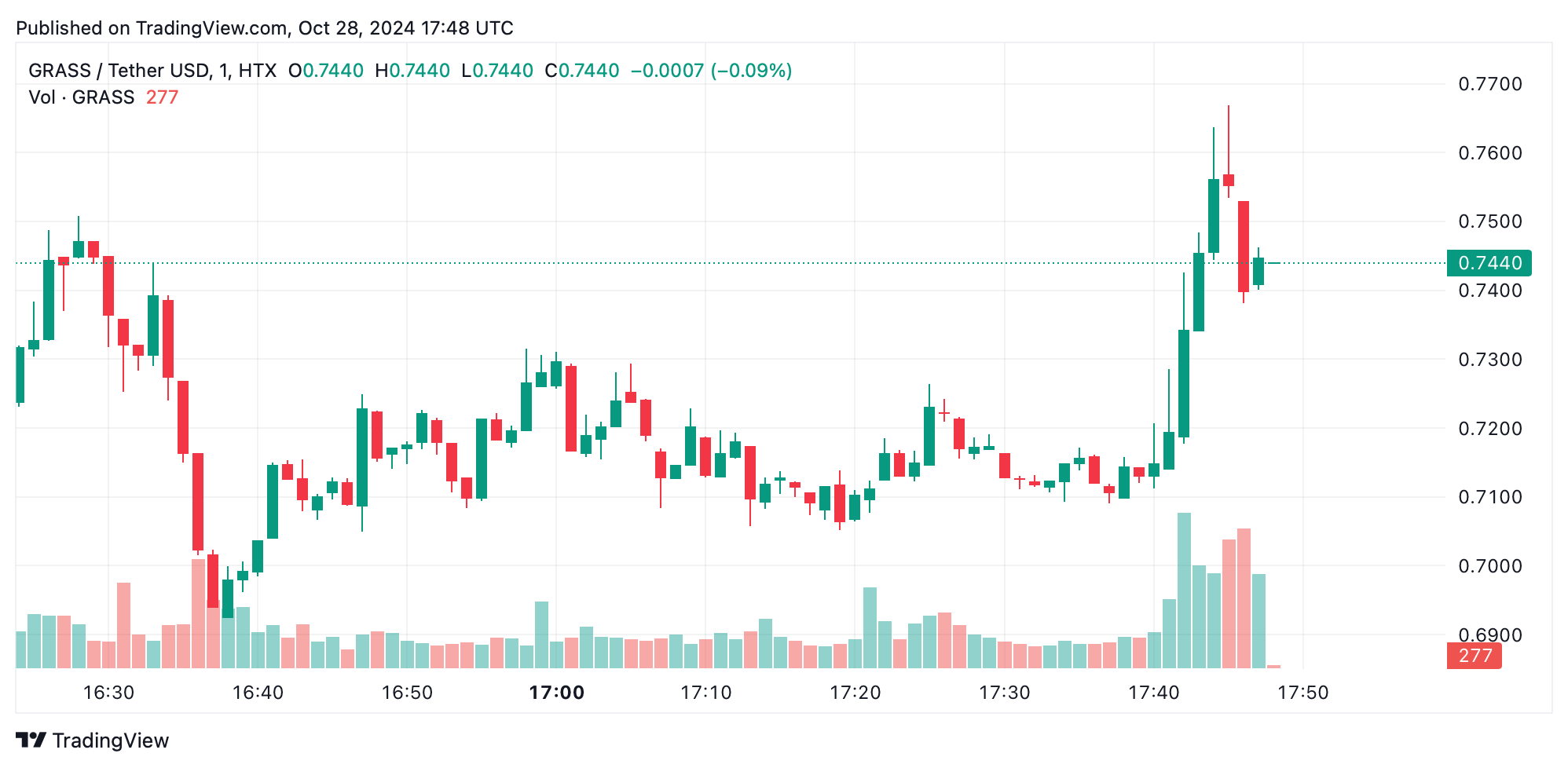
Following its much-anticipated airdrop, Grass’s GRASS token struggles to gain momentum in a challenging market debut on Oct. 28, 2024.
Grass Network’s GRASS Token Falls Short in Market Debut After Airdrop

This article was published more than a year ago. Some information may no longer be current.
WRITTEN BY

SHARE

GRASS Token Airdrop Stumbles Amid Technical Issues and Market Decline
The Grass network, a decentralized layer two ( L2) platform on Solana, offers users the option to share their unused internet bandwidth to support data collection for training artificial intelligence (AI) models. Marketed as privacy-conscious, Grass’s framework enables users to passively earn through a browser extension that taps into idle bandwidth, channeling data for AI training while claiming to avoid collecting personal details.
Grass Foundation promotes this data-gathering strategy as a distinctive addition to the growing AI field, supplying what it asserts as secure, verifiable data for AI developers. Grass’s longer-term vision revolves around a sustainable AI data repository, focusing on a decentralized, user-oriented approach. It aims to drive the AI industry forward by establishing a data ledger built on verifiable datasets, backed by zero-knowledge proofs for integrity and transparency.
Project leaders present this as a path toward an ethical AI ecosystem where users are compensated for their data contributions, addressing AI development demands while adhering to data collection principles. This ambition echoes the rising demand for AI training data as the big data sector expands.
However, Grass’s token distribution on Oct. 28 encountered unanticipated obstacles. Technical issues prevented numerous Phantom wallet users from accessing their GRASS tokens, sparking frustration and criticism in online communities.
The airdrop, aimed at rewarding early supporters and contributors, allocated 10% of the token’s total supply, or 100 million GRASS, yet was overshadowed by these operational missteps. These setbacks have cast doubt on Grass’s readiness and planning capabilities, marring initial excitement around the token release.
On launch day, the GRASS token showed a lackluster market performance, potentially indicating market hesitation and compounded by the technical issues seen during the airdrop. Initial interest in the token faded on the market, with broader market conditions and exuberent sell pressure contributing to a value decrease.
Grass’s initial technical setbacks and weak trading activity could jeopardize its ability to maintain user support, highlighting the critical role of infrastructure preparedness in blockchain airdrop events. Lately, however, airdrops have been taking some hits, and hamster kombat (HMSTR) is a prime example. Just like many other airdrops, it waded through its own significant market downtrend after launch.