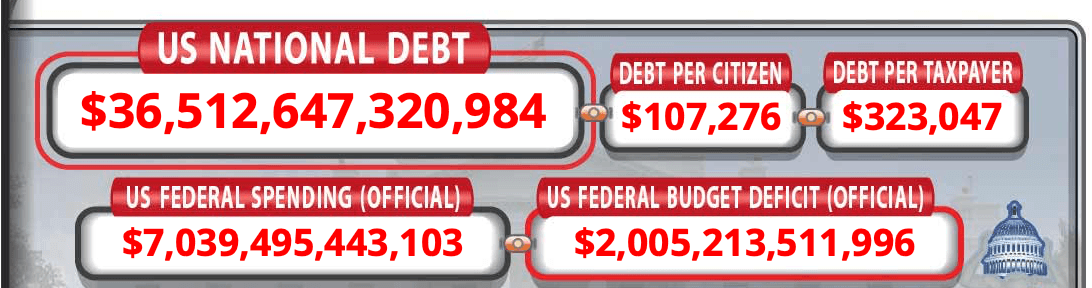
A perennial inquiry among financial circles—from bitcoin enthusiasts to gold stalwarts—centers on the U.S. national debt’s vertiginous climb to $36.51 trillion by Feb. 22, 2025. Contrary to the specious assertions of certain commentators who simplistically blame tax reductions, the crux lies in three interlocking forces: expansive fiscal outlays, unrelenting shortfalls between revenue and expenditures, and the compounding weight of interest obligations.
From Reagan to Covid: The Factors Behind America’s $36.51 Trillion Debt

This article was published more than a year ago. Some information may no longer be current.
WRITTEN BY

SHARE
The Debt Dilemma Defined
Sound money proponents—bitcoin loyalists and gold adherents alike—argue that disciplined monetary frameworks (like fixed-supply currencies) inherently curb unchecked state borrowing by enforcing fiscal accountability. Free markets, they posit, permit natural economic corrections—bankruptcies, austerity—to prune excess. Fiat systems, by contrast, enable endless deficit financing through inflationary mechanisms, divorcing spending from tangible constraints.
What’s driving the colossal $36.51 trillion U.S. deficit? A closer look reveals its primary causes.
America’s debt first surpassed $1 trillion in 1981 under Ronald Reagan, largely fueled by military spending. The expansion of the military-industrial complex, spurred by initiatives like the Strategic Defense Initiative (SDI) and conventional forces programs, played a significant role. The Iran-Contra Affair also contributed, with billions lost to misappropriations. Alongside this, throughout Reagan’s tenure, nuclear modernization and the production of intercontinental ballistic missiles (ICBMs) grew significantly.
During Bill Clinton’s presidency, military spending climbed as the U.S. maintained an active presence in Somalia, Bosnia, Kosovo, Iraq, Haiti, and in Afghanistan and Sudan. Defense expenditures remained high during the Gulf War (1990–1991) and escalated again after the Sept. 11, 2001 attacks, funding prolonged operations in Afghanistan and Iraq.

Meanwhile, mandatory spending on entitlement programs such as Social Security and Medicare steadily increased over the years as demographic shifts placed greater demand on these systems. The debt hit $10 trillion in 2008 amid the Great Recession, driven further by financial bailouts and economic stimulus efforts.

These included rescue packages for financial institutions and automakers, along with emergency unemployment benefits. By 2017, the debt had climbed to $20 trillion after years of deficit spending under both Republican and Democratic administrations. Ongoing military commitments continued to add to the total, while trillions more were allocated to combat the economic fallout of the Covid-19 pandemic. According to the COVID Money Tracker, total authorized pandemic relief funding exceeded $4.6 trillion.
Misplaced Blame: Tax Cuts
Although evidence indicates that government spending raises the deficit, some critics—including a majority of Democratic party members and their followers—blame the rise on tax cuts. The argument that tax cuts cause the expanding national debt rests on the idea that wealth is owned by the state and merely ‘allocated’ to individuals or corporate entities at the government’s discretion. This premise—that the government ‘loses’ money when it allows individuals to keep more of their earnings—challenges the world’s traditional views of justice and private property.
The wealth generated by individuals and businesses is rightfully theirs rather than subject to bureaucratic permission. According to this perspective, the true driver of the debt is not a lack of taxation but unchecked government spending—spending driven by the conviction that bailouts are essential, that war is peace, and that the spending is ‘good’ because the government is allegedly “good.” The government increases its influence through entitlement programs, ongoing military interventions, and corporate bailouts, while also arguing that the productive class must forfeit additional earnings to support this unsustainable system.
The fact is tax cuts do not generate deficits; rather, deficits result solely from expenditures that exceed available revenue. Attributing the deficit to tax cuts implies that the government claims wealth before it is earned—a view that diminishes individual rights by portraying workers as subordinate contributors to an ever-growing state.
Restoring Accountability Through Sound Money
As noted earlier, sound money—supported by a fixed standard such as gold or bitcoin—provides a strict fiscal limit on government, curtailing imprudent deficit spending. Without the ability to print money indefinitely, the state must work within genuine economic constraints, compelling politicians to justify spending rather than inflate away accountability. This method restores accountability and restrains unchecked government growth.
Beyond U.S. borders, nations worldwide face similar challenges of excessive spending, relentless money printing, and central banks influencing economic outcomes. Many governments, from Europe to Asia, struggle with policies that fuel inflation and destabilize fiscal balance. These issues highlight that fiscal mismanagement by irresponsible governments is a global problem, affecting economies far and wide, not solely confined to America’s policy decisions with urgency.