Yang, who campaigned in favor of a $1,000 universal basic income (UBI) back in 2020, stated that as more companies substitute labor with AI, there should be a shift to tax these artificial solutions rather than labor, as a popular backlash against the tech is brewing.
Former Presidential Hopeful Andrew Yang Proposes to Tax AI Instead of Labor
WRITTEN BY

SHARE

Andrew Yang Vows to Tax AI Instead of Labor
As technologies like artificial intelligence (AI) become widespread in the workplace, threatening workers, analysts are starting to discuss how to deal with the upcoming layoff wave and its unavoidable consequences.
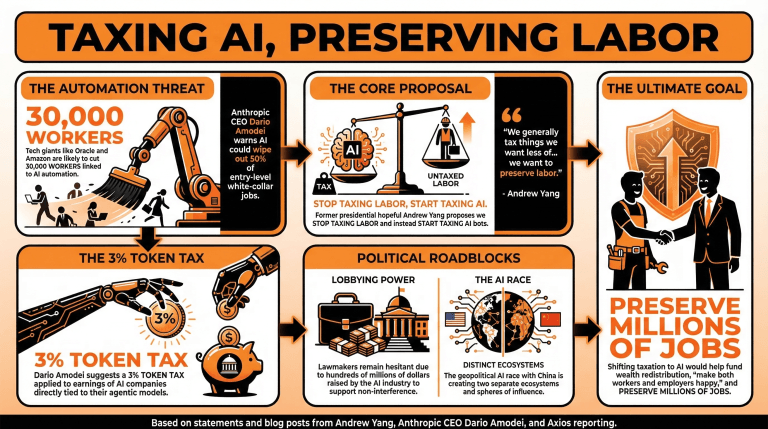
Andrew Yang, a former presidential hopeful who campaigned on a universal basic income (UBI) dividend for Americans, has proposed a tax on companies that use AI bots and stop taxing labor.
In a recent blog post, Yang pointed out that Oracle and Amazon would likely cut 30,000 workers linked to AI automation, and that there should be moves to preserve labor.
He stressed:
“We generally tax things we want less of. In this situation, we want to preserve labor in every corner and environment. So we should stop taxing labor and instead take the advice of Dario Amodei, the CEO of Anthropic, and start taxing AI.”
Amodei, who has warned that AI could wipe out half of all entry-level white-collar jobs, has suggested a 3% token tax that could raise millions to finance wealth redistribution. The tax would apply to earnings of AI companies directly tied to the use of their agentic models, with some of these funds going “to the government” and being “redistributed in some way,” he told Axios in 2025.
Nonetheless, Yang acknowledges lawmakers have not delved into the AI issue, in part due to the industry’s lobbying power, with hundreds of millions raised so far to support a non-interference policy as the AI race with China continues.
Yang highlighted that the AI race will not be won on the amount of dollars spent, and that Chinese and U.S. AI models are already “separating into two ecosystems and spheres of influence.”
Finally, Yang concluded that the shift to tax AI would “make both workers and employers happy” and help “preserve millions of jobs in a time when that should be the top priority.”
$2K per Month for Every American: Andrew Yang Begs Congress to Pass Basic Income
While most of the U.S. remains on lockdown, a few states across the nation are starting to open up businesses…
Read Now

$2K per Month for Every American: Andrew Yang Begs Congress to Pass Basic Income
While most of the U.S. remains on lockdown, a few states across the nation are starting to open up businesses…
Read Now$2K per Month for Every American: Andrew Yang Begs Congress to Pass Basic Income
Read NowWhile most of the U.S. remains on lockdown, a few states across the nation are starting to open up businesses…
FAQ 🔎
- Why is Andrew Yang proposing a tax on AI? Yang suggests taxing AI companies instead of human labor to protect workers from an impending wave of AI-driven layoffs.
- What specific AI tax model is being discussed? The proposal builds on Anthropic CEO Dario Amodei’s idea of a 3% tax on AI earnings to fund government wealth redistribution.
- Why are US lawmakers hesitant to tax AI? Legislative action remains stalled due to massive industry lobbying efforts and competitive concerns regarding the global AI race with China.
- How would this tax shift benefit the workforce? Shifting the tax burden from labor to AI would theoretically incentivize companies to retain millions of human jobs.