


Prediction markets and the CME Fedwatch tool are lining up behind the U.S. Federal Reserve holding rates steady in September, but anyone watching the board knows this is hardly a done deal. Traders have moved toward a pause, yet the pricing still leaves plenty of room for another hike.
Fed Hike Bets Crack as September Hold Odds Storm Into Lead
WRITTEN BY

SHARE
Key Takeaways
- Polymarket gives a September Fed hold 63% odds after more than $20.3 million traded.
- Kalshi prices a Fed hold at 65%, while CME Fedwatch puts the probability at 55.6%.
- CME’s Fedwatch tool still gives a Sept. 16 hike 44.4% odds, keeping the decision wide open.
Across some of the market’s closely watched gauges, the hold trade currently has the edge. Polymarket puts the probability of no change at 63%, Kalshi prices it at 65%, and CME’s Fedwatch monitor shows a much tighter 55.6% chance that the Fed keeps its target range at 3.50% to 3.75%.
Prediction Markets Put the Hold Trade in Front
Polymarket’s “Fed Decision in September?” market has pulled in more than $20.3 million in total trading volume.
No change on Polymarket trades at 63 cents, translating into roughly a 63% implied probability, while a quarter-point increase sits at 36%. A quarter-point cut is priced at just 1.6%, making the real wager obvious: traders are betting on whether the Fed pauses or hikes.
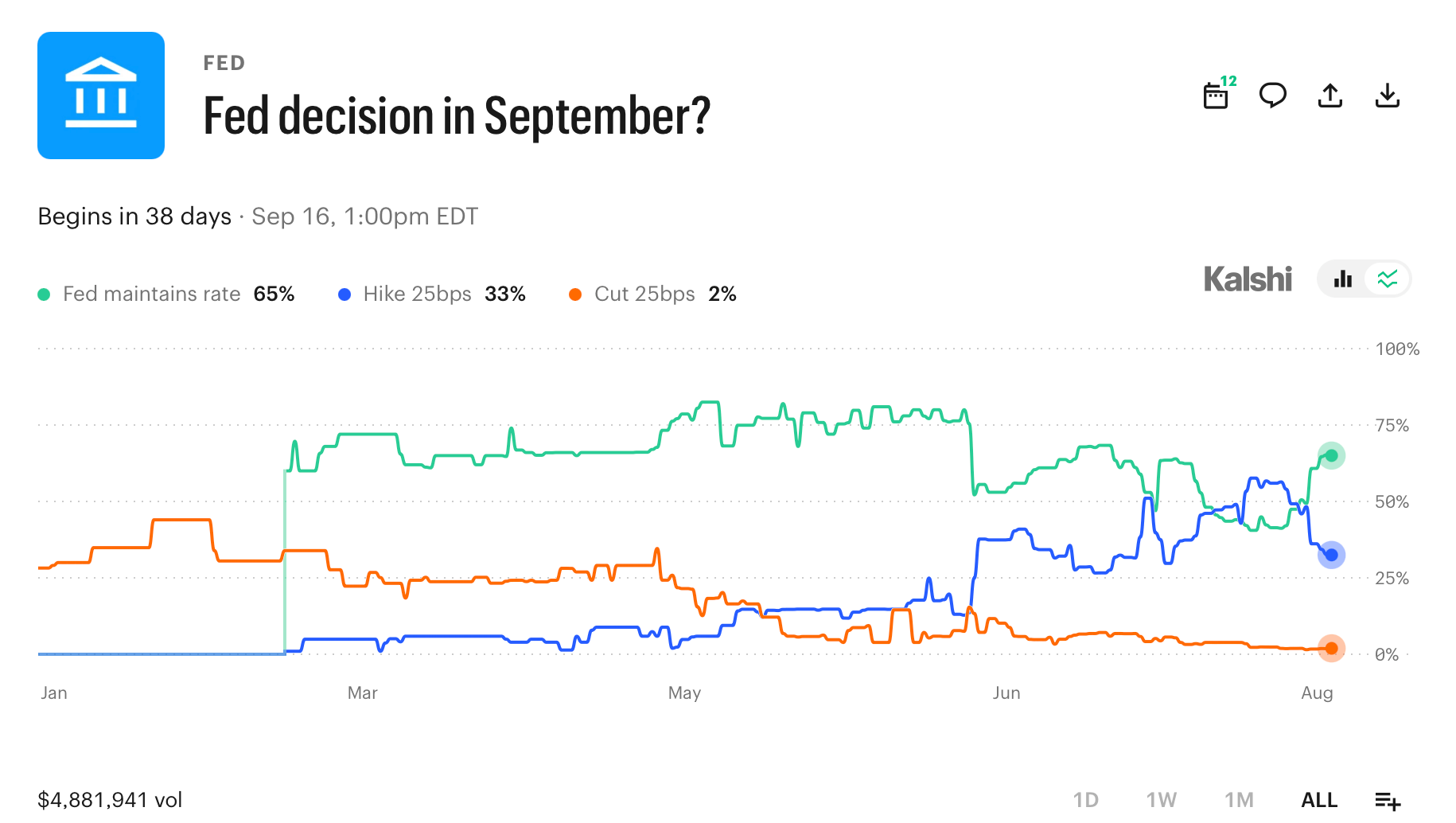
Kalshi’s September Fed decision market, with nearly $4.9 million in volume, tells almost the same story. Contracts give the Fed maintaining rates a 65% chance, compared with 33% for a 25-basis-point hike and only 2% for a quarter-point cut. One basis point equals one-hundredth of a percentage point, meaning a 25-basis-point move equals a quarter percentage point.
The alignment between the two leading prediction markets matters because these are not survey answers or Wall Street talking points. Traders are putting actual money behind the probabilities. Between Polymarket and Kalshi, more than $25 million has traded around September’s decision, and both markets currently put a hold roughly 30 percentage points ahead of a hike.
CME Fedwatch Keeps the Hike Very Much Alive
CME’s Fedwatch tool, however, refuses to call this race early. The tool currently assigns a 55.6% probability to no change on Sept. 16 and a 44.4% probability to a quarter-point hike. CME’s Fedwatch calculates those probabilities from prices in 30-Day Federal Funds futures, contracts traders use to position around expectations for future Federal Reserve policy.
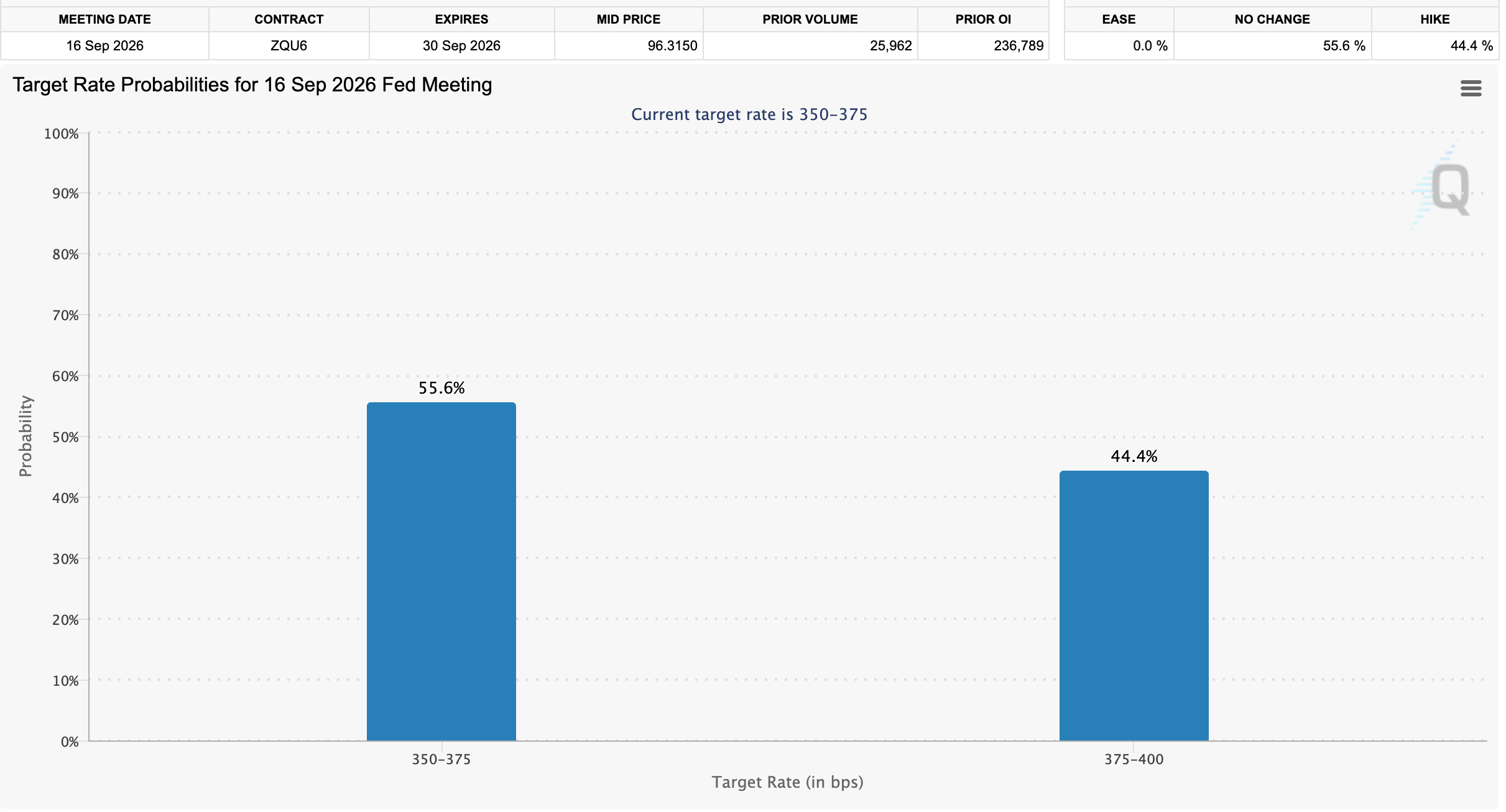
That makes the CME market easily the most hawkish of the three. Polymarket gives a hike 36% odds and Kalshi puts it at 33%, while CME’s Fedwatch monitor sits nearly 9 to 11 percentage points higher. All three favor a hold, but futures traders clearly are not buying the idea that September is already settled.
The CME numbers have also swung hard. A week earlier, on July 31, Fedwatch showed a 67% chance of a quarter-point hike and only a 33% probability of no change, according to the supplied market data. The current 55.6% hold probability therefore marks a serious reversal in just over a week.
One Jobs Report Rewrote the Betting Board
That reversal accelerated after the July employment report showed nonfarm payrolls falling by 23,000 while unemployment held at 4.1%. The weaker labor picture gave traders fresh ammunition to question whether the Fed needs to raise borrowing costs again this quickly. The Bureau of Labor Statistics released the report Aug. 7.
Prediction markets responded by shoving the hold trade into a clearer lead, while CME futures moved toward a coin flip. That gap matters because the three markets price expectations differently, yet they are arriving at the same basic verdict: a cut is barely on the board, and September has become a showdown between standing pat and hiking by a quarter point.
The Fed kept its target range unchanged at 3.50% to 3.75% at its July 28-29 meeting. Its next meeting runs Sept. 15-16, with the policy announcement scheduled for Sept. 16.
CPI Could Flip the Odds All Over Again
The next major test for Polymarket, Kalshi and CME Fedwatch will be inflation. If price pressures land hotter than expected, those 33% to 44.4% hike probabilities could jump fast. A softer reading would likely push even more money toward the hold side of the market.
For now, the scoreboard favors a pause but offers nothing resembling certainty: Polymarket says 63% hold, Kalshi says 65%, and CME Fedwatch says 55.6%. The question is no longer whether traders favor a September pause. They do. The real question is whether incoming inflation and labor data can keep that trade alive before the Fed votes Sept. 16.
This editorial is from this week’s edition of the newsletter Week in Review, sent to subscribers on Friday. Subscribe to…
Read Now: CLARITY Stalls, Coldcard Fallout Continues, Bitcoin Barely Budges