



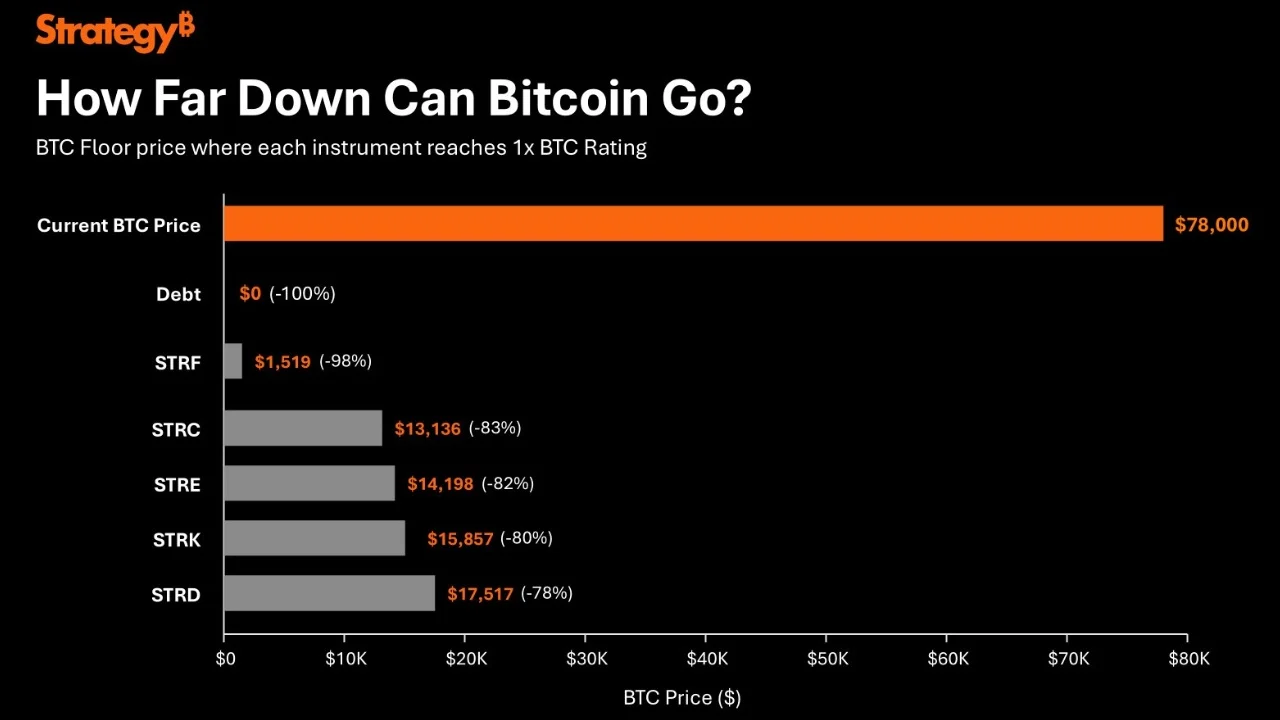
Based on Strategy’s model, bitcoin would need to fall 83% before STRC reaches a 1x BTC Rating. The company maps its preferred securities against separate bitcoin price thresholds under an internal calculation.
Strategy: Bitcoin Would Have to Fall 83% for STRC to Hit 1x BTC Rating
WRITTEN BY

SHARE
Key Takeaways
- Strategy says bitcoin would need to fall 83% to reach STRC’s $13,136 threshold.
- STRD had the highest displayed bitcoin threshold at $17,517.
- BTC Rating is an illustrative metric, not an external credit rating.
Why Strategy Published the Bitcoin Floor Chart
Strategy Inc. (Nasdaq: MSTR) used the Sept. 1 chart to address a central risk created by its capital structure: how far bitcoin could decline before the reserve’s modeled value matched the obligations counted for each security. The company stated:
“$BTC would have to fall 83% from current levels before $STRC reaches a 1x BTC Rating.”
A 1x BTC Rating means that, under Strategy’s internal calculation, the value of its bitcoin reserve equals the notional debt and preferred-stock claims included for that instrument. A rating above 1x indicates that the modeled bitcoin value exceeds those claims. It does not mean STRC would default, stop paying dividends, or trade at a particular price once bitcoin reached $13,136.

Each security has a different threshold as the calculation includes a different amount of the company’s capital structure. The chart listed $1,519 for STRF, $13,136 for STRC, $14,198 for STRE, $15,857 for STRK, and $17,517 for STRD. Debt reached 1x at zero under the displayed model.
The gap between bitcoin’s price and STRC’s $13,136 threshold supports Strategy’s argument that its bitcoin reserve provides substantial modeled asset coverage. However, the calculation does not measure the cash available for dividends, the securities’ market values, or potential recovery during a restructuring. Strategy’s credit metrics also note that BTC Rating is illustrative, excludes potential cross-defaults, and is not an external credit rating.
The thresholds shown on the company’s chart represent a snapshot rather than fixed protection levels. Future bitcoin purchases or sales, preferred-stock issuance or repurchases, debt changes, and movements in dollar assets could alter the calculations even if bitcoin’s market price remained unchanged.
What Strategy’s 1x BTC Rating Measures
Strategy’s latest capital update showed that the company held 845,050 BTC and $6.71 billion in dollar assets as of Aug. 30. The Aug. 31 disclosure also reported a $152 million STRC repurchase and a $30 million allocation to USD Cash, bringing that balance to $1.61 billion.
The broader Digital Credit Capital Framework established policies governing preferred-stock dividends, repurchases, dollar reserves, and potential bitcoin sales. Strategy had increased the STRC annual dividend rate to 12% and set a corporate objective of keeping the security near its $100 stated amount.
The company’s latest bitcoin purchase added 4,603 BTC for approximately $369.7 million at an average price of $80,318 per coin. Strategy also reported zero net leverage after the transaction, while coverage of the capital update described how the bitcoin acquisition, cash increase, and STRC repurchase affected its balance sheet.
Strategy cautions that the metric excludes possible cross-defaults and uses preferred-stock notional values, even when liquidation preferences could exceed those amounts. The company also states that BTC Rating is neither a liquidity measure nor a key performance indicator.
Bitcoin Supports Strategy’s Expanding Capital Structure
Strategy has described bitcoin, digital credit, and common equity as three connected parts of its long-term capital model. The company set an ambition to become the world’s largest public company while presenting BTC as its reserve base, STRC as a credit instrument, and MSTR as equity offering amplified bitcoin exposure.
The structure extends beyond the model of a company that merely holds cryptocurrency on its balance sheet. A bitcoin corporate treasury can acquire BTC through operating funds, stock issuance, debt, or preferred securities, exposing investors to both bitcoin price movements and the company’s financing decisions.
Strategy’s capital model has also become central to its dispute with MSCI over a proposed index eligibility test. The company argues that its bitcoin operations constitute an active business rather than passive asset ownership. The MSCI consultation closes Sept. 30, with a decision expected by Oct. 16.
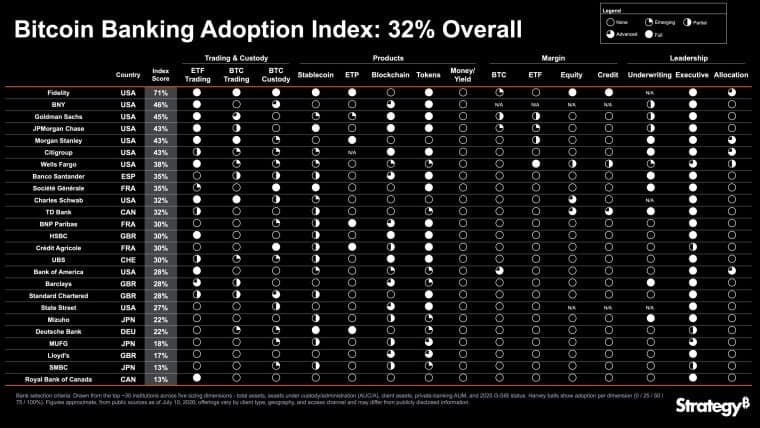
Strategy unveiled its Bitcoin Banking Adoption Index on July 13, finding that major banks and financial institutions are expanding bitcoin…
Read Now: Strategy Launches Bitcoin Bank Adoption Index With 32% Overall Score