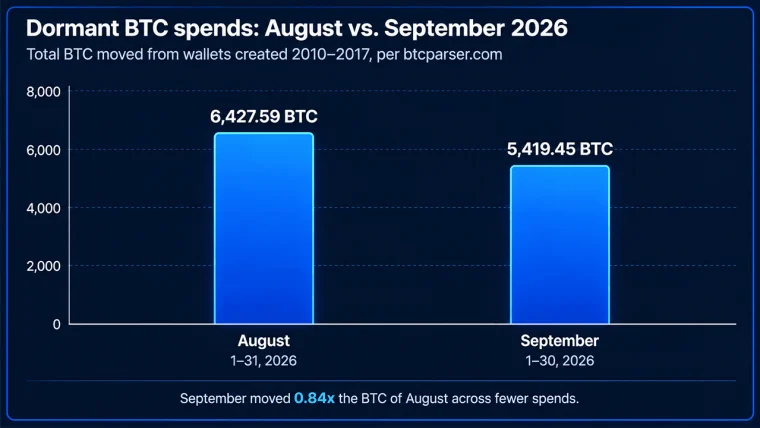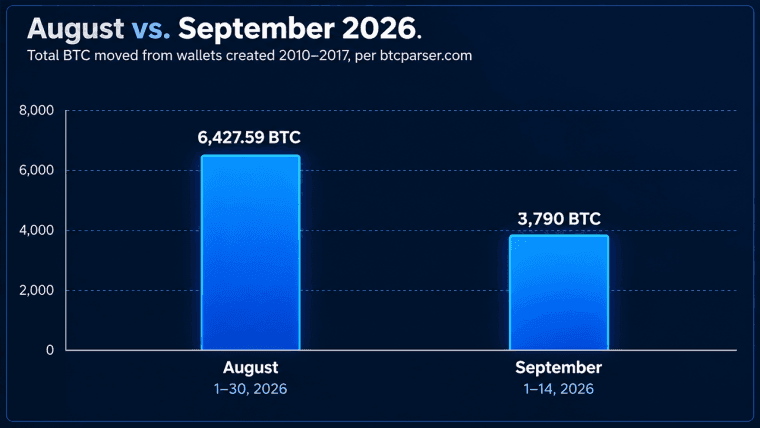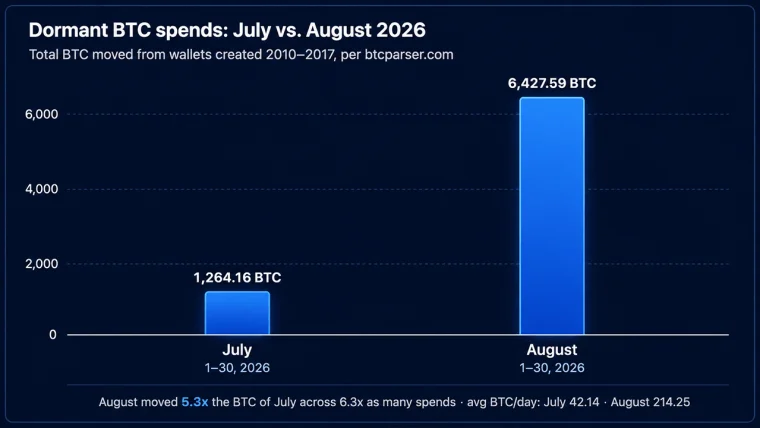



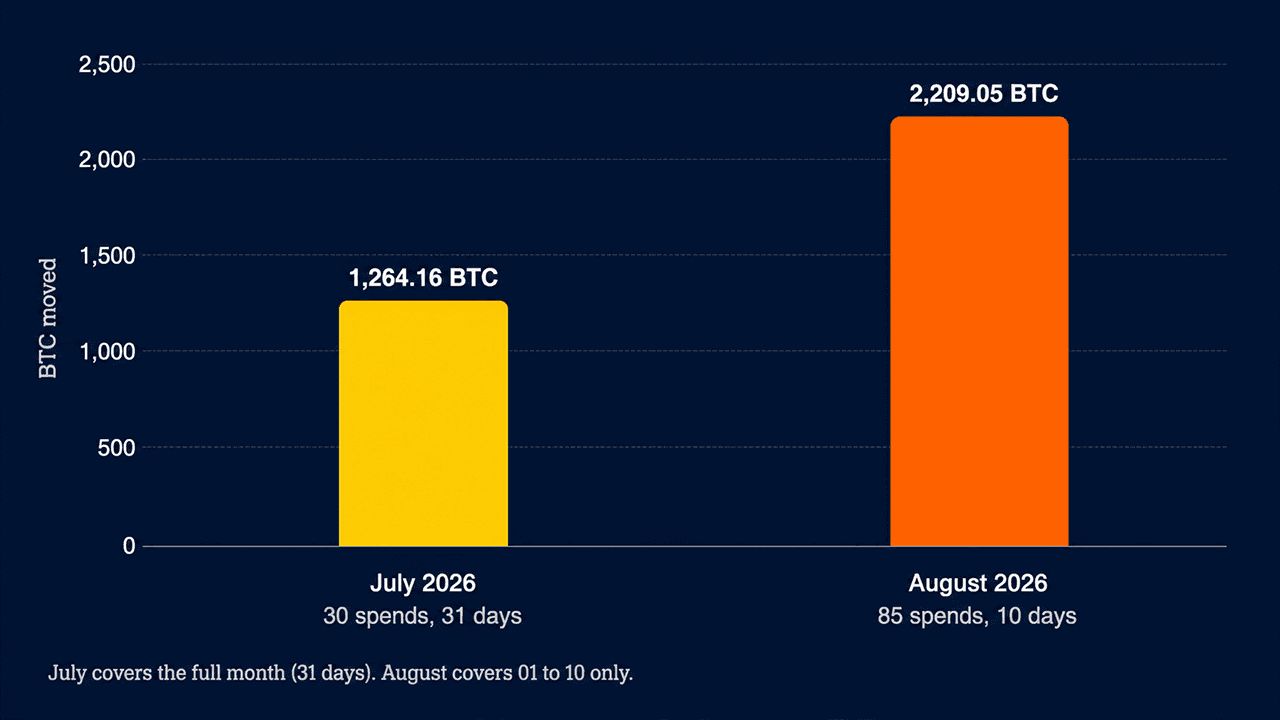
Dormant bitcoin is moving at a dramatically faster pace in August, with 2,209.05 BTC leaving long-idle addresses during the first 10 days of the month, already 74.7% more than the 1,264.16 BTC tracked across all of July.
Dormant Bitcoin Erupts as 10 August Days Blow Past All of July
WRITTEN BY

SHARE
Key Takeaways
- Btcparser.com tracked 2,209 BTC in 85 dormant spends through Aug. 10.
- Bitcoin’s August dormant pace hit 220.91 BTC daily, more than 5 times July.
- The data set leaves 1,215 BTC moving after 2 major clusters are removed.
The movements, identified through the blockchain parser tool Btcparser.com, represent bitcoin held in addresses dating from 2010 through 2017. The comparison is striking because August’s dataset covers only ten days, with Aug. 10 itself still incomplete, while July covers nearly the entire month.
July averaged about 40.78 BTC moved per calendar day. August is running at 220.91 BTC per day, more than five times that pace.
Dormant Bitcoin Activity Shifts Into High Gear
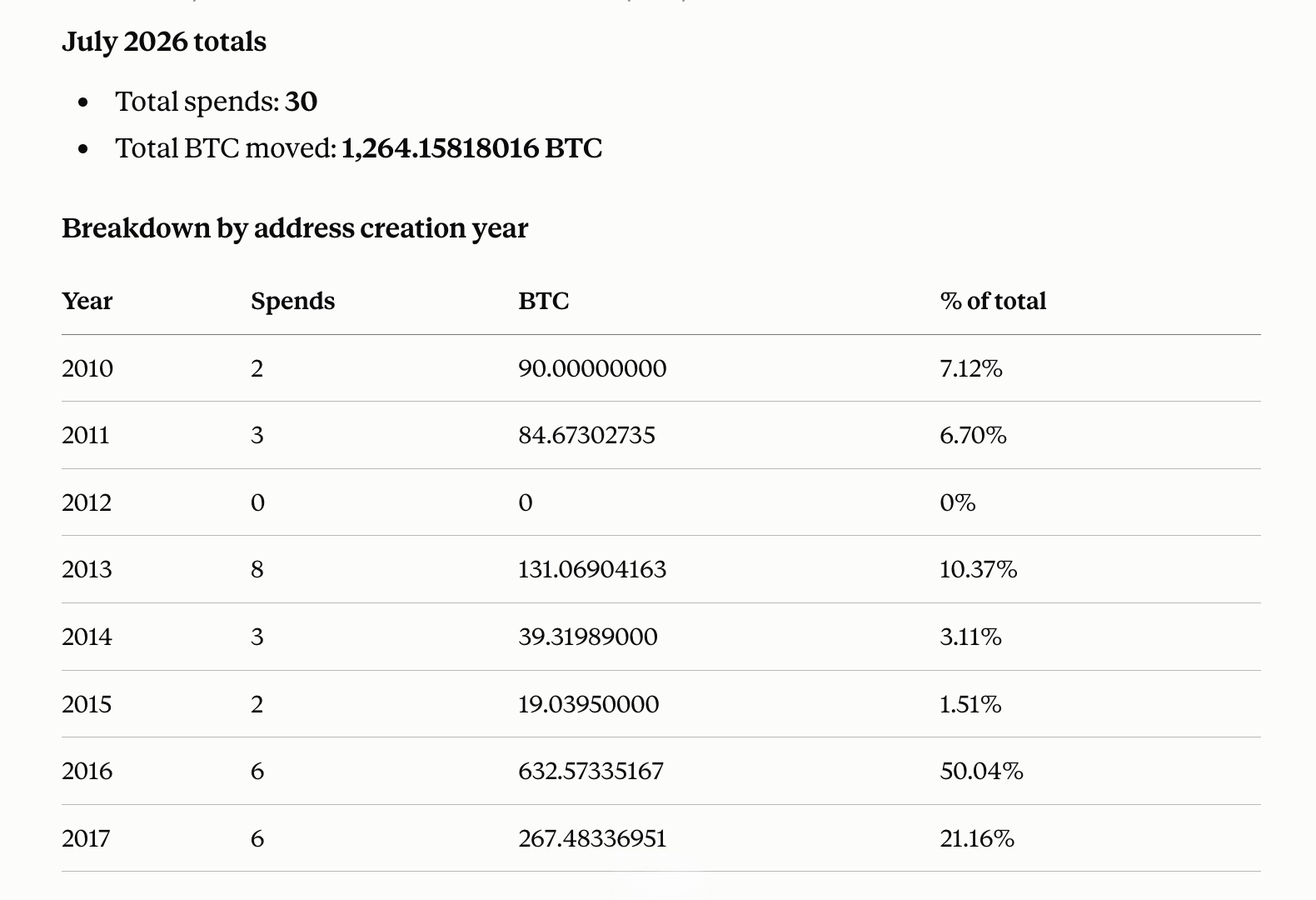
The increase is even more pronounced by transaction count. July recorded 30 dormant spends, or just under one per day. From Aug. 1 through Aug. 10, the parser picked up 85, averaging 8.5 per day. August also has yet to record a completely silent day, while July’s activity was far more episodic, including a stretch of nearly five days without one of the tracked movements.
That does not mean 85 separate longtime holders suddenly decided to move their coins. Blockchain activity often comes in batches, and August contains several obvious clusters that may represent individual owners sweeping numerous addresses at once. Thirty-five spends from addresses created in 2014 moved 854.42 BTC over the last ten days, while 21 spends from 2016 addresses shifted another 224.18 BTC. Nineteen of those 2016 movements were exactly 10 BTC each, with their original address dates packed into a four-day period in October 2016.
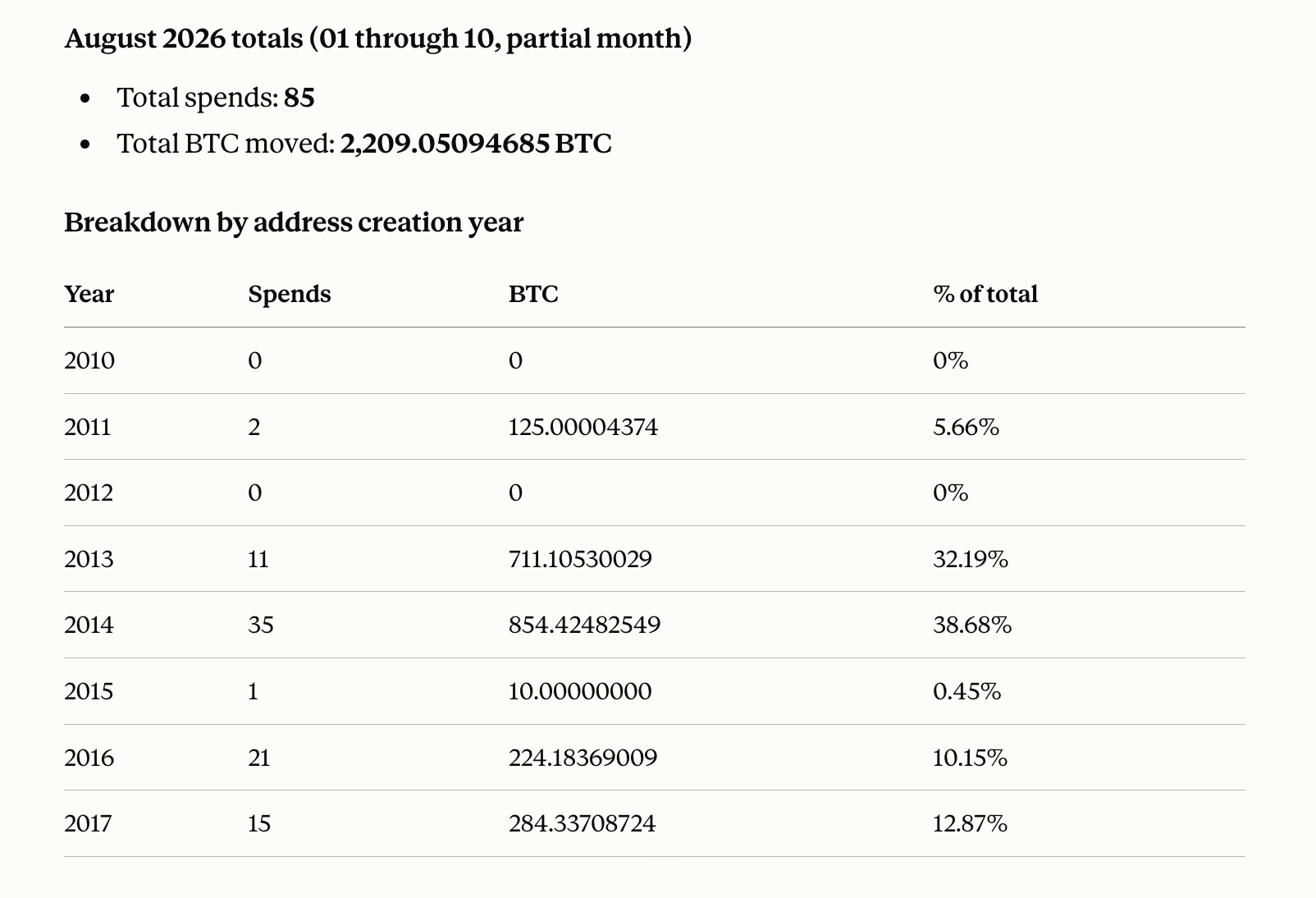
Even after accounting for that concentration, however, August’s acceleration does not disappear. Removing two suspected clusters, a 33-spend group tied to 2014 addresses and a 19-spend group tied to October 2016, leaves 1,215.15 BTC across 33 other August spends. That residual activity works out to about 121.51 BTC per day, nearly three times July’s 40.78 BTC daily rate of dormant activity.
August’s Old Coins Look Very Different From July’s
The age profile has changed, too. July was dominated by BTC sitting in legacy bitcoin addresses created in 2016 and 2017, which together represented roughly 71% of the month’s tracked volume. August has flipped toward older holdings. Addresses created in 2013 and 2014 account for about 71% of the bitcoin moved during the first 10 days.
The 2014 cohort produced the most dramatic change. Just three spends totaling 39.32 BTC appeared in July. August recorded 35 spends totaling 854.42 BTC, although the tight timing and address-creation dates suggest much of that activity came from one entity rather than 35 independent holders. Addresses created in 2013 contributed another 711.11 BTC, including a single 500 BTC movement on Aug. 3.
Aug. 3 was the standout session, with 897.14 BTC moving in eight tracked spends. That single day represented about 40.6% of the first 10 days’ volume and equaled roughly 71% of everything tracked during July. But August’s broader pattern is not simply the product of that one day. Dormant coins moved every day in the period, including 14 spends on Aug. 1 and another 14 on Aug. 7.
Coldcard Exploit Creates an Uncomfortable Timing Question
The acceleration comes immediately after the Coldcard wallet exploit jolted the self-custody community, creating an obvious question about whether the security scare prompted longtime holders to reassess how their bitcoin was stored. The timing is quite notable, but the blockchain data does not establish a causal connection between the exploit and the dormant movements.
More importantly, the old addresses tracked here were not the Coldcard wallets compromised in the exploit. Their histories stretch from 2010 to 2017, predating Coldcard’s launch and the vulnerable 2021 firmware involved in the security incident. The dormant movements therefore should not be characterized as additional stolen funds. At most, the timing raises the possibility that the widely publicized breach encouraged a large number of unrelated long-term holders to review old keys, consolidate wallets or migrate bitcoin into newer storage setups.
There is an interesting delay that fits that possibility perfectly without proving it. Dormant movement remained relatively quiet on July 30 and July 31 before accelerating massively on Aug. 1. An automated theft can unfold immediately once attackers possess usable private-key information. Human wallet maintenance is different. Holders may first read about a security problem, check old backups or hardware, create new wallets and only then transfer funds.
Blockchain Clues Point to Coordinated Wallet Sweeps
The transaction structure also provides clues. July’s activity appeared across 28 distinct blocks, with only one block containing multiple tracked spends. August recorded nine multi-spend blocks, and 32 of the 85 spends occurred inside those concentrated groups. August activity was roughly 8.7 times denser when measured by blocks per spend.
One particularly curious fingerprint appears repeatedly in August: eight amounts end with 547 satoshis, including a tiny movement of exactly 0.00000547 BTC. A satoshi is the smallest unit of bitcoin, equal to one hundred-millionth of a coin. The repeated suffix across addresses of different vintages could indicate common wallet software, transaction construction or sweeping infrastructure, although tracing the receiving addresses would be necessary before drawing a firm conclusion.
The broader market backdrop offers little evidence of panic selling. Bitcoin recovered from an early-August dip around $62,200 to $62,300 and traded near $65,000 by Aug. 10, a gain of roughly 3% to 4% across the period. That does not prove the dormant transfers were wallet migrations rather than sales, since blockchain transfers alone cannot reveal an owner’s motivation or whether coins eventually reached an exchange.
What happens to the receiving coins may provide the clearest answer. If the August clusters consolidate into fresh addresses and remain dormant again, precautionary wallet migration becomes the stronger explanation. If substantial amounts flow onward to exchanges, selling or portfolio restructuring becomes more plausible.
For now, the firm conclusion is narrower but still striking: after an episodic and also lackluster July, dormant bitcoin activity accelerated sharply in August, and even after removing the most obvious wallet clusters, old coins are moving at roughly triple July’s daily pace.

Bitcoin mining pool OCEAN revealed that a configuration issue caused some miners to unknowingly mine on the stalled BIP-110 chain…
Read Now: OCEAN Pledges BTC Refunds After Chain-Split Error