


Galaxy Research documented a Bitcoin blockchain reorganization on Sept. 11, when two of the network’s largest mining pools found competing valid blocks, setting off a brief race that ended with one pool’s block joining the chain with the most accumulated work while the rival block was ultimately discarded.
Bitcoin Miners Found 2 Valid Blocks, Then One Was Left Behind
WRITTEN BY

SHARE
Key Takeaways
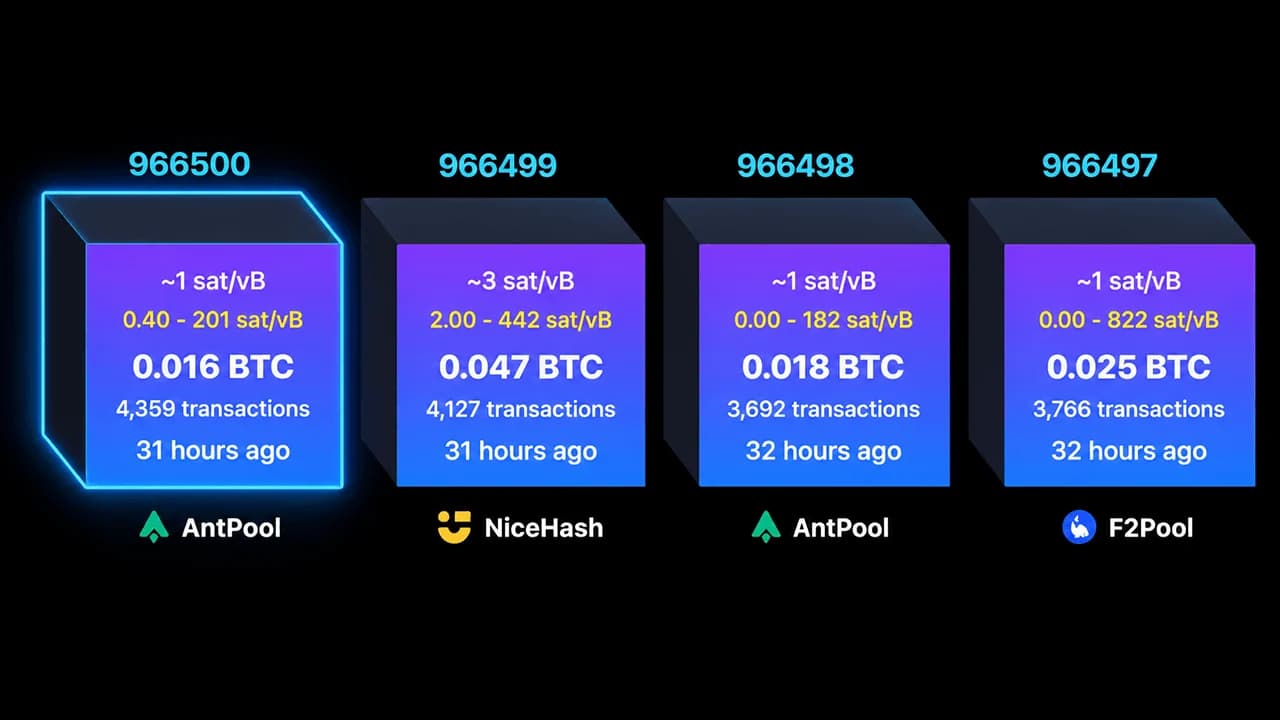
- Antpool won the race at block 966500, while Spiderpool watched its perfectly valid Bitcoin block get tossed.
- Galaxy Research says Bitcoin has seen 3 one-block reorgs in 4 weeks, but small ones are typically part of the game.
- Monero’s 18-block and Bitcoin SV’s 100-block reorgs show how quickly things can get serious when reorgs run deep.
Bitcoin’s One-Block Reorg Pits Spiderpool Against Antpool
At block height 966500, Spiderpool and Antpool discovered two valid blocks that both pointed back to the same parent. Galaxy Research discovered the anomaly via its private node. “Bitcoin experienced a small 1 block reorg this morning. This is common: the third time in four weeks (962,722 on Aug. 16, 963,853 on Aug. 24). Here, Spiderpool had its chain obviated by Antpool,” the Galaxy Research X account wrote.
Galaxy added:
“Our node never saw the Antpool block until it confirmed and the chain extended on top of it.”
When Two Valid Blocks Collide, Only One Survives
Blockchain reorgs like this are not entirely uncommon, and like Galaxy said, this specific occurrence has happened at least three times over the last month. As for what a chain reorganization actually is, imagine a network of kids building a tower of blocks when two builders happen to place different blocks at the top at nearly the same time.
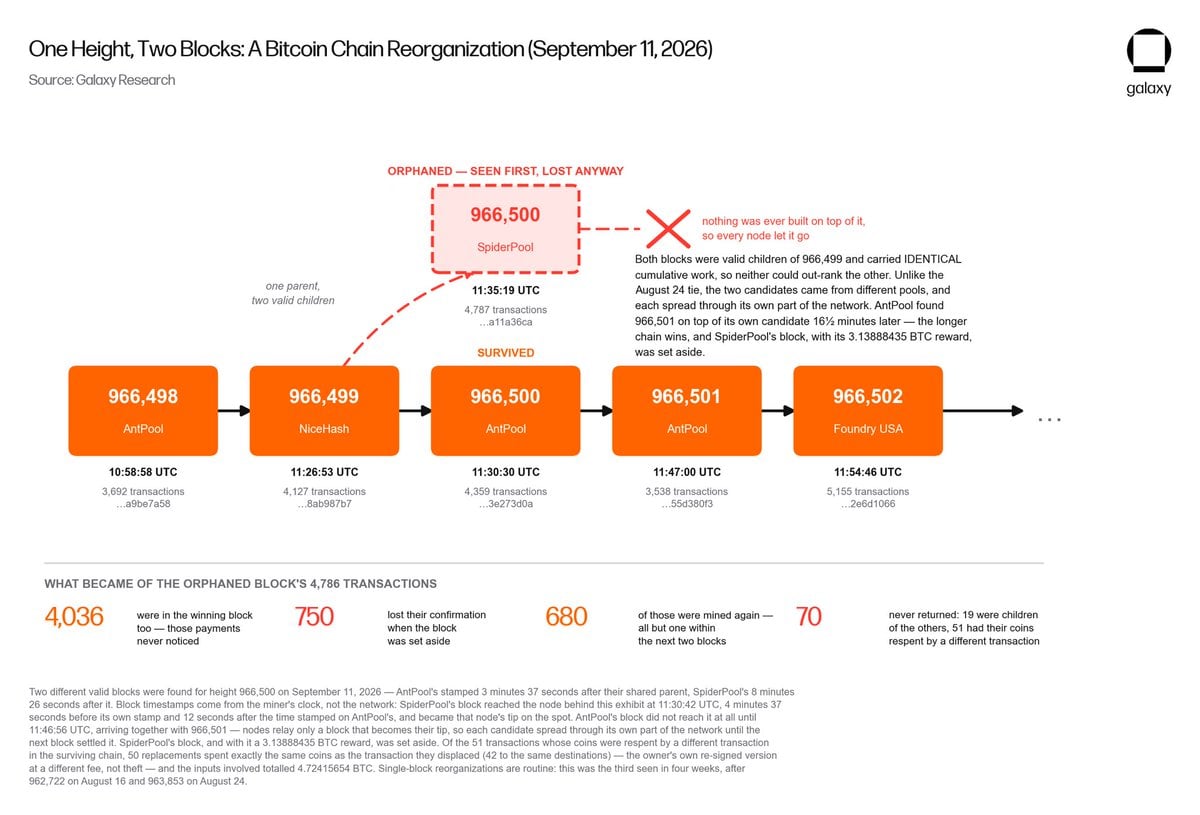
A 1-block reorg occurs when the network ultimately builds on one of those competing blocks, causing the other to be dropped as everyone converges on the chain with the most accumulated work. Think of it as two groups of kids racing to build the same tower. Whichever tower attracts the next block and gains more work becomes the version everyone follows, while the competing block is left behind and eventually forgotten.
From 1 Block to 100, Reorg Depth Changes the Stakes
While reorgs are natural and on Bitcoin most are short-lived, there’s been much deeper chain reorganizations on other proof-of-work (PoW) networks. On Monero, Qubic released a withheld chain from block height 3,499,659 and replaced 18 blocks. When blocks are reshuffled like this, if you have transactions in those blocks, the confirmations disappear, and it’s like they never happened. Another instance was in the summer of 2021 when Bitcoin SV saw a massive 100-block reorg.
When deeper reorgs occur like the ones mentioned above, the blockchain has some real security issues, and it is not to be shrugged off. Small reorgs do occasionally occur on the Bitcoin blockchain, and while they are relatively rare, they do not carry the same security implications that chains suffering deeper reorganizations have confronted in the past.
Solana has been trading above the $100 mark since the end of August, but the more interesting action may be…
Read Now: Inside Solana’s Staking Giants and the Mystery Whales With Billions