


U.S. banks held $325.1 billion in unrealized losses on their investment securities at the end of the first quarter of 2026, according to the Federal Deposit Insurance Corporation. The figure rose for a second straight quarter even as the industry posted strong profits.
FDIC: US Banks Post $80 Billion in Profit as Unrealized Losses Swell to $325 Billion
WRITTEN BY

SHARE

Key Takeaways
A Growing Paper Loss
The Federal Deposit Insurance Corporation (FDIC) said total unrealized losses climbed $19.0 billion, or 6.2%, from the prior quarter, according to its quarterly banking profile for the first quarter of 2026. The agency tied much of the increase to a rise in the 30-year mortgage rate in March, which lowered the value of the mortgage-backed securities that banks hold in size.
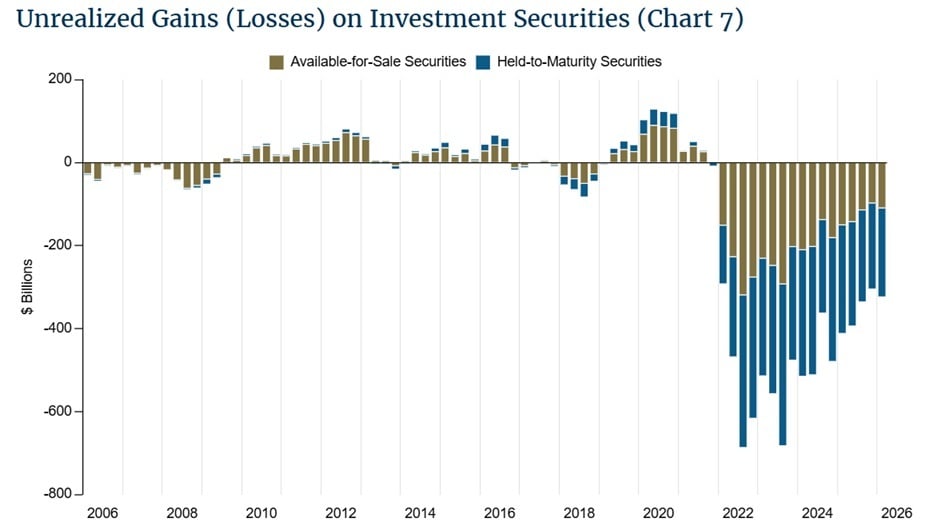
Unrealized losses are paper losses on bonds and other securities whose market value has fallen below the price a bank paid. They split into two buckets, i.e. available-for-sale (AFS) securities, which carried $110.6 billion in losses, and held-to-maturity (HTM) securities, which accounted for $214.5 billion. The losses only become real if a bank is forced to sell the underlying bonds before they mature.
Profits Mask the Pressure
On the surface, the industry looks healthy as banks earned $80.5 billion in net income in the quarter, up 3.6% from the prior period, with return on assets reaching 1.26%. Domestic deposits also grew $389.7 billion, a seventh consecutive quarter of growth, suggesting depositors are not fleeing en masse.
Yet the unrealized-loss figure is the same kind of stress that helped topple several regional lenders in 2023, when institutions including Silicon Valley Bank were forced to sell underwater bonds to meet withdrawals and crystallized losses they had hoped to ride out. As long as rates stay elevated, the gap between what banks paid for their securities and what those holdings are worth today remains a latent risk on balance sheets.
Why Bitcoiners Are Watching
Bitcoin.com News has tracked the aforementioned banking-sector strain for years, with the Federal Reserve previously revealing that 722 banks reported unrealized losses topping 50% of their capital, while separate reporting flagged some $517 billion in unrealized losses and dozens of troubled institutions across the system.
For proponents of bitcoin, an asset held in self-custody carries no counterparty and no maturity mismatch, the very mechanics behind the unrealized losses now piling up on bank books. For the time being, the $325.1 billion figure sits firmly in paper-loss territory and does not threaten the system on its own, turning real only if higher-for-longer interest rates or a sudden deposit exodus force banks to sell.
The next reading, due in the FDIC’s second-quarter profile, will be one to watch out for as it will reveal whether the trend is easing or deepening, and whether the gap between record profits and growing securities losses can keep widening without tangible consequences.

The largest U.S. banks are reportedly planning a joint tokenized deposit network set to launch in 2027, positioning regulated bank…
Read Now: JPMorgan, Citi and America’s Biggest Banks Plan Tokenized Deposit Network: Report