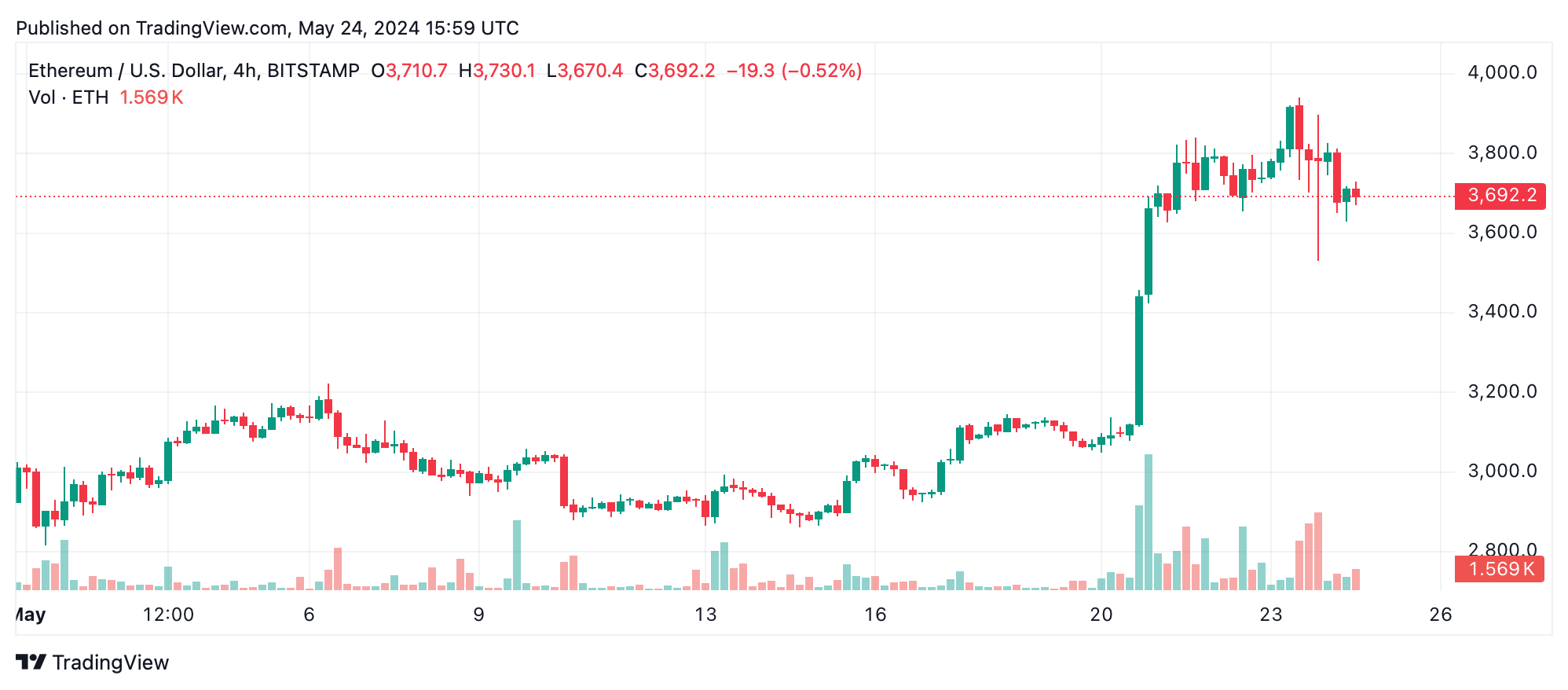
Following the approval of several spot ethereum exchange-traded funds (ETFs) in the U.S., ether’s price has been rather subdued, ranging between $3,640 to $3,740 over the last 12 hours. There’s wasn’t really any substantial upticks other than when the rumors of the approval fueled the previous rise. Market observers are questioning whether or not a big jump will come when the ETFs start trading.
Ethereum's Subdued Market Performance Follows US Approval of Spot ETFs

This article was published more than a year ago. Some information may no longer be current.
WRITTEN BY

SHARE

Ethereum ETF Approval Highlights Hopes and Concerns Among Market Observers
Ethereum’s price saw lackluster performance after the U.S. Securities and Exchange Commission (SEC) approved 19b-4 filings for several spot ETH ETFs. Over the past day, the price has been consolidated, and during Friday’s afternoon trading sessions, ETH is coasting along at $3,692 per unit. Since the SEC approvals, ether has dropped 2.3% in U.S. dollar value but over the past week, ETH has gained more than 21%.
While the 19b-4 filings received approval, James Seyfarrt noted on X that this marks merely the start of the process. “This does not mean they will begin trading tomorrow,” Seyfarrt said. “This is just 19b-4 approval. Also needs to be an approval on the S-1 documents which is going to take time. We’re expecting it to take a couple weeks but could take longer. Should know more within a week or so.”
Currently, ETH is trading more than 23% below its Nov. 10, 2021, all-time high (ATH) of $4,878 per coin, which is significantly closer to the ATH compared to seven days ago when ETH was 36.6% under its peak. Some speculate that an increase in value might occur once the ETH ETFs begin trading and begin to draw ether from the market.
Meanwhile, Grayscale Ethereum Trust (ETHE) has been trading at a discount for an extended period, and its discount to net asset value (NAV) has seen substantial improvement. As of Friday, the ETHE discount to NAV stands at only 5.59%. This situation mirrors that of GBTC, suggesting ETHE could experience considerable reductions in its reserves through significant outflows of ETH.
Should the incoming demand from other ETH ETFs fail to counterbalance these potential outflows, ETHE might exert downward pressure on the ETH market. Should the ETFs navigate the S-1 process successfully and achieve listing, it remains to be seen how these funds will influence the ether spot market.
What do you think about ether’s market performance following the SEC approving several spot ether ETFs? Share your thoughts and opinions about this subject in the comments section below.